
What Is the Payback Period?
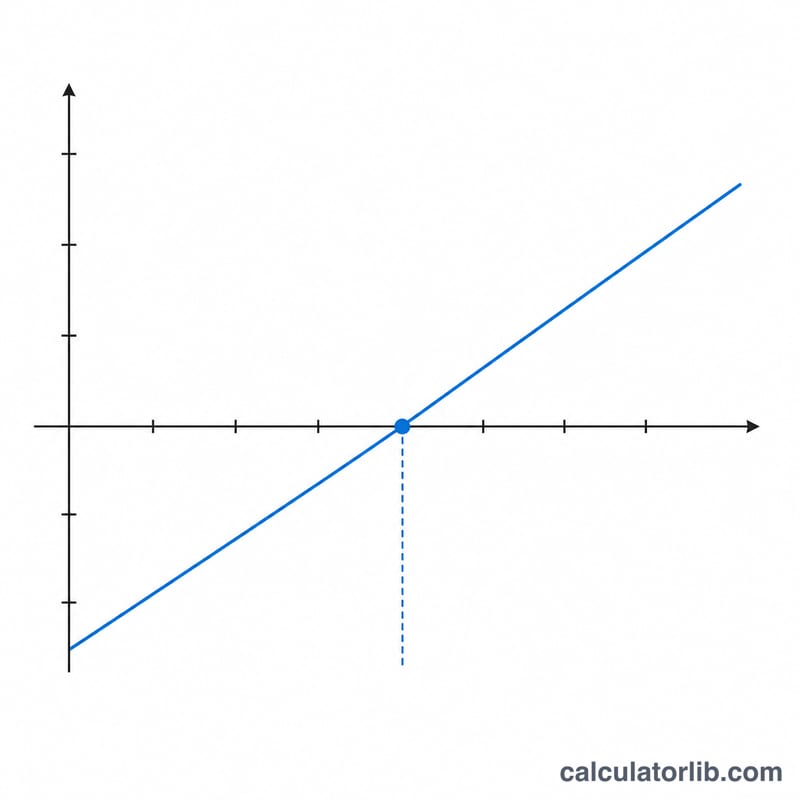
The payback period is the length of time it takes for an investment to generate enough cash inflow to recover its original cost. It is one of the simplest and most widely used metrics in capital budgeting and break-even analysis, helping investors and business owners quickly gauge how soon they will "get their money back."
How to Use This Calculator
Enter the initial investment — the up-front amount you spend — and the annual cash inflow, the net cash the investment returns each year. The calculator divides the two to give the payback period in years, then also expresses it in months and as a years-and-months breakdown.
The Formula Explained
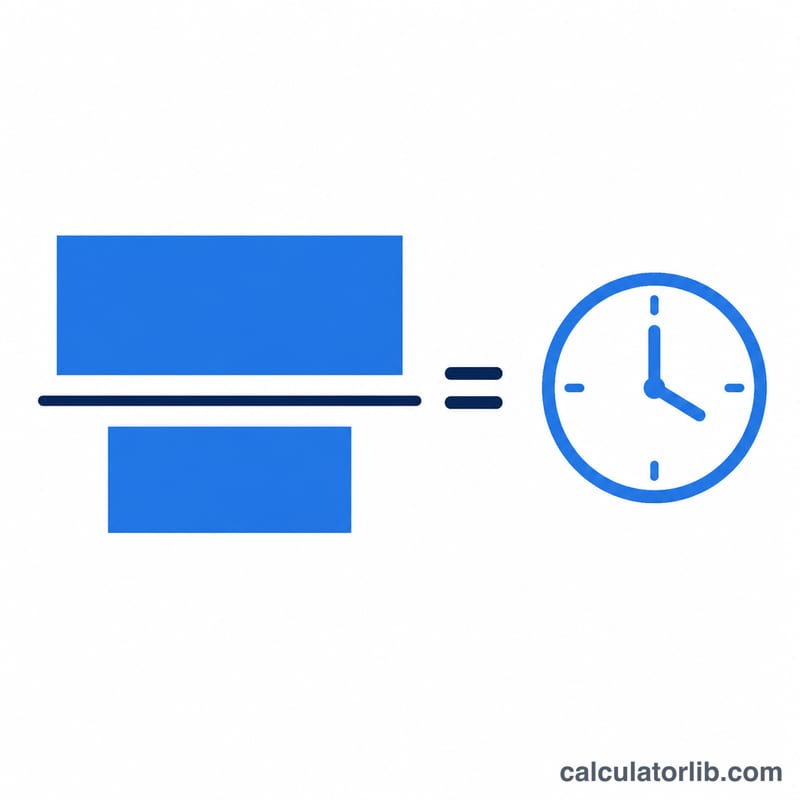
The core formula is simply:
$$\text{Payback Period (years)} = \frac{\text{Initial Investment}}{\text{Annual Cash Inflow}}$$
This assumes a constant, even cash inflow each year. A shorter payback period generally means lower risk and faster capital recovery, while a longer period ties up your money for more time.
Worked Example
Suppose you invest $100,000 in equipment that returns $25,000 per year. The payback period is $$100{,}000 \div 25{,}000 = 4 \text{ years}$$ If instead the inflow were $40,000, the period would be 2.5 years, or 2 years and 6 months.
Interpreting Your Payback Period
The payback period tells you how long it takes for an investment's cumulative cash inflows to equal its initial cost. It is calculated as:
$$\text{Payback Period (years)} = \frac{\text{Initial Investment}}{\text{Annual Cash Inflow}}$$A shorter payback period generally indicates that capital is recovered quickly. This improves liquidity, frees cash sooner for reinvestment, and is often viewed as lower risk because the investor is exposed to uncertainty for less time. A longer payback period means capital is tied up longer, which can increase exposure to changing market conditions, technological obsolescence, and forecasting error.
For example, a $50,000 investment generating $12,500 in annual cash inflow has a payback period of 4 years — meaning the original outlay is fully recovered after four years of equal inflows.
Important limitations. The basic payback period has two well-known weaknesses:
- It ignores the time value of money — a dollar received in year five is treated as equal to a dollar received today. The discounted payback period partly addresses this by discounting future inflows.
- It ignores all cash flows after the break-even point. An investment that pays back quickly but then stops generating cash may look better than one with a slightly longer payback but far larger long-term returns.
Because of these limitations, the payback period is best used as a quick liquidity and risk screen rather than a sole decision criterion. Pair it with metrics that account for the full cash-flow profile and the time value of money, such as Net Present Value (NPV) and Internal Rate of Return (IRR), before committing capital.
This is general educational information about a financial metric and not personalized financial advice. Consult a qualified professional for decisions specific to your situation.
Key Terms & Definitions
- Initial Investment
- The total upfront cash outlay required to acquire or start the investment — for example, equipment purchase price, installation, and setup costs. It forms the numerator of the payback formula.
- Annual Cash Inflow
- The net cash the investment is expected to generate each year, typically after operating costs but before considering financing. When inflows are roughly equal each year, dividing the initial investment by this figure gives the payback period directly.
- Payback Period
- The length of time required for cumulative cash inflows to recover the initial investment, expressed in years (and often months). It measures how fast capital is returned, not how profitable the investment is overall.
- Break-Even Point
- The moment at which total cash inflows equal the initial investment, so the net cumulative cash flow is zero. The payback period is the time taken to reach this point.
- Discounted Payback Period
- A refined version of the payback period that discounts each future cash inflow to its present value before accumulating it. Because discounted inflows are smaller, the discounted payback period is always equal to or longer than the simple payback period, and it accounts for the time value of money.
- Net Present Value (NPV)
- The sum of all of an investment's cash flows — inflows and the initial outflow — each discounted to its present value at a chosen rate. A positive NPV indicates the investment is expected to add value; unlike payback, NPV reflects every cash flow over the full project life.
FAQ
Does the payback period account for the time value of money? No. The simple payback method ignores discounting. For a more accurate measure, use the discounted payback period or net present value (NPV).
What is a "good" payback period? It depends on the industry and risk tolerance, but shorter is generally better. Many businesses target 2–4 years for capital projects.
What if cash flows vary each year? This calculator assumes even annual inflows. For uneven cash flows, accumulate yearly inflows until they equal the initial investment.