
What is the calories-per-pound rule?
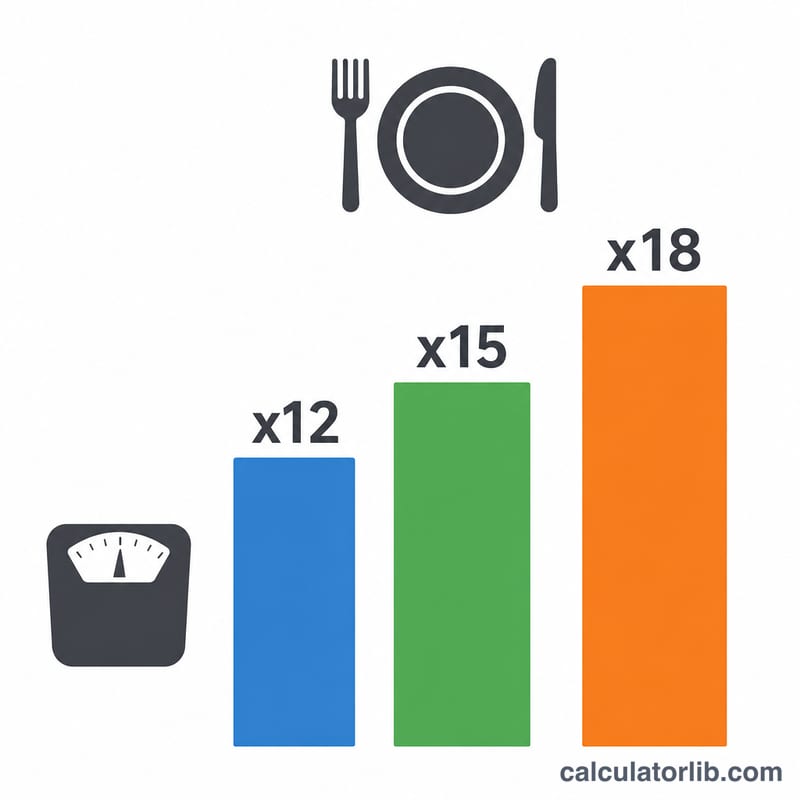
The calories-per-pound method is a quick rule of thumb for estimating daily calorie needs based purely on your bodyweight in pounds. Instead of a detailed metabolic equation, it multiplies your weight by a single number that reflects your goal: roughly 12 calories per pound to lose fat, 15 to maintain, and 18 to gain muscle. It is popular in fitness and bodybuilding circles because it is easy to remember and gives a fast starting target.
How to use it
Enter your current bodyweight in pounds and choose your goal. The calculator multiplies your weight by the chosen multiplier and also shows all three targets (cut, maintain, bulk) so you can compare. Use the result as a starting point, then adjust up or down by 100–200 calories every couple of weeks based on real scale and progress-photo trends.
The formula explained
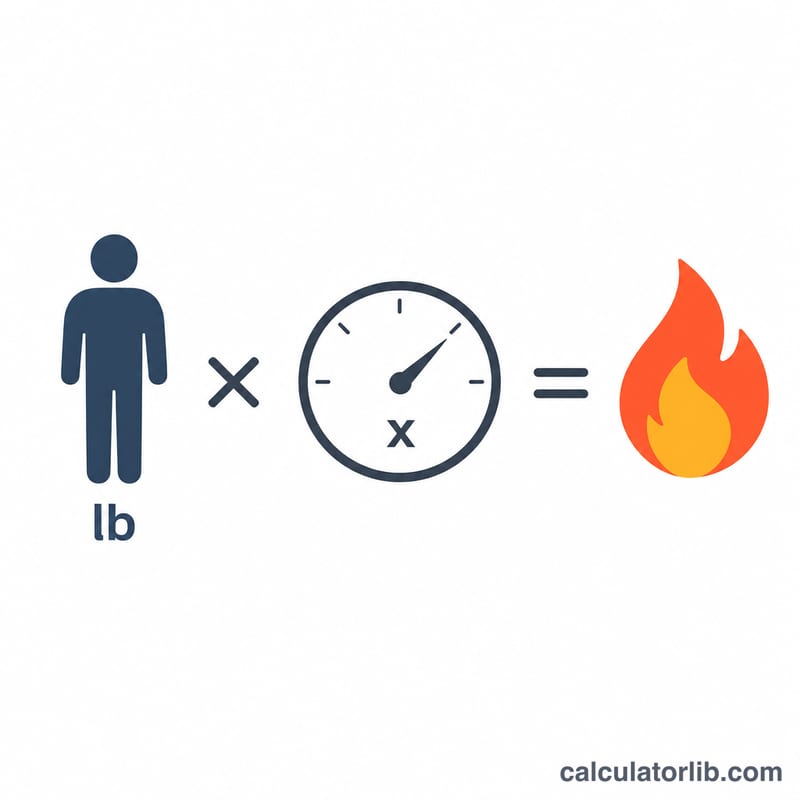
The equation is simply Calories = Bodyweight (lb) × Multiplier. The multiplier bundles together your resting metabolism and typical activity into one number. Lighter, less active people sit near the lower end; heavier or very active people may need slightly more. Because it ignores height, age, and exact activity, treat it as an estimate, not a prescription.
Worked example
A 180 lb lifter aiming to maintain weight: 180 × 15 = 2,700 calories per day. To cut, the same person would target 180 × 12 = 2,160 calories; to bulk, 180 × 18 = 3,240 calories.
Calorie Targets by Bodyweight and Goal
The calories-per-pound rule multiplies your bodyweight by a single factor based on your goal: ×12 for a cut (calorie deficit), ×15 for maintenance, and ×18 for a bulk (calorie surplus). The table below shows daily calorie targets for common bodyweights so you can quickly find a starting point.
| Bodyweight (lb) | Cut (×12) | Maintain (×15) | Bulk (×18) |
|---|---|---|---|
| 120 | 1,440 | 1,800 | 2,160 |
| 140 | 1,680 | 2,100 | 2,520 |
| 160 | 1,920 | 2,400 | 2,880 |
| 180 | 2,160 | 2,700 | 3,240 |
| 200 | 2,400 | 3,000 | 3,600 |
| 220 | 2,640 | 3,300 | 3,960 |
| 250 | 3,000 | 3,750 | 4,500 |
For example, a 180 lb person aiming to lose fat would start near \(180 \times 12 = 2{,}160\) calories per day, while the same person maintaining would target \(180 \times 15 = 2{,}700\) calories.
What Your Result Means
The number you get is a starting estimate, not a precise prescription. Multiplying bodyweight by 12, 15, or 18 is a fast shortcut that lands many moderately active adults in a reasonable range for cutting, maintaining, or bulking. Treat it as a first guess to test and adjust.
This rule differs from full energy-expenditure formulas because it ignores several variables that genuinely affect your needs. Equations such as Mifflin-St Jeor or Harris-Benedict calculate your basal metabolic rate (BMR) from your weight, height, age, and sex, then multiply by an activity factor to estimate total daily energy expenditure (TDEE). The calories-per-pound rule collapses all of that into one multiplier, so two people at the same weight get the same number even if one is a tall, young, very active person and the other is shorter, older, and sedentary.
Because the multiplier is applied to total bodyweight, it tends to overestimate calorie needs for people with higher body-fat percentages. Fat tissue is far less metabolically active than muscle, so a higher-body-fat individual burns fewer calories per pound than the rule assumes. In those cases, estimates based on lean body mass or a BMR equation usually give a more realistic target.
The most reliable way to refine your number is your own progress data. Eat at your estimated target consistently for two to four weeks, track your weight trend (using weekly averages rather than single-day readings), and adjust: if you are not losing on a cut, lower intake slightly; if you are not gaining on a bulk, raise it. Real-world results always outrank any formula.
For a more individualized estimate that accounts for your age, height, and activity, compare this figure against a dedicated TDEE or BMR calculator. This is general educational information, not medical or nutritional advice; consult a qualified professional for guidance specific to your situation.
FAQ
Is this accurate? It is a reasonable estimate for moderately active adults but does not replace a full TDEE calculation that uses age, height, and activity level.
Should I use lean mass instead of total weight? For people carrying significant excess fat, using a goal weight or lean mass can prevent overestimating needs.
How fast should I adjust? Hold a calorie target for 2–3 weeks, watch your weekly average weight, then nudge intake by ~150 calories toward your goal.