
What is the Celsius to Kelvin converter?
This tool converts a temperature given in degrees Celsius (°C) to its equivalent on the Kelvin (K) scale, the SI base unit of thermodynamic temperature. Because both scales use the same size of degree, the conversion is a pure additive offset: you simply add 273.15.
How to use it
Enter the temperature in degrees Celsius in the input field. Decimals and negative values are accepted (for example −40). Press calculate to see the Kelvin result together with the substitution steps. Results are shown to two decimal places to preserve the .15 part of the offset.
The formula explained
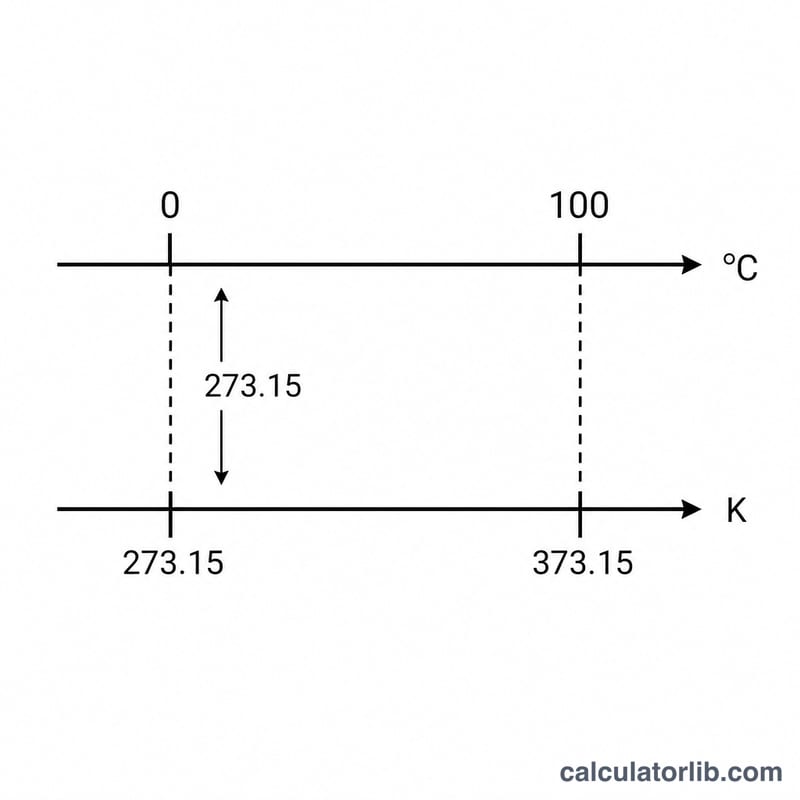
The conversion rule is $$K = {}^{\circ}\text{C} + 273.15$$ The constant 273.15 is the magnitude of absolute zero on the Celsius scale: absolute zero equals 0 K, which is −273.15 °C. Since a change of 1 K is exactly the same as a change of 1 °C, there is no scaling factor — only the position of zero changes.
Worked example
Convert 21.5 °C to Kelvin: $$K = 21.5 + 273.15 = 294.65 \text{ K}$$ Useful reference points: water freezes at 0 °C = 273.15 K, water boils at 100 °C = 373.15 K, and absolute zero is −273.15 °C = 0 K.
FAQ
Why is there no degree symbol on Kelvin? By convention Kelvin is written as "K" without the degree sign, e.g. 294.65 K, while Celsius keeps its symbol as °C.
Can Kelvin be negative? No. Absolute zero (0 K) is the lowest possible temperature. A Celsius input below −273.15 would give a negative, physically meaningless Kelvin value, so the tool warns you in that case.
Is 273.15 ever rounded to 273? Some quick estimates use 273, but the exact constant is 273.15; this converter uses the precise value for accuracy.