Что такое калькулятор веса бриллианта?
Этот калькулятор оценивает вес бриллианта круглой огранки (round brilliant) в каратах по его физическим размерам — среднему диаметру и высоте, заданным в миллиметрах. Это удобный инструмент для ювелиров, оценщиков и покупателей, которым нужно прикинуть вес камня в каратах, не вынимая его из оправы, когда взвесить камень на весах невозможно.
Как пользоваться калькулятором
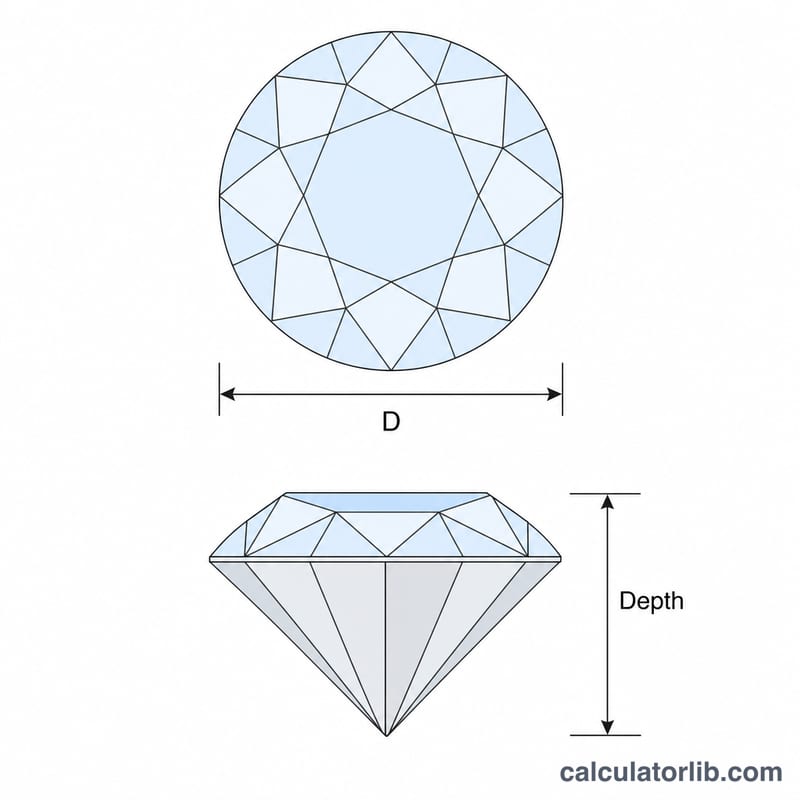
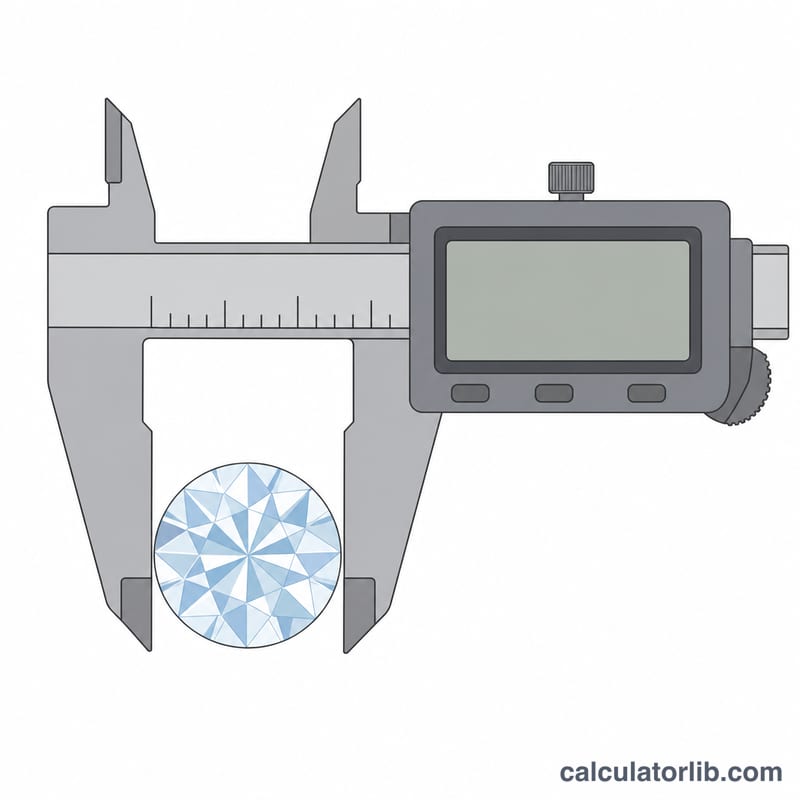
Измерьте средний диаметр круглого бриллианта по рундисту в миллиметрах (если камень слегка некруглый, возьмите среднее между максимальным и минимальным значениями). Затем измерьте высоту — от площадки (стола) до калетты. Введите оба значения, и калькулятор покажет ориентировочный вес в каратах.
Разбор формулы
Для бриллианта круглой огранки используется стандартная формула оценки:
$$\text{Караты} = \text{Диаметр}^{2} \times \text{Высота} \times 0{,}0061$$Коэффициент 0,0061 объединяет плотность алмаза и геометрический объём типичного бриллианта круглой огранки. Для камней с толстым рундистом или нестандартными пропорциями иногда применяют чуть больший коэффициент (например, 0,0066), чтобы повысить точность расчёта.
Пример расчёта
Допустим, круглый бриллиант имеет диаметр 6,5 мм и высоту 4,0 мм. Тогда вес составит:
$$6{,}5^{2} \times 4{,}0 \times 0{,}0061 = 42{,}25 \times 4{,}0 \times 0{,}0061 = 169 \times 0{,}0061 \approx 1{,}0309 \text{ карата}$$— то есть почти ровно один карат. Камень в 1 карат обычно как раз и имеет диаметр около 6,5 мм.
Частые вопросы
Это точный результат? Нет — это оценка. Реальный вес зависит от качества огранки, толщины рундиста и калетты. Когда есть возможность, для точного определения веса в каратах используйте весы.
Подходит ли формула для фантазийных форм? Эта формула предназначена только для бриллиантов круглой огранки. Для овала, принцессы и других форм применяются другие формулы и поправочные коэффициенты.
Какой диаметр у типичного бриллианта в 1 карат? Хорошо огранённый круглый бриллиант весом в 1 карат обычно имеет диаметр около 6,4–6,5 мм.
Typical Round Brilliant Diameter by Carat Weight
The table lists approximate face-up diameters for well-cut round brilliant diamonds. Use it to sanity-check a result from the calculator. Diameter is measured across the girdle, and a typical total depth is about 59–62% of the diameter.
| Carat weight | Approx. diameter (mm) |
|---|---|
| 0.25 ct | ~4.1 |
| 0.33 ct | ~4.4 |
| 0.50 ct | ~5.1 |
| 0.75 ct | ~5.8 |
| 1.00 ct | ~6.4–6.5 |
| 1.50 ct | ~7.4 |
| 2.00 ct | ~8.1–8.2 |
| 3.00 ct | ~9.3 |
These values are approximate. Real stones vary with cut quality, girdle thickness and depth percentage, so two diamonds of the same weight can differ in diameter by a few tenths of a millimeter.
Correction Factors by Girdle Thickness and Proportions
The standard formula \(\text{Carat} = \text{Diameter}^2 \times \text{Depth} \times 0.0061\) assumes a round brilliant with a thin-to-medium girdle. A thicker girdle adds extra material, so the real weight is somewhat higher than the basic estimate. The adjustments below are approximate industry rules of thumb, not exact values.
| Girdle thickness | Approx. adjustment to estimated weight | Effective factor (approx.) |
|---|---|---|
| Thin / medium | Baseline | 0.0061 |
| Slightly thick | +1–2% | 0.0062 |
| Thick | +3–5% | 0.0063–0.0064 |
| Very thick | +5–10% | 0.0064–0.0067 |
Some references cite a higher alternative factor of 0.0066, which corresponds to roughly +8% over the baseline and fits stones with a very thick girdle.
Proportions also affect accuracy. Very deep or very shallow cuts, and stones with unusual crown or pavilion angles, can shift the true weight away from the estimate. Treat the result as an estimate, not a substitute for a scale or a grading report.
Scenario Comparison: Same Diameter, Different Depths
Each row uses a fixed diameter of 6.5 mm and the 0.0061 factor. Since \(6.5^2 = 42.25\), the weight is \(42.25 \times \text{Depth} \times 0.0061\).
| Cut | Высота (мм) | Depth % of diameter | Calculation | Estimated carats |
|---|---|---|---|---|
| Shallow | 3.7 | ~57% | \(42.25 \times 3.7 \times 0.0061\) | ~0.95 ct |
| Ideal | 4.0 | ~61.5% | \(42.25 \times 4.0 \times 0.0061\) | ~1.03 ct |
| Deep | 4.4 | ~68% | \(42.25 \times 4.4 \times 0.0061\) | ~1.13 ct |
Weight scales linearly with depth. The deep stone weighs about 19% more than the shallow one (1.13 vs 0.95 ct), yet from above all three look the same size. A deep stone hides its extra weight in the pavilion, where it cannot be seen face-up. You pay for carats that do not add visible size, and the stone may also lose brilliance. When comparing diamonds, check the depth percentage along with the carat weight and diameter.