
What Is the Absolute Eosinophil Count?
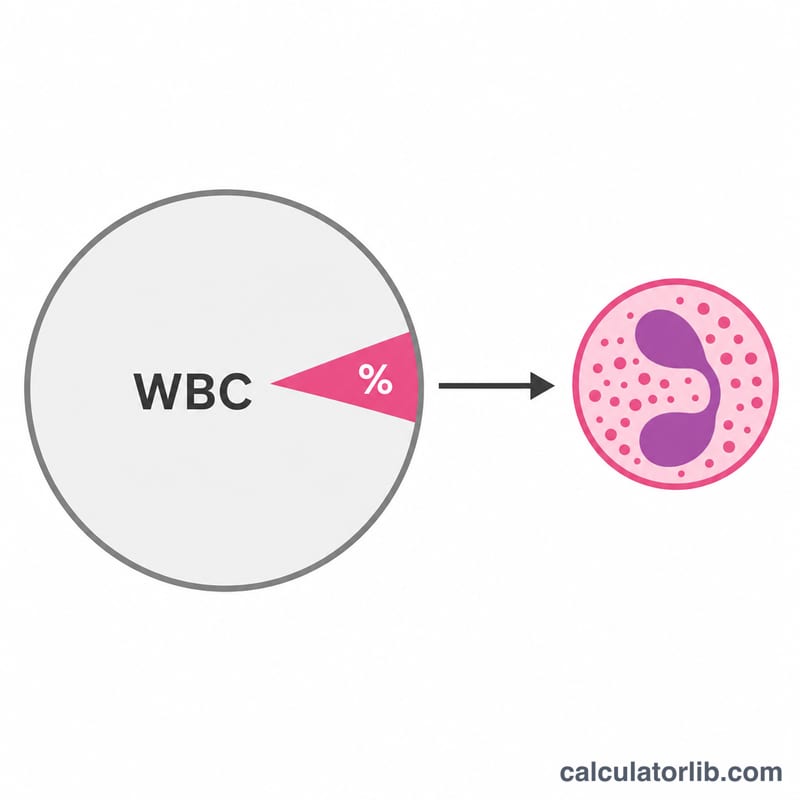
The absolute eosinophil count (AEC) measures the actual number of eosinophils — a type of white blood cell involved in allergic reactions and parasitic infections — in a microliter of blood. While a complete blood count (CBC) often reports eosinophils as a percentage of total white blood cells, the absolute number is more clinically meaningful. This calculator converts that percentage into an absolute count.
How to Use This Calculator
Enter your total white blood cell (WBC) count in cells per microliter (cells/µL) and the eosinophil percentage from your differential. The calculator returns the AEC in cells/µL along with a general category (normal, mild, moderate, or severe eosinophilia). This tool is for educational purposes — always discuss results with a healthcare provider.
The Formula Explained
The calculation is simple multiplication:
$$\text{AEC} = \text{WBC} \times \dfrac{\text{Eosinophil \%}}{100}$$The percentage is converted to a decimal fraction, then multiplied by the total WBC count to recover the absolute number of eosinophils.
Worked Example
Suppose a CBC shows a WBC count of 8,000 cells/µL and eosinophils at 5%. The
$$\text{AEC} = 8{,}000 \times \left(5 \div 100\right) = 8{,}000 \times 0.05 = 400 \text{ cells/µL}$$which falls within the normal range (under 500 cells/µL).
Eosinophilia Severity Reference Ranges
The absolute eosinophil count (AEC) expresses the number of eosinophils per microliter of blood, calculated from the white blood cell (WBC) count and the eosinophil percentage from the differential:
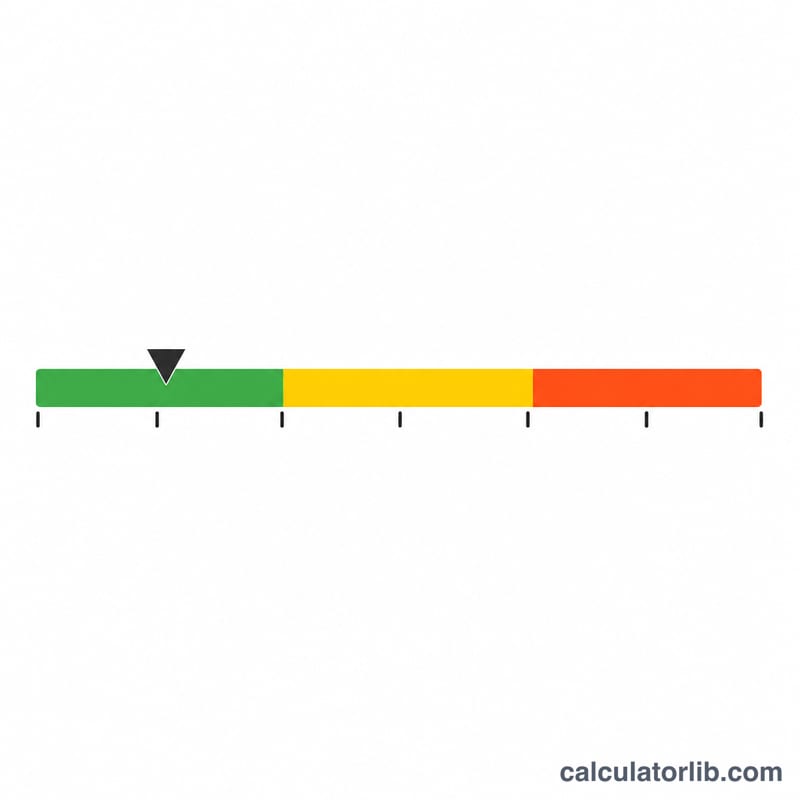
$$\text{AEC} = \text{WBC (cells/µL)} \times \frac{\text{Eosinophils (\%)}}{100}$$The table below maps common AEC bands to clinical categories. These thresholds are widely used in hematology, though exact laboratory reference limits vary slightly between institutions.
| AEC (cells/µL) | Category | Brief clinical note |
|---|---|---|
| Less than 500 | Normal | Typical reference range; no eosinophilia. Most healthy adults fall between roughly 0 and 500 cells/µL. |
| 500 – 1,500 | Mild eosinophilia | Often seen with allergies, asthma, eczema, and parasitic or drug reactions. Usually warrants clinical correlation. |
| 1,500 – 5,000 | Moderate eosinophilia | May indicate marked allergic disease, parasitic infection, drug reaction, or hypereosinophilic conditions; further evaluation is common. |
| Greater than 5,000 | Severe eosinophilia | Markedly elevated; raises concern for hypereosinophilic syndrome and risk of end-organ damage. Prompt clinical assessment is indicated. |
Persistent eosinophilia above 1,500 cells/µL on repeated counts is the usual threshold for the term hypereosinophilia.
AEC Across Different WBC and Eosinophil % Scenarios
The same eosinophil percentage produces very different absolute counts depending on the total WBC, which is why the AEC — not the percentage alone — drives interpretation. Each row applies the formula \(\text{AEC} = \text{WBC} \times \tfrac{\text{Eos\%}}{100}\).
| WBC (cells/µL) | Eosinophils (%) | AEC (cells/µL) | Category |
|---|---|---|---|
| 8,000 | 5 | 400 | Normal |
| 12,000 | 5 | 600 | Mild eosinophilia |
| 6,000 | 12 | 720 | Mild eosinophilia |
| 10,000 | 20 | 2,000 | Moderate eosinophilia |
| 7,500 | 3 | 225 | Normal |
| 25,000 | 30 | 7,500 | Severe eosinophilia |
Note in the first two rows that an identical 5% eosinophil reading is normal at a WBC of 8,000 but crosses into mild eosinophilia at 12,000 — the absolute count clarifies what the percentage alone cannot. The other cell lines work the same way; for example, the lymphocyte share of the same WBC is found with an absolute lymphocyte count calculator.
FAQ
What is a normal eosinophil count? A typical AEC is below 500 cells/µL. Counts of 500–1,500 suggest mild eosinophilia, 1,500–5,000 moderate, and above 5,000 severe.
Why use the absolute count instead of the percentage? The percentage depends on the total WBC count, so the same percentage can mean very different absolute numbers. The AEC standardizes interpretation.
What causes a high eosinophil count? Common causes include allergies, asthma, parasitic infections, certain drug reactions, and some autoimmune or blood disorders. A doctor should evaluate elevated results.