
What Is the AC Tonnage Calculator?
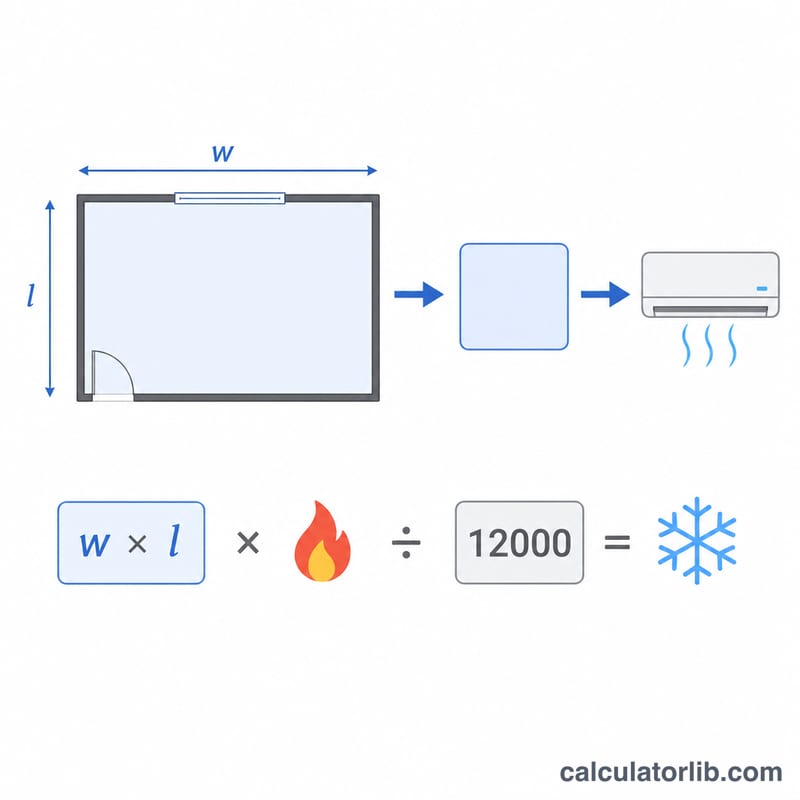
This calculator estimates the air conditioner capacity, measured in tons, needed to cool a room. One "ton" of cooling equals 12,000 BTU/hr — the amount of heat needed to melt one ton of ice in 24 hours. By multiplying your room area by a cooling-load factor (BTU per square foot) and dividing by 12,000, you get the recommended AC tonnage.
How to Use It
Enter your room area in square feet and the BTU per square foot. A typical value is 20–30 BTU/sq ft; 25 is a common default for average rooms with normal insulation, ceiling height, and sun exposure. Increase it for sunny rooms, kitchens, or hot climates, and decrease it for shaded, well-insulated spaces.
The Formula Explained
First the total cooling load is found: $$\text{BTU} = \text{Area} \times \text{BTU per sq ft}$$. Then it is converted to tons: $$\text{Tonnage} = \text{BTU} \div 12{,}000$$. The 12,000 figure is the fixed industry conversion between BTU/hr and tons of refrigeration.
Worked Example
For a 600 sq ft living room at 30 BTU/sq ft: $$\text{BTU} = 600 \times 30 = 18{,}000 \text{ BTU/hr}$$ $$\text{Tonnage} = 18{,}000 \div 12{,}000 = 1.5 \text{ tons}$$ You would round up to the next standard unit size, so a 1.5-ton AC fits well.
Recommended AC Tonnage by Room Size
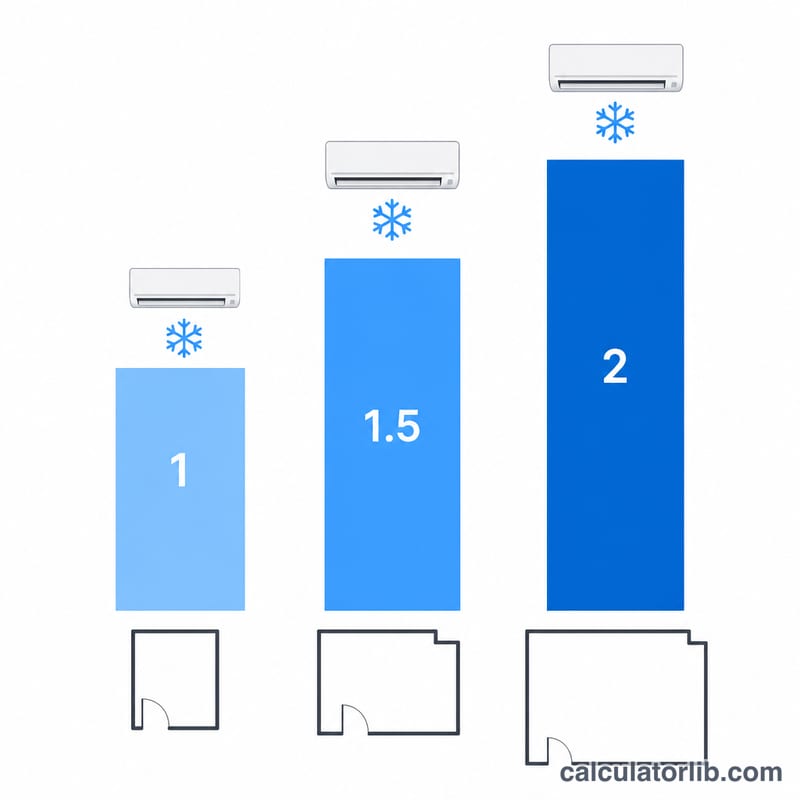
Air conditioner capacity is measured in tons, where 1 ton of cooling equals 12,000 BTU/hr. As a quick rule of thumb, many residential rooms in temperate climates need roughly 20 BTU/hr per square foot of floor area. The table below maps common room-size ranges to typical cooling load and the standard AC tonnage you would choose. These are starting points — always round up to the nearest standard size and adjust for the conditions described in the next section.
| Room Area (sq ft) | Approx. Cooling Load (BTU/hr) | Standard AC Size (tons) |
|---|---|---|
| 100 – 250 | 5,000 – 9,000 | 0.75 ton |
| 250 – 400 | 9,000 – 12,000 | 1 ton |
| 400 – 600 | 12,000 – 18,000 | 1.5 ton |
| 600 – 800 | 18,000 – 24,000 | 2 ton |
| 800 – 1,000 | 24,000 – 30,000 | 2.5 ton |
| 1,000 – 1,200 | 30,000 – 36,000 | 3 ton |
Worked example: for a 500 sq ft living room at 20 BTU/sq ft, the load is \(500 \times 20 = 10{,}000\) BTU/hr, giving \(\tfrac{500 \times 20}{12000} \approx\) 0.83 tons, which you would round up to a standard 1-ton unit.
BTU per Sq Ft by Room Type and Conditions
The flat 20 BTU/sq ft baseline must be adjusted for how a space is used and how it gains heat. Kitchens, sun-exposed rooms, high-occupancy spaces, poor insulation and hot climates all raise the effective BTU per square foot. Use the figures below to pick a BTU-per-sq-ft value for this calculator's btu_per_sqft field.
| Room / Condition | Suggested BTU per sq ft | Notes |
|---|---|---|
| Bedroom (shaded, normal insulation) | 18 – 20 | Low internal heat gain |
| Living room (normal) | 20 – 22 | Moderate occupancy |
| Sunny room (large south/west windows) | 22 – 26 | Add ~10% for heavy sun |
| Shaded room | 18 – 19 | Subtract ~10% for deep shade |
| Kitchen | 26 – 30 | Add ~4,000 BTU for appliance heat |
| Climate / Insulation Adjustment | Multiplier |
|---|---|
| Cold / mild climate, good insulation | × 0.85 – 0.90 |
| Temperate climate, normal insulation | × 1.00 (baseline) |
| Hot climate or poor insulation | × 1.10 – 1.20 |
| Each occupant beyond two | + 600 BTU/hr |
For a more detailed load that builds in occupancy and sun exposure automatically, you can cross-check with a dedicated room sizing tool such as the BTU-based AC calculator.
Practical Sizing Recommendations
- Round up to the nearest standard size. AC units are sold in fixed increments (0.75, 1, 1.5, 2, 2.5, 3 tons). If your calculated load lands between sizes, choose the next size up so the system can keep up on the hottest days.
- Add load for high-gain spaces. Increase BTU per sq ft for kitchens (appliance heat), rooms with strong afternoon sun, ceilings above the standard 8 ft, and rooms that hold many people. A rough guide is +10% for very sunny rooms and about +600 BTU/hr for each occupant beyond two.
- Avoid oversizing. An oversized unit cools the air quickly but short-cycles — turning on and off frequently — before it can remove enough humidity. The result is a cold, clammy room, higher wear on the compressor, and wasted energy. Bigger is not better.
- Account for insulation and climate. Well-insulated, shaded homes in mild climates need less capacity; poorly insulated homes in hot climates need more. Apply the multipliers in the table above before choosing a size.
- Get a Manual J load calculation for precision. For a permanent installation, have an HVAC professional perform an ACCA Manual J load calculation. It accounts for window orientation, insulation R-values, infiltration, duct losses and local design temperatures far more accurately than any square-footage rule of thumb.
This is general guidance for estimating and comparing AC sizes; it is not a substitute for a professional load calculation or licensed HVAC advice for your specific home.
FAQ
What BTU per sq ft should I use? Use about 20 for shaded, well-insulated rooms, 25 for average rooms, and 30+ for sunny rooms or hot climates.
Should I round the tonnage? Yes — pick the nearest standard size (0.75, 1, 1.5, 2 tons, etc.). Slight oversizing is usually safer than undersizing.
Is 1 ton always 12,000 BTU? Yes, 1 ton of refrigeration is defined as exactly 12,000 BTU per hour.