

What this calculator does
This tool solves the classic "age" word problem found in algebra textbooks: a parent's current age is n times the child's age, and after some number of years a the parent's age becomes m times the child's age. Enter the two multiples and the number of years, and it returns the current age of both the child and the parent. It is a pure-algebra utility and works for any country or language — there is nothing region-specific about it.
How to use it
Fill in three numbers: (1) the current multiple n — how many times older the parent is right now; (2) the number of years later a; and (3) the future multiple m — how many times older the parent will be after those years. The calculator instantly outputs the child's current age and the parent's current age. For a realistic positive answer, the current multiple should be larger than the future multiple (people's age ratios shrink over time as the child grows).
The formula explained
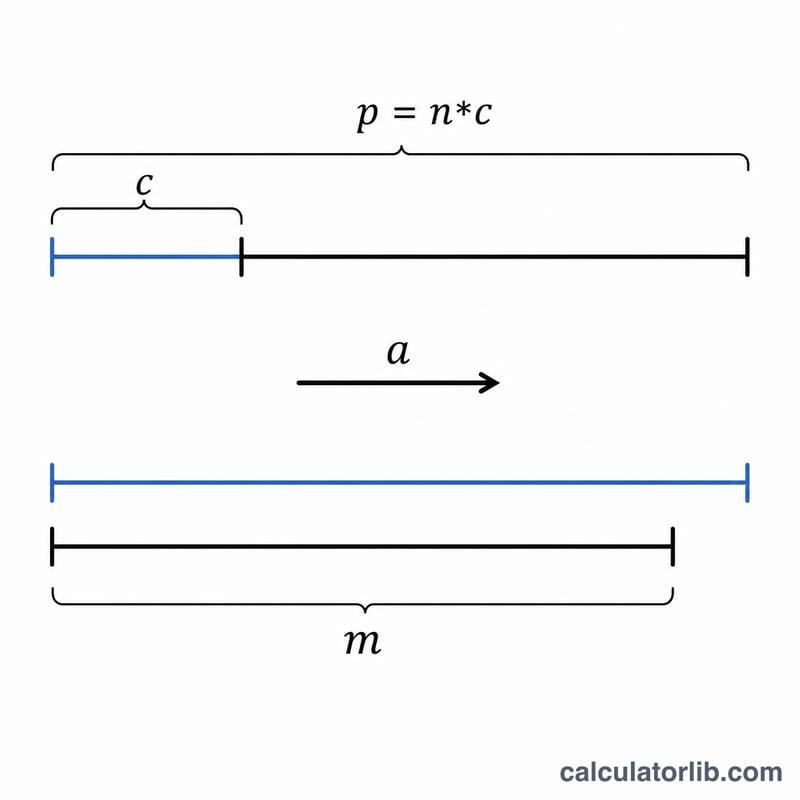
The key insight is that the age difference between two people never changes. Right now the difference is \(n \cdot c - c = (n-1) \cdot c\). After a years the parent is \(n \cdot c + a\) and the child is \(c + a\), with the relationship \(n \cdot c + a = m \cdot (c + a)\). Rearranging gives \(c \cdot (n - m) = a \cdot (m - 1)\), so $$c = \frac{a \cdot (m - 1)}{n - m},$$ and the parent's age is simply $$p = n \cdot c.$$ If \(n = m\) the denominator is zero and the problem has no unique solution.
Worked example
Suppose the parent is now 3 times the child's age, and in 15 years the parent will be 2 times the child's age. Then $$c = \frac{2 - 1}{3 - 2} \times 15 = 15$$ years and $$p = 3 \times 15 = 45$$ years. Check: now \(45 = 3 \times 15\). In 15 years the parent is 60 and the child is 30, and \(60 = 2 \times 30\). Both conditions hold.
More Worked Examples
Each problem uses the core formula \[C = \frac{(m-1)\cdot a}{n-m},\qquad P = n\cdot C\] where \(n\) is the current multiple, \(m\) is the future multiple, and \(a\) is the number of years later. After solving we verify that in \(a\) years the parent's age really is \(m\) times the child's age.
Example 1 — n = 4, m = 3, after 6 years
- Substitute into the child formula: \[C = \frac{(3-1)\cdot 6}{4-3} = \frac{2\cdot 6}{1} = \frac{12}{1} = 12.\] The child is currently 12 years old.
- Parent's current age: \[P = n\cdot C = 4\cdot 12 = 48.\]
- Verification: In 6 years the child is \(12+6=18\) and the parent is \(48+6=54\). Check the multiple: \(54 \div 18 = 3 = m\). ✓
Example 2 — n = 5, m = 2, after 9 years
- Child's current age: \[C = \frac{(2-1)\cdot 9}{5-2} = \frac{1\cdot 9}{3} = \frac{9}{3} = 3.\] The child is currently 3 years old.
- Parent's current age: \[P = n\cdot C = 5\cdot 3 = 15.\]
- Verification: In 9 years the child is \(3+9=12\) and the parent is \(15+9=24\). Check the multiple: \(24 \div 12 = 2 = m\). ✓ (Here the "parent" is more like an older sibling — the math still holds.)
Example 3 — n = 6, m = 4, after 4 years
- Child's current age: \[C = \frac{(4-1)\cdot 4}{6-4} = \frac{3\cdot 4}{2} = \frac{12}{2} = 6.\]
- Parent's current age: \[P = n\cdot C = 6\cdot 6 = 36.\]
- Verification: In 4 years the child is \(6+4=10\) and the parent is \(36+4=40\). Check the multiple: \(40 \div 10 = 4 = m\). ✓
How the Ages Change Across Scenarios
The table below shows how the computed current child age \(C\) and parent age \(P=nC\) change as the multiples and the year gap change. A valid problem always requires \(n>m\): the age ratio must shrink over time because the constant age gap becomes a smaller fraction of two growing ages. When \(n\le m\) the denominator \(n-m\) is zero or negative, so there is no positive solution.
| n (now) | a (years later) | m (later) | Child age C | Parent age P | Validity note |
|---|---|---|---|---|---|
| 4 | 6 | 3 | 12 | 48 | Valid (n > m) |
| 5 | 9 | 2 | 3 | 15 | Valid (n > m) |
| 6 | 4 | 4 | 6 | 36 | Valid (n > m) |
| 3 | 10 | 2 | 10 | 30 | Valid (n > m) |
| 7 | 5 | 3 | 2.5 | 17.5 | Valid but non-integer ages |
| 3 | 8 | 3 | — | — | Invalid: n = m (divide by zero, no change in ratio) |
| 2 | 6 | 4 | negative | negative | Invalid: n < m (ratio can't grow over time) |
For the n=4, m=3, a=6 row, the formula gives \(C=\frac{(3-1)\cdot 6}{4-3}=\) 12 years for the child.
Key Terms & Variables
- n — current age multiple: How many times older the parent is than the child right now. In the formula this is the
currentMultiple. Example: "a parent is 4 times as old as the child" means \(n=4\). - m — future age multiple: How many times older the parent will be than the child after the stated number of years (
futureMultiple). Example: "in 6 years the parent will be 3 times as old" means \(m=3\). - a — number of years later: The gap in time between "now" and the future moment described in the problem (
yearsLater). Both ages increase by exactly \(a\). - C — child's current age: The solution we solve for: \(C = \dfrac{(m-1)\,a}{\,n-m\,}\).
- P — parent's current age: Found directly from the child's age: \(P = n\cdot C\).
- Age difference is constant: The single most important idea in age word problems — the difference \(P-C\) never changes, because both people age at the same rate (one year per year). Adding \(a\) to both ages leaves \(P-C\) untouched. What does change is the ratio: as both ages grow, the fixed gap becomes a smaller share of the total, so the multiple always decreases over time, which is exactly why a valid problem requires \(n>m\).
FAQ
Why must the current multiple be greater than the future multiple? As the child grows, the ratio of the two ages always gets smaller, so a realistic problem has \(n > m\). If you enter \(n < m\) the math still runs but the ages come out negative.
What if both multiples are equal? Then \(n - m = 0\) and there is no unique solution — the calculator flags this instead of dividing by zero.
Do the answers have to be whole numbers? No. The formula is exact and may return decimals; textbook problems are usually arranged to give clean integers.