
What Is the Air-Fuel Ratio?
The air-fuel ratio (AFR) is the mass of air divided by the mass of fuel in a combustion engine's mixture. It tells you how "rich" or "lean" the engine is running. The stoichiometric ratio is the chemically perfect blend where all fuel and oxygen are consumed — for gasoline this is about 14.7:1, meaning 14.7 grams of air per gram of fuel.
Lambda vs. AFR
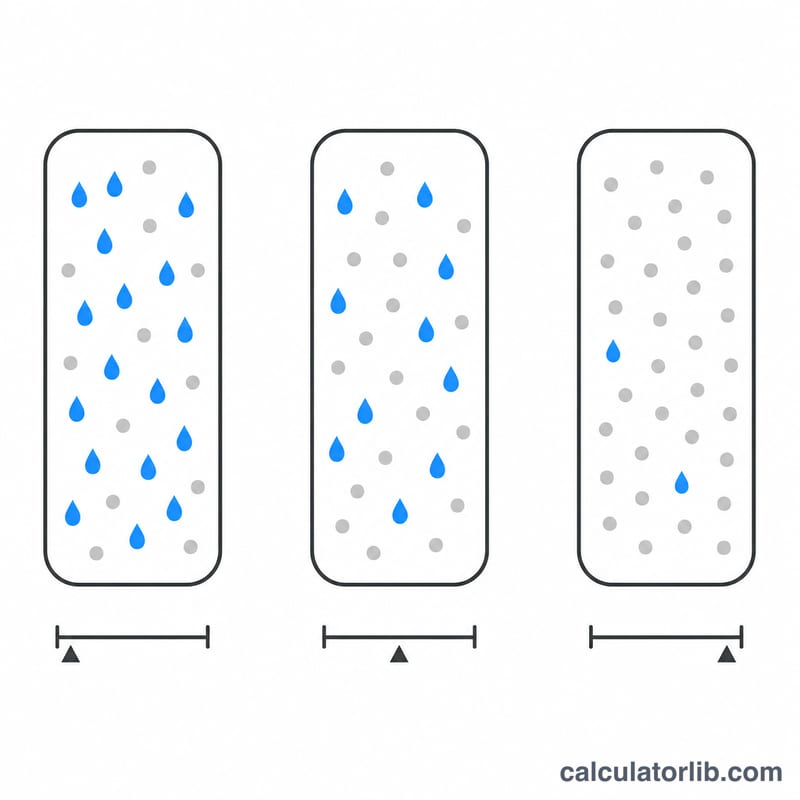
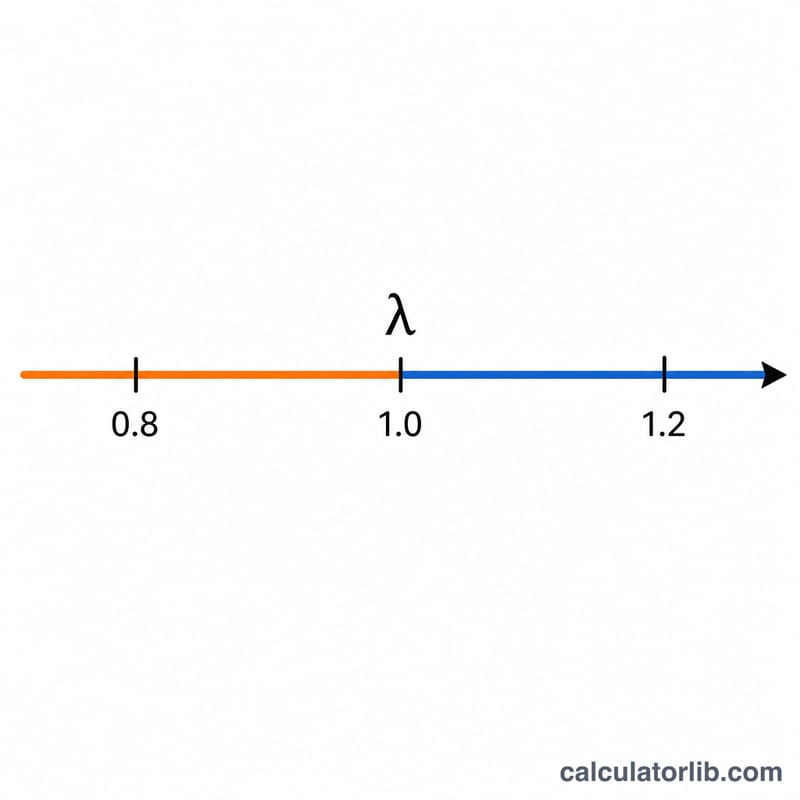
Lambda (λ) is a normalized way to express the same idea, independent of fuel type. A lambda of 1.0 is always stoichiometric. λ below 1.0 is a rich mixture (excess fuel), and λ above 1.0 is a lean mixture (excess air). This calculator converts lambda into the actual AFR for the fuel you choose.
How to Use This Calculator
Enter your measured lambda value (commonly read from a wideband O₂ sensor) and select the fuel type to set the stoichiometric reference. The calculator multiplies the two values to give you the AFR and tells you whether the mixture is rich, lean, or stoichiometric.
The Formula
$$\text{AFR} = \lambda \times \text{AFR}_{\text{stoich}}$$ The stoichiometric reference depends on the fuel: gasoline ≈ 14.7, E85 ≈ 9.8, diesel ≈ 14.5, and methanol ≈ 6.4.
Worked Example
Suppose a wideband sensor reads \(\lambda = 0.85\) on a gasoline engine. The AFR is $$0.85 \times 14.7 = 12.495:1.$$ Because lambda is below 1.0, the mixture is rich — a common target for maximum power under load.
Stoichiometric AFR by Fuel Type
The stoichiometric air-fuel ratio (AFR) is the exact mass ratio of air to fuel needed for complete combustion, where lambda (\(\lambda\)) equals 1.0. Because each fuel has a different chemical composition, its stoichiometric AFR differs. The actual AFR is found from the simple relationship:
$$\text{AFR} = \lambda \times \text{AFR}_{\text{stoich}}$$
The table below lists the stoichiometric AFR for common fuels, along with a worked conversion of two representative lambda values (a rich \(\lambda = 0.90\) and a lean \(\lambda = 1.05\)) to actual AFR for each fuel.
| Fuel | Stoichiometric AFR (\(\lambda=1.0\)) | AFR at \(\lambda=0.90\) (rich) | AFR at \(\lambda=1.05\) (lean) |
|---|---|---|---|
| Gasoline | 14.7 | 13.23 | 15.44 |
| E85 (ethanol blend) | 9.765 | 8.79 | 10.25 |
| Ethanol (E100) | 9.0 | 8.10 | 9.45 |
| Methanol | 6.4 | 5.76 | 6.72 |
| Diesel | 14.5 | 13.05 | 15.23 |
| LPG / Propane | 15.5 | 13.95 | 16.28 |
| CNG / Methane | 17.2 | 15.48 | 18.06 |
Note: E85 stoichiometric AFR varies with the actual ethanol percentage (summer blends can be closer to E70); the value of 9.765 reflects a nominal blend. Methanol and ethanol require much more fuel per unit of air, which is why flex-fuel and racing applications need larger injectors.
Lambda-to-AFR Across Common Tuning Targets
For gasoline (\(\text{AFR}_{\text{stoich}} = 14.7\)), the table below shows how lambda translates to actual AFR and what each region means for engine tuning. Lambda is fuel-independent, which is why many tuners work in lambda directly — but the corresponding AFR is what most wideband gauges display.
| Lambda (\(\lambda\)) | Gasoline AFR | Mixture state | Typical use case |
|---|---|---|---|
| 0.80 | 11.76 | Rich | Heavy boost / safety margin under high load |
| 0.85 | 12.50 | Rich | Maximum power (naturally aspirated WOT) |
| 0.90 | 13.23 | Rich | Best torque, slightly cooler combustion |
| 1.00 | 14.70 | Stoichiometric | Closed-loop cruise, catalytic converter efficiency |
| 1.05 | 15.44 | Lean | Light-load economy |
| 1.10 | 16.17 | Lean | Maximum economy / lean cruise (watch EGT) |
Best-power AFR for gasoline typically falls near \(\lambda \approx 0.85\text{–}0.90\) (≈12.5–13.2 AFR), while best-economy lean cruise sits above \(\lambda = 1.0\). Forced-induction engines are usually run richer than this under boost to control combustion temperatures and detonation.
FAQ
What AFR is best for full power? Gasoline engines often target around 12.5–13.0:1 (\(\lambda \approx 0.85\text{–}0.88\)) at wide-open throttle for peak power.
What does a lean mixture mean? A lean mixture (\(\lambda > 1.0\), AFR > 14.7 for gasoline) has excess air. It can improve economy but risks higher combustion temperatures and detonation under load.
Why use lambda instead of AFR? Lambda is fuel-independent, so a tuner can compare mixtures across gasoline, ethanol, and other fuels without converting reference ratios.