
What this calculator does
This tool estimates how long it takes your body to eliminate alcohol from your bloodstream, returning your Blood Alcohol Concentration (BAC) to 0.00%. The human body metabolizes alcohol at a roughly constant rate, so the time needed depends mainly on how high your current BAC is.
How to use it
Enter your current BAC as a percentage (for example, the common legal driving limit of 0.08). The calculator divides this by the average elimination rate of 0.015% per hour and shows the result both as decimal hours and as hours and minutes.
The formula explained
The estimate uses a simple linear model:
$$\text{hours} = \dfrac{\text{current BAC}}{0.015}$$
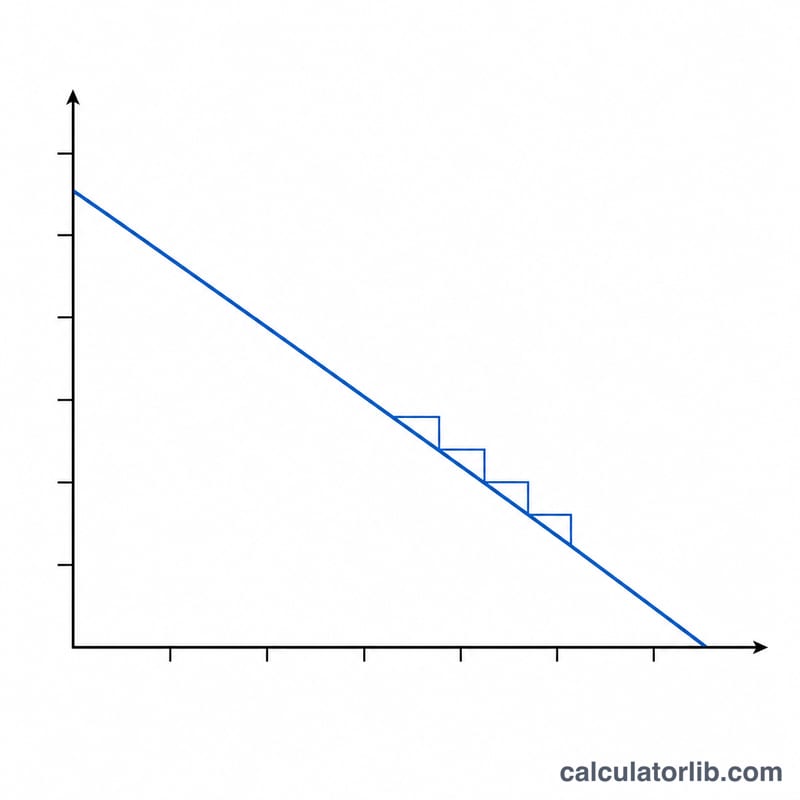
Studies show the body clears alcohol at roughly 0.015 BAC percentage points per hour on average. Because elimination is approximately zero-order (constant rate regardless of concentration), dividing your BAC by 0.015 gives an estimate of the time to fully sober up.
Worked example
Suppose your BAC is 0.08%. Then $$\text{hours} = \dfrac{0.08}{0.015} = 5.33 \text{ hours},$$ or about 5 hours and 20 minutes until your BAC reaches roughly zero.
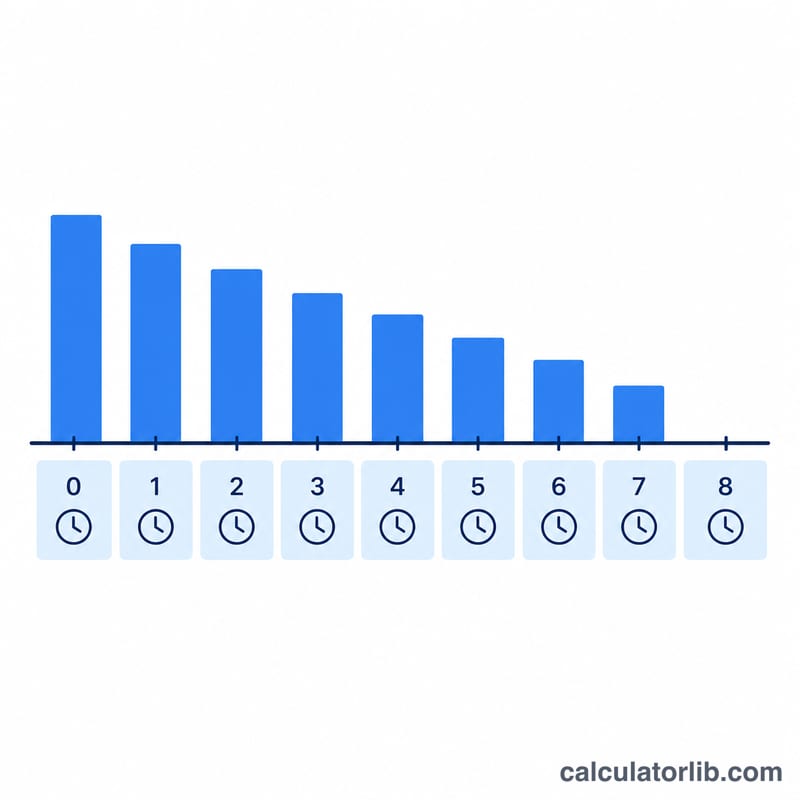
Metabolism Time by BAC Level
The body eliminates alcohol at a roughly constant average rate of about 0.015 percentage points of blood alcohol concentration (BAC) per hour. To estimate the time needed to return to 0.00%, divide your current BAC by 0.015:
$$\text{Hours} = \frac{\text{BAC (\%)}}{0.015}$$For example, a BAC of 0.08% would take about 5.33 hours (5 hours 20 minutes) to fully metabolize at the average rate.
| BAC (%) | Decimal hours | Hours:minutes |
|---|---|---|
| 0.02 | 1.33 | 1:20 |
| 0.05 | 3.33 | 3:20 |
| 0.08 | 5.33 | 5:20 |
| 0.10 | 6.67 | 6:40 |
| 0.15 | 10.00 | 10:00 |
| 0.20 | 13.33 | 13:20 |
| 0.30 | 20.00 | 20:00 |
These figures assume no further drinking. They represent the time from the moment the listed BAC is measured until it reaches approximately 0.00%.
Common BAC Thresholds and Effects
The table below summarizes widely-documented general effects associated with rising blood alcohol concentration. Individual responses vary considerably, and the same BAC can affect different people very differently.
| BAC (%) | Typical general effects |
|---|---|
| 0.02 | Mild relaxation, slight mood elevation; some loss of judgment and a small decline in visual tracking. |
| 0.05 | Lowered alertness, reduced coordination, impaired judgment and inhibition; legal driving limit in some jurisdictions. |
| 0.08 | Impaired muscle coordination, balance, reaction time and reasoning; the common legal driving limit in most U.S. states. |
| 0.10 | Clear deterioration of reaction time and control; slurred speech and poor coordination. |
| 0.15 | Major impairment of balance and muscle control; substantially increased risk of falls and accidents. |
| 0.20 | Disorientation, confusion, nausea; may need help to stand or walk. |
| 0.30 and above | Severe intoxication; possible loss of consciousness. Levels approaching 0.40% and higher risk life-threatening alcohol poisoning. |
In the United States, a BAC of 0.08% is the standard per se legal limit for driving for adults aged 21 and over (lower limits apply to commercial drivers and to drivers under 21 under zero-tolerance laws).
Interpreting Your Result
The number this calculator produces is a population-average estimate of how long it takes to reach approximately 0.00% BAC, based on a constant elimination rate of 0.015% per hour. It is a rough guide, not a precise prediction for any one person.
Actual elimination times vary because the rate at which the body clears alcohol depends on many factors, including:
- Sex and body composition — differences in body water and enzyme activity affect both peak BAC and clearance.
- Liver function — the liver metabolizes most ingested alcohol, so its health and capacity strongly influence the rate.
- Food in the stomach — eating slows absorption, which changes how BAC rises but not how it falls.
- Medications and other substances — some can interact with alcohol metabolism.
- Genetics, regular drinking patterns, and overall health.
Across individuals, the elimination rate typically ranges from roughly 0.012% to 0.020% per hour, so real clearance times can be meaningfully faster or slower than the average estimate shown here.
Most importantly, this estimate should not be used to judge whether you are fit to drive or operate machinery. Only time (not coffee, food, or showers) removes alcohol from the body, and impairment can persist even at low BAC. When in doubt, do not drive. This is general educational information, not medical or legal advice.
FAQ
Is this exact? No. It is an average estimate. Real metabolism varies by individual, sex, liver health, food intake, and other factors. Never use it to decide if you are safe to drive.
Why 0.015 per hour? This is a widely cited population average for alcohol elimination. Some people metabolize faster or slower.
Does drinking water or coffee speed it up? No. Only time reduces BAC. Coffee may make you feel more alert but does not lower alcohol levels.