
What Is the Annealing Temperature Calculator?
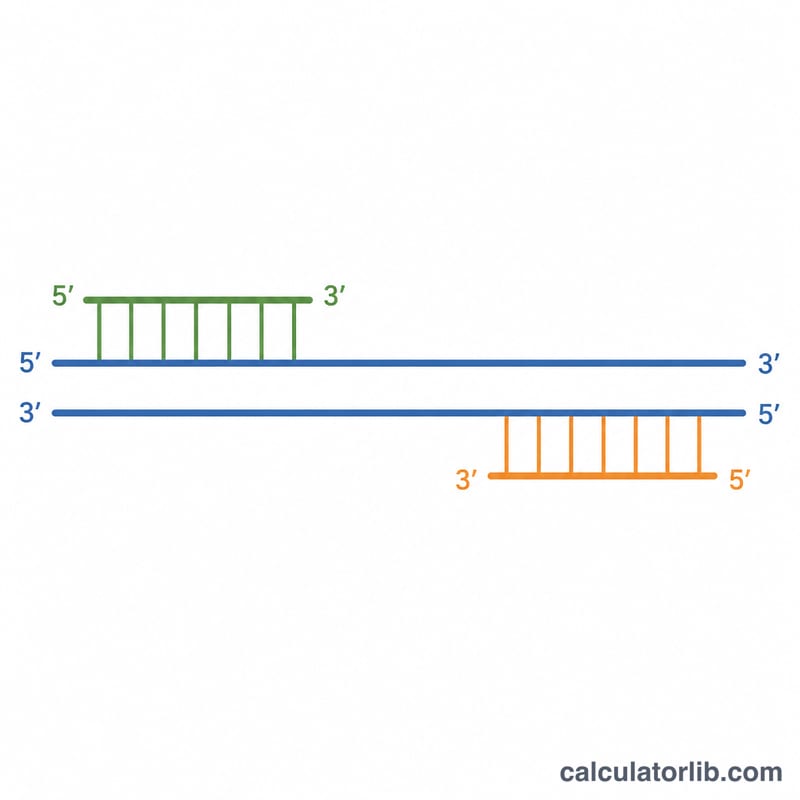
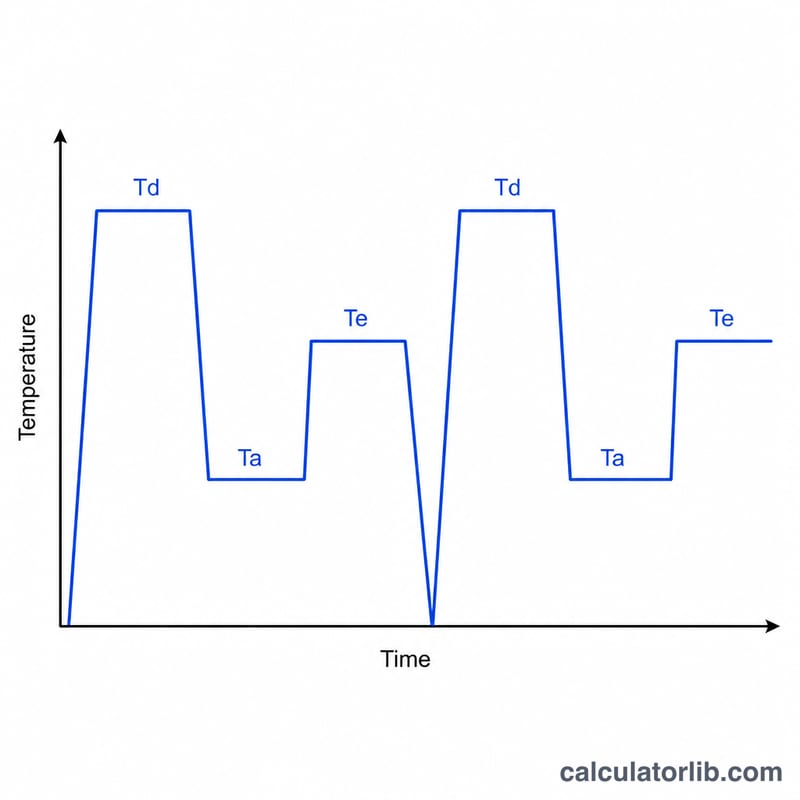
In a polymerase chain reaction (PCR), the annealing temperature (Ta) is the step where primers bind to the single-stranded template DNA. Choosing the right Ta is critical: too high and the primers fail to anneal, too low and they bind non-specifically, producing off-target products. This calculator estimates an optimal Ta from the melting temperatures (Tm) of your primers and your expected PCR product.
How to Use It
Enter the primer melting temperature and the product melting temperature, both in degrees Celsius. The primer Tm is usually the lower of the two primer Tm values (or their average), while the product Tm reflects the longer amplicon. Click calculate to get a recommended starting annealing temperature for your thermocycler protocol.
The Formula Explained
This tool uses the widely cited Rychlik empirical relationship:
$$T_a = 0.3 \cdot T_m^{primer} + 0.7 \cdot T_m^{product} - 14.9$$The primer Tm is weighted at 30% and the product Tm at 70%, with a fixed offset of 14.9 °C. The product contributes more heavily because the full amplicon governs overall duplex stability during the early cycles.
Worked Example
Suppose your primer Tm is 60 °C and the product Tm is 85 °C. Then:
$$T_a = 0.3 \times 60 + 0.7 \times 85 - 14.9 = 18 + 59.5 - 14.9 = \mathbf{62.6\ \degree C}$$You would program your annealing step around 62.6 °C and may fine-tune ±2 °C with a gradient PCR.
Key PCR Terms Defined
Understanding the terminology behind the annealing temperature formula \(T_a = 0.3 \times \text{Primer Tm} + 0.7 \times \text{Product Tm} - 14.9\) helps you apply it correctly when optimizing a PCR reaction.
- Annealing temperature (Ta)
- The reaction temperature at which primers hybridize (bind) to the single-stranded template DNA during the annealing step of PCR. A well-chosen Ta is high enough to suppress non-specific binding but low enough to allow efficient, stable primer–template duplex formation.
- Melting temperature (Tm)
- The temperature at which half of a given DNA duplex is dissociated into single strands. In PCR optimization, the primer Tm reflects the stability of the primer–template duplex, while the product Tm reflects the stability of the full amplicon.
- Primer
- A short, single-stranded synthetic oligonucleotide (typically 18–25 nucleotides) that is complementary to the ends of the target sequence and provides the free 3′-OH group from which DNA polymerase begins synthesis.
- Amplicon / product
- The defined DNA fragment generated by amplification, bounded by the forward and reverse primers. Its length and GC content determine the product Tm used in the annealing-temperature formula.
- Denaturation
- The high-temperature step (commonly 94–98 °C) that separates double-stranded DNA into single strands so that primers can access their binding sites in the next cycle.
- Extension
- The step (typically around 72 °C for Taq polymerase) in which the polymerase synthesizes the new complementary strand by adding nucleotides to the primer's 3′ end.
- Gradient PCR
- A technique that runs the same reaction across a range of annealing temperatures simultaneously in different wells, allowing rapid empirical identification of the optimal Ta when a calculated value needs verification.
- Non-specific binding
- Primer hybridization to unintended, partially complementary sites on the template, producing spurious products or primer dimers. Raising the annealing temperature increases stringency and reduces non-specific binding.
Typical Annealing Temperature Ranges
The calculated value from \(T_a = 0.3 \times \text{Primer Tm} + 0.7 \times \text{Product Tm} - 14.9\) is a strong starting point, but it is helpful to know the practical ranges most reactions fall within.
| Parameter | Typical range | Notes |
|---|---|---|
| Annealing temperature (Ta) | 50–72 °C | Most standard PCR reactions anneal in this window; values below 50 °C often increase non-specific products. |
| Rule-of-thumb Ta | ~3–5 °C below the lower primer Tm | A widely used quick estimate when only primer Tm values are known. |
| Primer Tm target | 52–58 °C | Standard PCR protocols recommend designing primers within this range, with both primers within ~5 °C of each other. |
| Primer pair Tm difference | ≤ 5 °C | Closely matched Tm values ensure both primers anneal efficiently at the same Ta. |
Worked example. Suppose the primer Tm is 56 °C and the amplicon (product) Tm is 80 °C. Substituting into the formula:
$$T_a = 0.3 \times 56 + 0.7 \times 80 - 14.9 = 16.8 + 56 - 14.9 = \text{57.9 °C}$$
This gives a recommended annealing temperature of 57.9 °C, which sits comfortably within the typical 50–72 °C range. As a cross-check against the rule of thumb, 3–5 °C below a 56 °C primer Tm would give roughly 51–53 °C; the formula's higher value reflects the additional stabilizing influence of the longer amplicon, and running a gradient PCR across this span (about 52–58 °C) is a reliable way to confirm the optimum empirically.
These ranges are general guidance drawn from standard PCR protocols and primer-design recommendations; always validate the annealing temperature experimentally for your specific primers, polymerase, and template.
FAQ
Should I use the higher or lower primer Tm? Commonly the lower of the two primer Tm values is used to ensure both primers anneal, though some protocols use the average.
Why subtract 14.9? It is an empirically derived constant that calibrates the weighted Tm average to the experimentally observed optimal annealing temperature.
Is this exact? No estimate is perfect. Use the result as a starting point and optimize with a temperature gradient if you see poor yield or non-specific bands.