

What is the AP® Calculus AB Score Calculator?
This tool estimates your final AP® Calculus AB score on the College Board's 1–5 scale (a US Advanced Placement exam) using your raw multiple-choice (MC) and free-response (FRQ) results. AP® is a registered trademark of the College Board, which is not affiliated with this calculator. Because the College Board re-scales cut points each year, the bands here are typical approximations and your actual score may differ by a point.
How to use it
Enter the number of multiple-choice questions you answered correctly (out of 45) and the total points you earned across the six free-response questions (out of 54). The calculator weights your MC score, adds your FRQ points to form a composite score, and maps it to a 1–5 band.
The formula explained
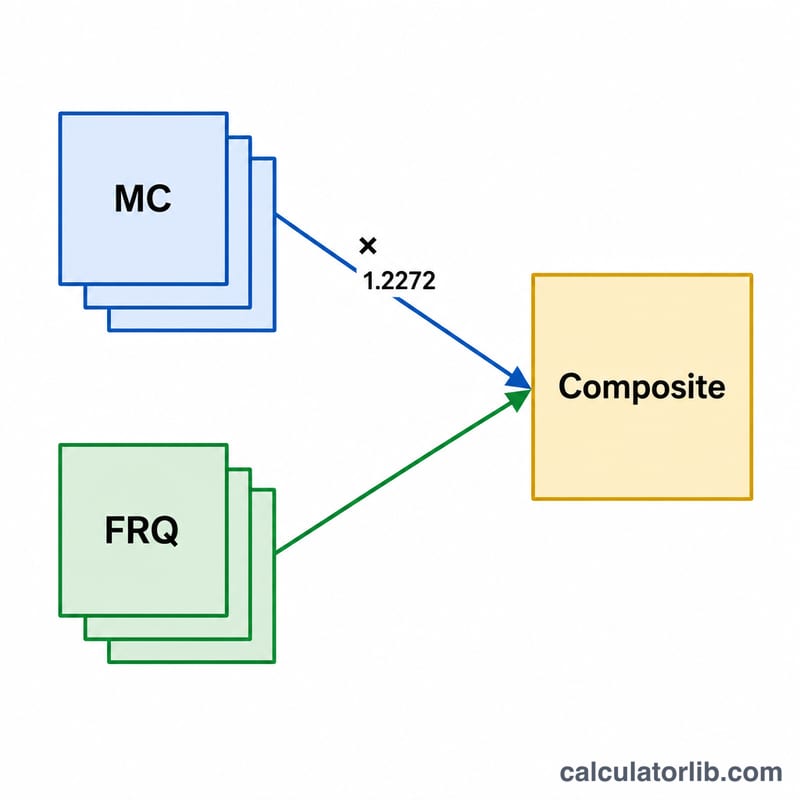
The AB exam has two sections weighted equally. There are 45 MC questions and 6 FRQs worth 54 points total. To put them on the same scale, each correct MC answer is multiplied by \(1.2272\) (so 45 correct ≈ 55.2 points). The composite is:
$$\text{Composite} = 1.2272 \times \text{MC Correct} + \text{FRQ Points}$$
The composite (roughly 0–108) is then compared to score bands: 5 if ≥70, 4 if 56–69, 3 if 42–55, 2 if 27–41, otherwise 1.
Worked example
Suppose you answer 30 MC questions correctly and earn 30 FRQ points. MC score = \(1.2272 \times 30 = 36.816\). Composite = \(36.816 + 30 = 66.816\). Since 66.816 falls in the 56–69 range, the predicted AP score is 4 (well qualified).
Sample Score Scenarios
The AP® Calculus AB exam has 45 multiple-choice questions (MC) and 6 free-response questions worth up to 54 raw FRQ points. The composite score is estimated with the formula:
$$\text{Composite} = 1.2272 \times (\text{MC Correct}) + (\text{FRQ Points})$$The table below shows several realistic combinations. The composite is rounded, and the resulting 1–5 score is based on typical published composite-score bands (note: the exact cutoffs shift slightly each year and are set by the College Board).
| MC Correct (of 45) | FRQ Points (of 54) | Composite | Estimated Score |
|---|---|---|---|
| 40 | 45 | 94 | 5 |
| 35 | 38 | 81 | 5 |
| 30 | 32 | 69 | 4 |
| 25 | 28 | 59 | 3 |
| 20 | 24 | 49 | 3 |
| 18 | 20 | 42 | 2 |
| 12 | 14 | 29 | 1 |
Worked example for the first row: \(1.2272 \times 40 + 45 = 49.088 + 45 = 94.088 \approx 94\), which falls in the 5 band. Because the College Board re-calibrates cutoffs annually, treat any composite near a band boundary (for example a 3/4 borderline) as approximate.
What Your AP® Score Means
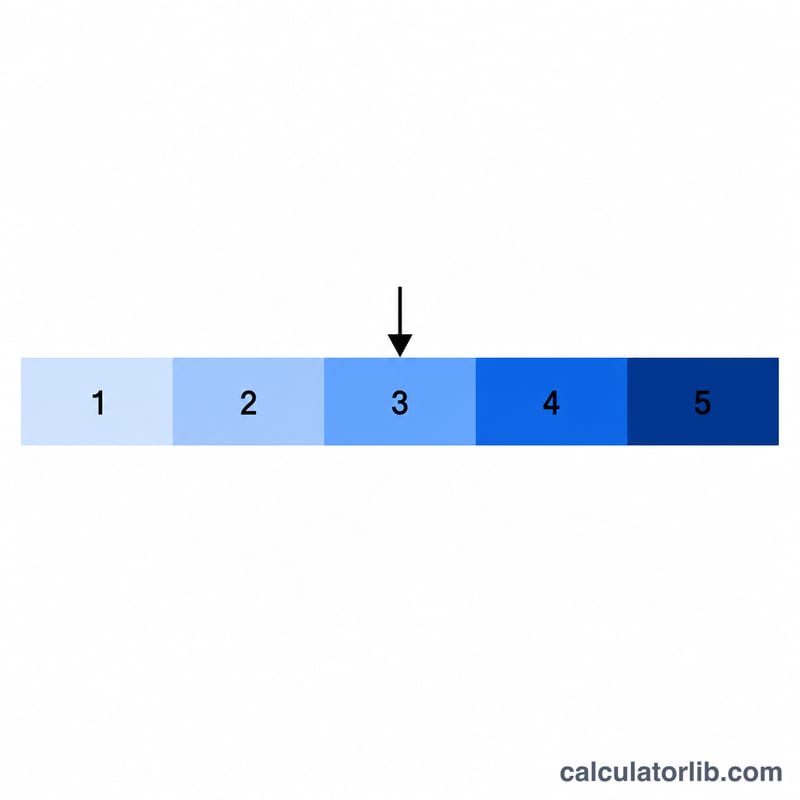
AP® exams are reported on a 1–5 scale that reflects how qualified you are to receive college credit and/or advanced placement in the subject. The College Board defines the scale as follows:
| Score | Qualification |
|---|---|
| 5 | Extremely well qualified |
| 4 | Well qualified |
| 3 | Qualified |
| 2 | Possibly qualified |
| 1 | No recommendation |
A score of 3 or higher is commonly considered "passing" and is the threshold many colleges use as a minimum for awarding credit or placement. A 4 or 5 broadly demonstrates strong command of differential and integral calculus and is more likely to earn credit at selective institutions.
That said, credit and placement policies vary widely by institution. Some schools grant credit for a 3, others require a 4 or 5, and a few highly selective colleges grant placement (letting you skip an introductory course) without course credit. Always check the specific AP credit policy of the college you plan to attend before assuming a score will count.
Finally, remember that this calculator produces an estimate, not an official result. The composite-to-score cutoffs are set anew each year based on exam difficulty and statistical equating, so your actual reported score may differ from the estimate shown here. Use this tool to gauge your readiness and target a comfortable margin above your desired score band rather than aiming for the exact cutoff.
FAQ
Are these cut points official? No. The College Board does not publish exact yearly thresholds; these are widely used approximations and should be treated as an estimate.
Is there a penalty for wrong MC answers? Not since 2011 — only correct answers count, so guess on every question.
What score do colleges accept? Many US colleges grant credit for a 3, 4, or 5, but policies vary by institution. Check the specific school's AP credit policy.