
What is the Arccosine Angle Calculator?
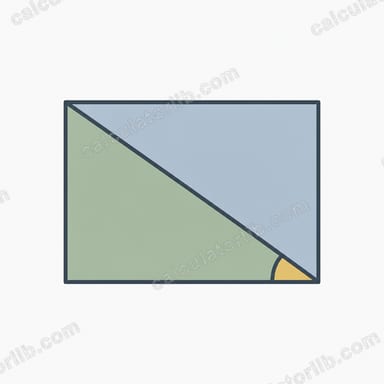
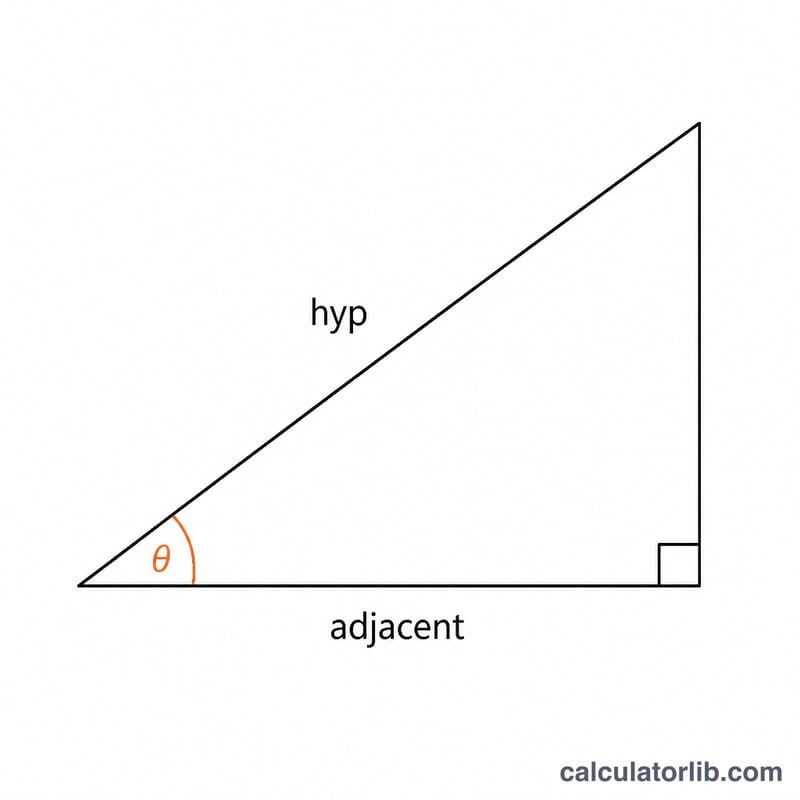
This calculator finds the angle of a right triangle when you know the length of the side adjacent to the angle and the hypotenuse. It applies the inverse cosine (arccosine) function, the mathematical operation that "undoes" cosine: if \(\cos(\theta) = \text{adjacent} / \text{hypotenuse}\), then \(\theta = \arccos(\text{adjacent} / \text{hypotenuse})\). The result is shown in both degrees and radians.
How to use it
Enter the length of the adjacent side and the length of the hypotenuse. The adjacent side is the side touching the angle (other than the hypotenuse), and the hypotenuse is the longest side, opposite the right angle. Press calculate to read the angle. Because cosine values must lie between -1 and 1, the ratio is automatically clamped to that range, so a slightly oversized adjacent value still returns a valid angle.
The formula explained
In a right triangle the cosine of an angle equals the adjacent side divided by the hypotenuse. Inverting this relationship gives the angle directly:
$$\theta = \arccos\!\left(\frac{\text{Adjacent}}{\text{Hypotenuse}}\right)$$
The arccosine returns a value from 0 to 180° (0 to \(\pi\) radians). To convert radians to degrees, multiply by \(180/\pi \approx 57.29578\).
Worked example
Suppose the adjacent side is 4 and the hypotenuse is 5. The ratio is \(4 / 5 = 0.8\). Then \(\theta = \arccos(0.8) \approx 0.6435\) radians \(\approx 36.8699\degree\). This is the familiar 3-4-5 right triangle, whose angles are about 36.87° and 53.13°.
Common Arccosine Values
The arccosine function takes a ratio between \(-1\) and \(1\) and returns the angle whose cosine equals that ratio. When the ratio comes from a right triangle, it is the adjacent side divided by the hypotenuse, so \(\theta = \arccos\!\left(\frac{\text{adjacent}}{\text{hypotenuse}}\right)\). The table below lists the standard reference values used most often.
| Ratio (adjacent / hypotenuse) | Angle (degrees) | Angle (radians) |
|---|---|---|
| 1 | 0° | 0 |
| 0.866 (\(\tfrac{\sqrt3}{2}\)) | 30° | \(\pi/6 \approx 0.5236\) |
| 0.707 (\(\tfrac{\sqrt2}{2}\)) | 45° | \(\pi/4 \approx 0.7854\) |
| 0.5 | 60° | \(\pi/3 \approx 1.0472\) |
| 0 | 90° | \(\pi/2 \approx 1.5708\) |
| -0.5 | 120° | \(2\pi/3 \approx 2.0944\) |
| -1 | 180° | \(\pi \approx 3.1416\) |
Note that arccosine returns angles from 0° to 180° (0 to \(\pi\) radians). For a physical right triangle the ratio is always between 0 and 1, giving acute angles from 0° to 90°; negative ratios appear only in more general trigonometry.
Angle Across Different Side Ratios
These examples use familiar Pythagorean triples and simple fractions. Each row computes the ratio \(\frac{\text{adjacent}}{\text{hypotenuse}}\) and then the angle \(\theta = \arccos(\text{ratio})\). For instance, with adjacent \(=3\) and hypotenuse \(=5\), the ratio is \(0.6\) and \(\theta = \arccos(0.6) = 53.13°\).
| Adjacent | Hypotenuse | Ratio | Angle (degrees) | Angle (radians) |
|---|---|---|---|---|
| 3 | 5 | 0.6000 | 53.13° | 0.9273 |
| 4 | 5 | 0.8000 | 36.87° | 0.6435 |
| 1 | 2 | 0.5000 | 60.00° | 1.0472 |
| 5 | 13 | 0.3846 | 67.38° | 1.1760 |
| 12 | 13 | 0.9231 | 22.62° | 0.3948 |
The 3-4-5 and 5-12-13 triangles illustrate a useful check: the two non-right angles in each triangle add to 90°. In the 3-4-5 triangle, \(53.13° + 36.87° = 90°\), confirming that the arccosine of one leg's ratio equals the arcsine of the other's.
FAQ
Why does the ratio have to be between -1 and 1? Cosine never exceeds 1 or drops below -1, so any larger ratio is physically impossible for a real triangle. The calculator clamps the input to keep the result defined.
What if the hypotenuse is shorter than the adjacent side? That cannot happen in a valid right triangle — the hypotenuse is always the longest side. The clamp handles such inputs gracefully by returning 0°.
Can I get the answer in radians? Yes — the result table shows the angle in radians alongside the degree value.