
What Is the Area of a Circle?
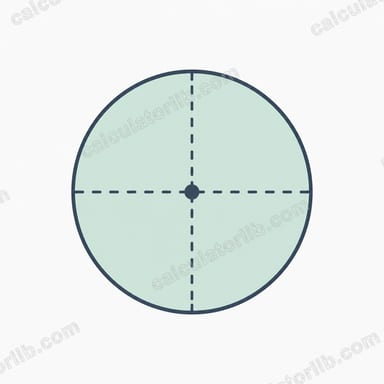
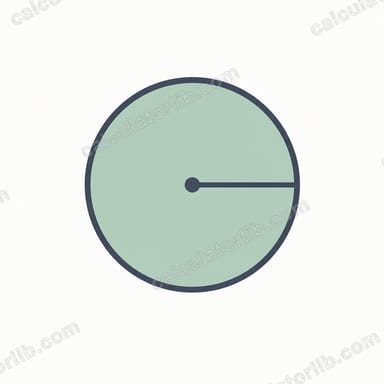
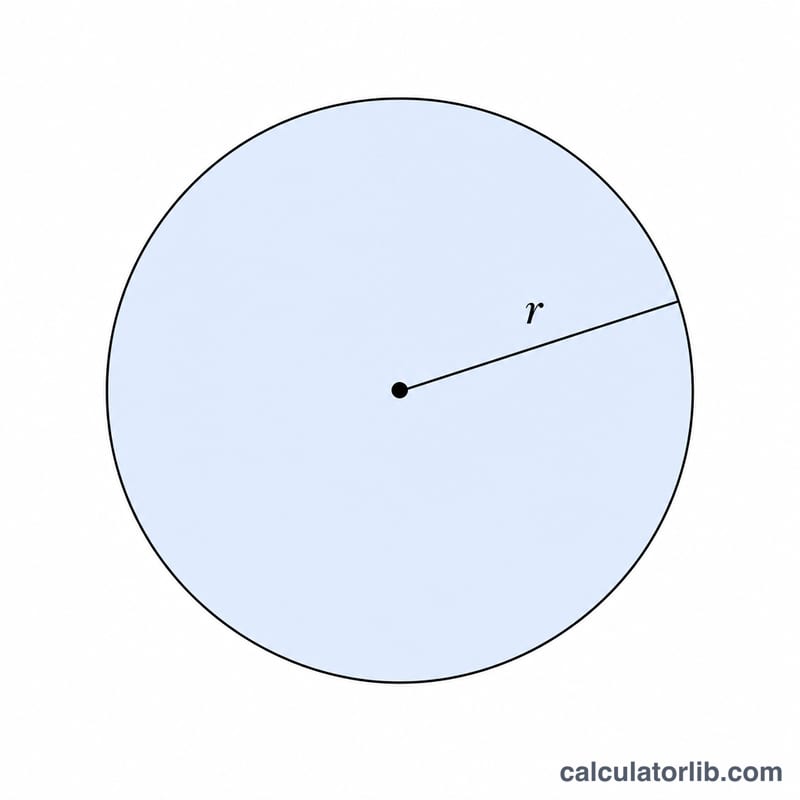
The area of a circle is the amount of space enclosed within its boundary. It is calculated from a single measurement — the radius (\(r\)), the distance from the center to the edge. This calculator uses the classic geometry formula \(A = \pi r^2\) and also reports the circle's diameter and circumference for convenience.
How to Use This Calculator
Enter the radius of your circle in any unit (centimeters, inches, meters — the result will be in those units squared) and the calculator instantly returns the area along with the diameter (\(2r\)) and the circumference (\(2\pi r\)). If you only know the diameter, divide it by two to get the radius first.
The Formula Explained
The constant \(\pi\) (pi) is approximately 3.14159. In the formula $$A = \pi r^2$$ the radius is squared (multiplied by itself) and then multiplied by \(\pi\). Because the radius is squared, doubling the radius quadruples the area — a circle of radius 4 has four times the area of one with radius 2.
Worked Example
Suppose a circular garden has a radius of 5 meters. Then $$A = \pi \times 5^2 = \pi \times 25 \approx 78.54 \text{ square meters}.$$ Its diameter is \(2 \times 5 = 10\) meters and its circumference is \(2 \times \pi \times 5 \approx 31.42\) meters.
Circle Area Reference Table
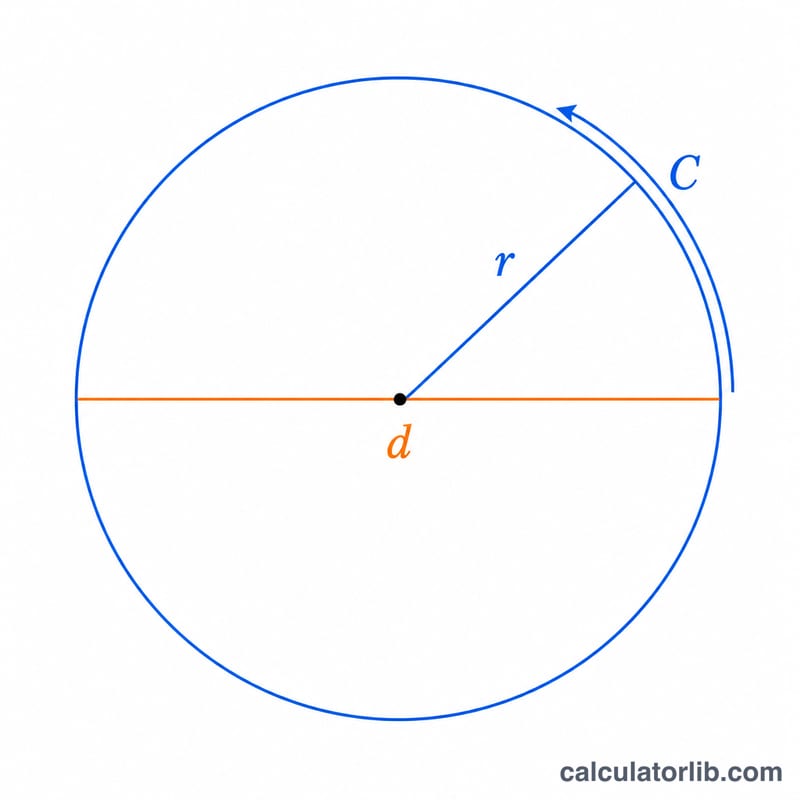
The table below lists common radius values with their corresponding diameter \((d = 2r)\), circumference \((C = 2\pi r)\), and area \((A = \pi r^2)\), all computed using \(\pi \approx 3.14159\) and rounded to two decimals.
| Radius (r) | Diameter (d) | Circumference (C) | Area (A = πr²) |
|---|---|---|---|
| 1 | 2 | 6.28 | 3.14 |
| 2 | 4 | 12.57 | 12.57 |
| 3 | 6 | 18.85 | 28.27 |
| 5 | 10 | 31.42 | 78.54 |
| 10 | 20 | 62.83 | 314.16 |
| 20 | 40 | 125.66 | 1256.64 |
| 50 | 100 | 314.16 | 7853.98 |
| 100 | 200 | 628.32 | 31415.93 |
All area values share the squared unit of the radius (for example, if the radius is in cm, the area is in cm²).
How to Calculate the Area by Hand
The area of a circle is found with the formula \(A = \pi r^2\). Follow these steps:
- Identify the radius (r). Measure or read off the distance from the center of the circle to its edge. If you only know the diameter \(d\), convert it first: \(r = \dfrac{d}{2}\).
- Square the radius. Multiply the radius by itself: \(r \times r = r^2\). For example, a radius of 7 gives \(7 \times 7 = 49\).
- Multiply by π. Multiply the squared radius by \(\pi \approx 3.14159\): \(A = 3.14159 \times 49 \approx 153.94\).
- Attach the squared unit. The result carries the radius's unit squared — for a radius in cm, the area is 153.94 cm².
Worked example with substitution: for \(r = 7\),
$$A = \pi r^2 = 3.14159 \times (7)^2 = 3.14159 \times 49 \approx 153.94\ \text{cm}^2$$
Key Terms
- Radius (r)
- The straight-line distance from the center of the circle to any point on its edge. It is the primary input for the area formula \(A = \pi r^2\).
- Diameter (d)
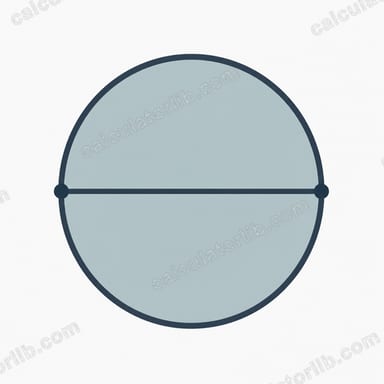
- The distance across the circle through its center — exactly twice the radius: \(d = 2r\), or equivalently \(r = \dfrac{d}{2}\).
- Circumference (C)
- The distance around the circle (its perimeter), given by \(C = 2\pi r = \pi d\).
- Area (A)
- The amount of surface enclosed by the circle, expressed in squared units, calculated as \(A = \pi r^2\).
- Pi (π)
- The mathematical constant that is the ratio of a circle's circumference to its diameter, approximately \(\pi \approx 3.14159\). It appears in both the circumference and area formulas.
FAQ
What if I only have the diameter? Divide the diameter by 2 to find the radius, then use the calculator.
What units does the area use? The area is in the square of whatever unit you used for the radius — enter centimeters and you get square centimeters.
Why is the radius squared? Area is two-dimensional, so it scales with the square of a linear measure like the radius.