
What Is the Atom Calculator?
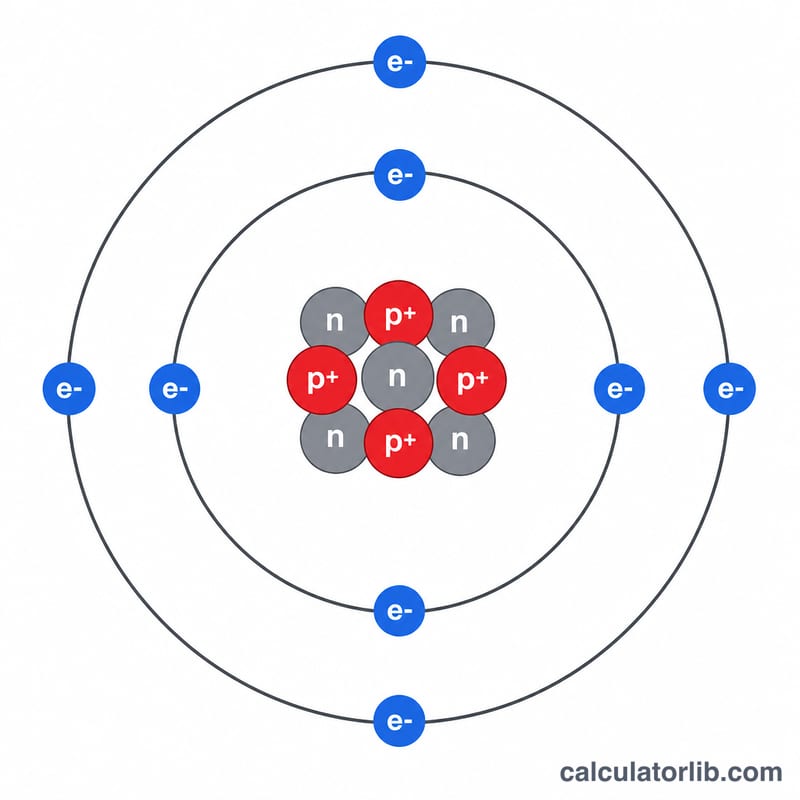
The Atom Calculator works out the three subatomic particle counts — protons, neutrons and electrons — for any atom or ion. All you need is the element's atomic number (\(Z\)), its mass number (\(A\)) and, for ions, the electric charge. It is a handy tool for chemistry and physics students learning about atomic structure and isotopes.
How to Use It
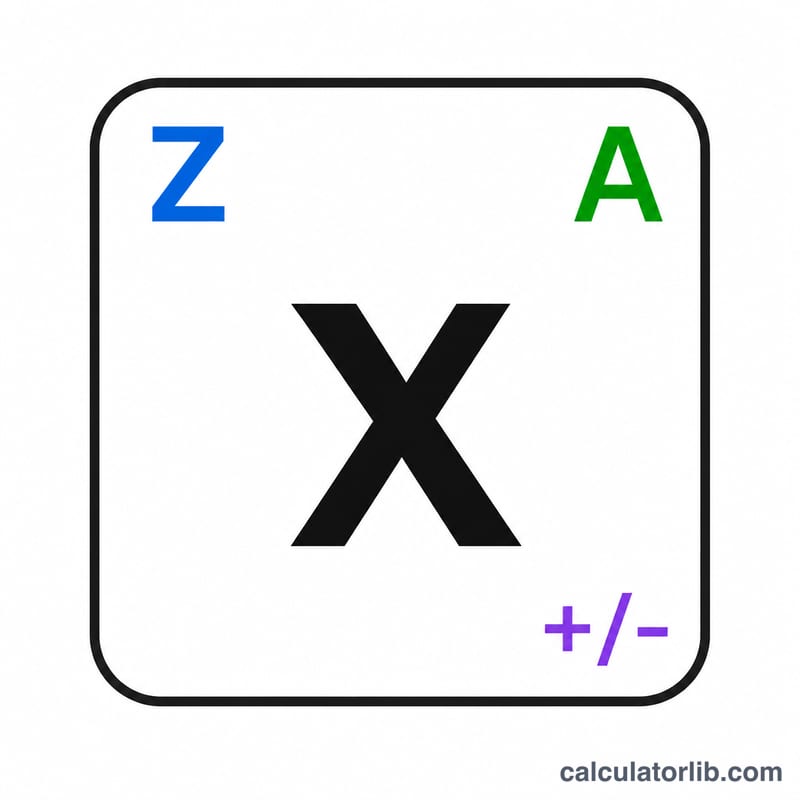
Enter the atomic number (\(Z\)), which uniquely identifies the element and equals its position in the periodic table. Enter the mass number (\(A\)), the total count of protons plus neutrons for that specific isotope. Finally enter the charge: use 0 for a neutral atom, a positive value for a cation (e.g. +2) or a negative value for an anion (e.g. -1). Press calculate to see the particle counts instantly.
The Formula Explained
Three simple relationships govern atomic composition:
Protons = Z. The atomic number always equals the number of protons in the nucleus.
Electrons = Z − Charge. A neutral atom has equal protons and electrons. Removing electrons gives a positive charge, so we subtract the charge value.
Neutrons = A − Z. The mass number counts protons and neutrons together, so subtracting the protons leaves the neutrons.
$$\text{Protons}=Z,\quad \text{Electrons}=Z-\text{Charge},\quad \text{Neutrons}=A-Z$$
Worked Example
Consider an oxide ion, O²⁻: oxygen has \(Z = 8\), the common isotope has \(A = 16\), and the charge is −2. Protons = 8. Electrons = 8 − (−2) = 10. Neutrons = 16 − 8 = 8.
$$\text{Protons}=8$$
$$\text{Electrons}=8-(-2)=10$$
$$\text{Neutrons}=16-8=8$$
So the ion has 8 protons, 10 electrons and 8 neutrons.
More Worked Examples
Each example uses the same three relationships: protons = Z, neutrons = A − Z, and electrons = Z − charge (where charge is the ion's overall sign and magnitude).
-
Neutral carbon-12 (Z = 6, A = 12, charge = 0).
Protons = Z = 6.
Neutrons = A − Z = 12 − 6 = 6.
Electrons = Z − charge = 6 − 0 = 6.Carbon-12 therefore has 6 protons, 6 neutrons, and 6 electrons.
-
Magnesium ion Mg²⁺ (Z = 12, A = 24, charge = +2).
Protons = Z = 12.
Neutrons = A − Z = 24 − 12 = 12.
Electrons = Z − charge = 12 − 2 = 10.The cation lost two electrons, so it has 10 electrons but still 12 protons.
-
Carbon-14 isotope (Z = 6, A = 14, charge = 0).
Protons = Z = 6.
Neutrons = A − Z = 14 − 6 = 8.
Electrons = Z − charge = 6 − 0 = 6.Carbon-14 has the same 6 protons as carbon-12 but 8 neutrons — the extra neutrons make it a heavier, radioactive isotope of the same element.
Key Terms Explained
- Atomic number (Z)
- The number of protons in an atom's nucleus. It uniquely identifies the element and equals the number of electrons in a neutral atom.
- Mass number (A)
- The total number of protons plus neutrons in the nucleus of a specific isotope. It is always a whole number (unlike the average atomic mass).
- Charge
- The net electrical charge of the particle. Zero for a neutral atom, positive when electrons are lost, and negative when electrons are gained.
- Proton
- A positively charged subatomic particle found in the nucleus. Its count equals the atomic number Z.
- Neutron
- An electrically neutral subatomic particle in the nucleus. Its count is found from A − Z.
- Electron
- A negatively charged subatomic particle surrounding the nucleus. In a neutral atom the number of electrons equals the number of protons.
- Isotope
- Atoms of the same element (same Z) that have different numbers of neutrons, and therefore different mass numbers A — for example, carbon-12 and carbon-14.
- Ion
- An atom or molecule that carries a net electric charge because it has gained or lost one or more electrons.
- Cation
- A positively charged ion formed when an atom loses electrons, so it has fewer electrons than protons (e.g. Na⁺, Mg²⁺).
- Anion
- A negatively charged ion formed when an atom gains electrons, so it has more electrons than protons (e.g. Cl⁻, O²⁻).
FAQ
What if the charge is zero? Then electrons equal protons (\(Z\)), as in a neutral atom.
Why can neutrons differ for the same element? Different isotopes of an element share the same \(Z\) but have different mass numbers \(A\), giving different neutron counts.
Can the charge be positive? Yes. A positive charge means electrons were lost, so \(\text{electrons} = Z - \text{charge}\) gives fewer electrons than protons.