
What is the HECS-HELP Repayment Calculator?
This calculator applies to Australia and uses the Australian Taxation Office (ATO) 2024-25 HECS-HELP repayment thresholds and rates. HECS-HELP is the federal student loan scheme. You don't make compulsory repayments until your repayment income reaches the minimum threshold ($54,435 for 2024-25). Above that, you repay a percentage of your total income that rises in tiers up to 10%.
How to use it
Enter your annual taxable income and, if applicable, any reportable fringe benefits and reportable super contributions. The calculator adds these to form your "repayment income," finds the matching rate band, and shows your estimated compulsory annual repayment plus an approximate monthly figure.
The formula explained
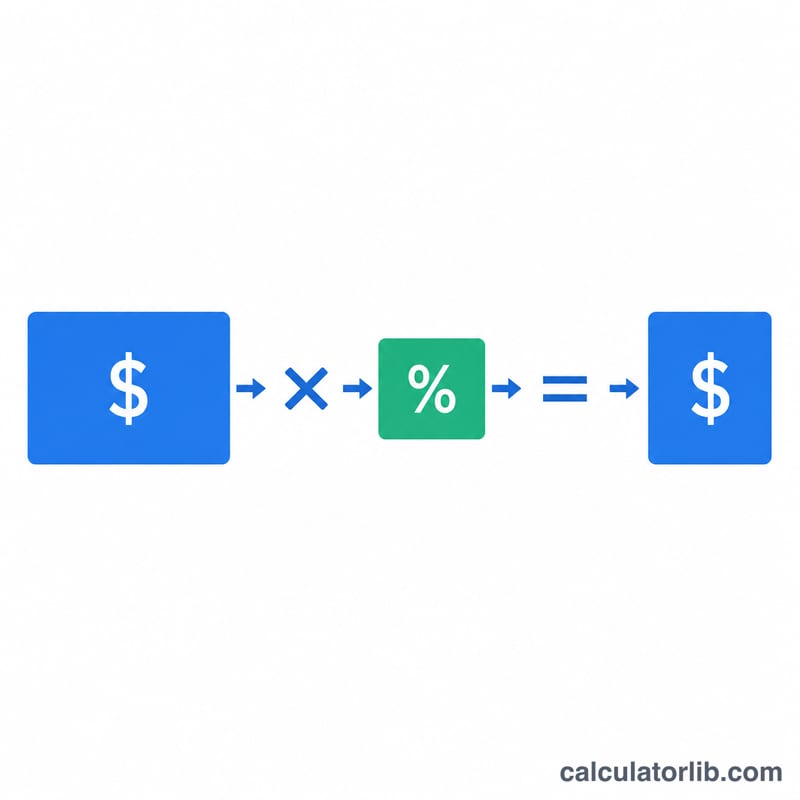
The compulsory repayment is calculated as: $$\text{Repayment} = \text{Repayment Income} \times \text{Rate}\%$$ Importantly, the percentage applies to your entire repayment income, not just the amount above the threshold. So crossing into a higher band increases the rate on all your income, not a marginal slice.
Worked example
Suppose your repayment income is $70,000. For 2024-25 the $66,620–$70,617 band has a rate of 2.5%. Your compulsory repayment is $$\$70{,}000 \times 2.5\% = \$1{,}750$$ per year, or about $145.83 per month.
2024-25 HECS-HELP Repayment Rates and Thresholds
For the 2024-25 income year, the Australian Taxation Office (ATO) applies compulsory HELP repayments based on your repayment income using a tiered scale. The applicable rate is multiplied by your entire repayment income (not just the portion above the threshold). No compulsory repayment is required while your repayment income stays below the minimum threshold of $54,435.
| Repayment income (2024-25) | Repayment rate |
|---|---|
| Below $54,435 | Nil |
| $54,435 – $62,850 | 1.0% |
| $62,851 – $66,620 | 2.0% |
| $66,621 – $70,618 | 2.5% |
| $70,619 – $74,855 | 3.0% |
| $74,856 – $79,346 | 3.5% |
| $79,347 – $84,107 | 4.0% |
| $84,108 – $89,154 | 4.5% |
| $89,155 – $94,503 | 5.0% |
| $94,504 – $100,174 | 5.5% |
| $100,175 – $106,185 | 6.0% |
| $106,186 – $112,556 | 6.5% |
| $112,557 – $119,309 | 7.0% |
| $119,310 – $126,467 | 7.5% |
| $126,468 – $134,056 | 8.0% |
| $134,057 – $142,100 | 8.5% |
| $142,101 – $150,626 | 9.0% |
| $150,627 – $159,663 | 9.5% |
| $159,664 and above | 10.0% |
The same scale applies to HECS-HELP, FEE-HELP, VET Student Loans, SA-HELP, OS-HELP and Student Start-up Loan (SSL) debts — they are all combined and repaid together.
Repayment at Different Income Levels
The table below shows the compulsory 2024-25 repayment at several repayment income levels. Because the rate applies to the whole repayment income, repayment jumps significantly as you move into higher bands. The monthly figure is the annual amount divided by 12 — it represents the effective cost spread across the year, though the debt is actually settled when you lodge your tax return.
| Repayment income | Rate | Annual repayment | Approx. monthly |
|---|---|---|---|
| $50,000 | 0% | $0 | $0 |
| $60,000 | 1.0% | $600 | $50 |
| $70,000 | 2.5% | $1,750 | $146 |
| $90,000 | 5.0% | $4,500 | $375 |
| $120,000 | 7.5% | $9,000 | $750 |
| $150,000 | 9.0% | $13,500 | $1,125 |
Note that repayment income can be higher than your taxable income alone. For example, someone with a $115,000 taxable income plus $5,000 in reportable super contributions has a repayment income of $120,000, pushing them into the 7.5% band for a repayment of $9,000. You can estimate the underlying income tax separately using an Australia Income Tax Calculator (2024-25).
Key Terms Explained
- Repayment income (HRI)
- The figure the ATO uses to determine your compulsory HELP repayment. It is the sum of your taxable income, reportable fringe benefits, reportable (salary-sacrificed) super contributions, total net investment loss, and any exempt foreign employment income. It is generally higher than taxable income alone.
- Taxable income
- Your assessable income (wages, business income, investment income, etc.) less allowable deductions. This is the base figure reported on your tax return before the HELP add-backs are applied.
- Reportable fringe benefits
- The grossed-up value of certain non-cash benefits your employer provides (such as a novated car lease or housing). Although not taxed in your hands, this amount is added back when calculating repayment income.
- Reportable super contributions
- Voluntary, salary-sacrificed concessional contributions to superannuation above the compulsory employer guarantee. These are added back so that salary sacrificing into super does not reduce your HELP repayment obligation.
- Compulsory vs voluntary repayment
- A compulsory repayment is the amount the ATO requires once your repayment income exceeds the threshold; it is calculated automatically when you lodge your tax return. A voluntary repayment is an extra payment you choose to make at any time to reduce your debt faster — it does not replace the compulsory amount due.
- PAYG withholding
- Pay As You Go amounts your employer withholds from each pay. If you notify your employer that you have a HELP debt, they withhold extra to cover the expected repayment, so the compulsory amount is largely pre-paid through the year and reconciled at tax time.
FAQ
Do I have to repay if I earn under the threshold? No. Below $54,435 (2024-25) no compulsory repayment is required, though you may make voluntary repayments.
Is the rate marginal? No — unlike income tax, the HECS-HELP rate applies to your whole repayment income once you reach a band.
How is the repayment collected? Your employer withholds extra PAYG tax during the year, and the actual repayment is calculated when you lodge your tax return.