

What Is ARPU?
ARPU (Average Revenue Per User) is one of the most widely used metrics in subscription, SaaS, telecom, gaming and mobile-app businesses. It measures how much revenue, on average, each active user or customer generates over a given period — typically a month (ARPMU) or a year. ARPU is unit-independent, so it works with any currency.
How to Use This Calculator
Enter your total revenue for the period and the number of users (or accounts, subscribers, or customers) over the same period. The calculator divides the two to give your average revenue per user. Be consistent with your time frame: if revenue is monthly, use the monthly active-user count so the figure is meaningful.
The Formula Explained
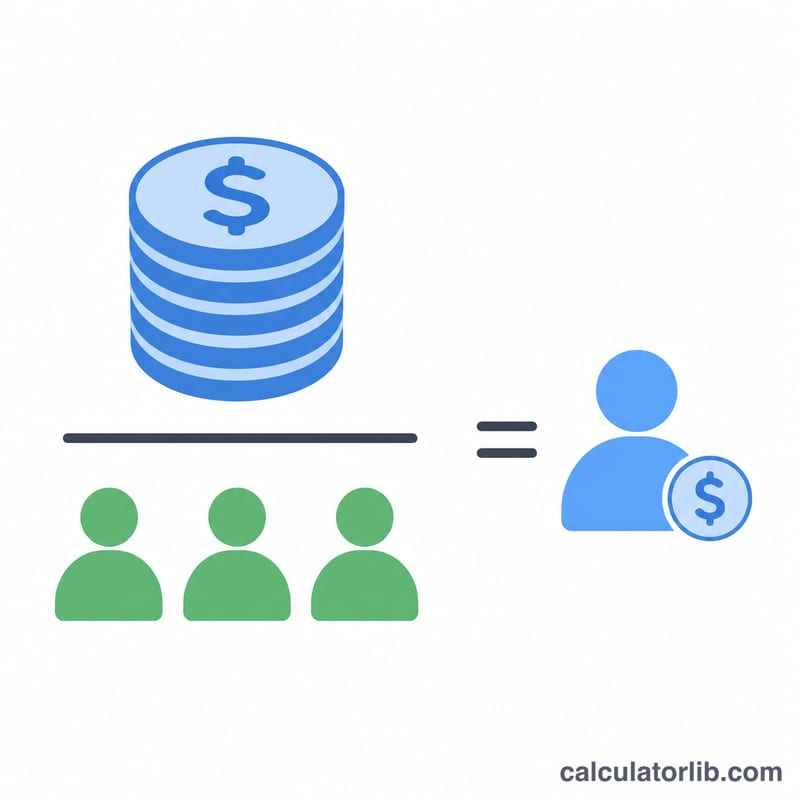
The math is simple:
$$\text{ARPU} = \dfrac{\text{Total Revenue}}{\text{Number of Users}}$$
The key challenge is defining the user base. Some teams use total registered users, others use monthly active users (MAU). Using active users usually yields a more honest, higher ARPU because dormant accounts are excluded.
Worked Example
Suppose a SaaS company earns $100,000 in a month from 5,000 active subscribers. $$\text{ARPU} = 100{,}000 \div 5{,}000 = \$20.00$$ per user per month. If they grow to 8,000 users on the same revenue, ARPU falls to \(\$12.50\) — a signal that monetization isn't keeping pace with growth.
Typical ARPU by Industry
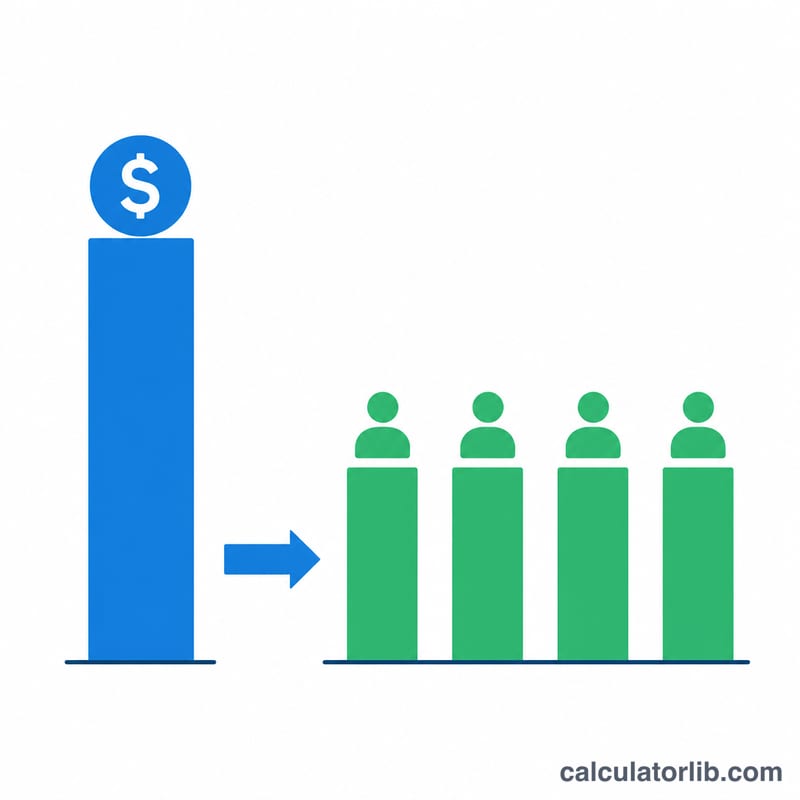
ARPU (Average Revenue Per User) is reported on different time bases depending on the industry. SaaS and telecom usually quote a monthly figure (often called ARPMU — Average Revenue Per Monthly User), while consumer apps and gaming may report daily, monthly, or annualized values. The ranges below are broad, widely-cited orders of magnitude — actual ARPU varies enormously by region, business model, and reporting period, so always compare against your own historical trend rather than a single benchmark.
| Industry / vertical | Typical ARPU range | Common time basis | Notes |
|---|---|---|---|
| B2B SaaS (SMB) | ~$15 – $100 / month | Monthly (ARPA) | Often called ARPA (per account); annual contracts divided by 12. |
| B2B SaaS (Enterprise) | $500 – several thousand / month | Monthly or annual | High ARPU, low user count; usually quoted per account. |
| Mobile / freemium gaming | ~$0.05 – $0.50 / day | Daily (ARPDAU) | Spread across all users; paying users (ARPPU) are far higher. |
| Telecom / mobile carriers | ~$10 – $50 / month | Monthly (ARPMU) | Varies sharply by country and prepaid vs postpaid. |
| Video / music streaming | ~$5 – $15 / month | Monthly | Driven by subscription tier mix and ad-supported plans. |
| Social / ad-supported apps | ~$1 – $50 / year | Annual | Revenue is mostly advertising; reported per active user (MAU/DAU). |
Because the denominator differs (registered users, active users, paying users), two companies quoting "ARPU" may not be measuring the same thing. Confirm whether a figure is per total user or per paying user before comparing.
Interpreting Your ARPU
ARPU answers a single question: on average, how much revenue does each user generate over a chosen period? Reading it well means looking at the level, the trend, and the denominator together.
- Level: A high ARPU indicates each user is monetized strongly (premium pricing, upsells, add-ons). A low ARPU is common in ad-supported or freemium models where scale matters more than per-user value.
- Trend vs user growth: Rising ARPU while users grow is the strongest signal — revenue is scaling faster than the base. Rising ARPU with shrinking users can mean you are losing low-value users (mix effect), not necessarily improving monetization. Falling ARPU during rapid user growth often reflects new users who haven't yet converted or upgraded.
- ARPU vs ARPPU: ARPU spreads revenue over all users; ARPPU spreads it over paying users only. In freemium models ARPPU can be many times larger than ARPU. Tracking both shows whether growth comes from more payers or higher spend per payer.
- ARPU vs LTV: ARPU is a single-period snapshot; lifetime value (LTV) extends it across the expected customer lifespan and (in some models) applies a margin. A useful rough link is \(\text{LTV} \approx \frac{\text{monthly ARPU}}{\text{monthly churn rate}}\).
- Segment it: A blended ARPU hides a lot. Break it out by plan tier, acquisition cohort, region, or signup month to see which segments actually drive revenue and how monetization matures over a cohort's lifetime.
ARPU is a descriptive metric, not a target in itself — these are general explanations of how the figure is read, not financial advice.
ARPU Across Scenarios
The examples below all use the same formula, \(\text{ARPU} = \frac{\text{Total Revenue}}{\text{Number of Users}}\), to show how different growth and monetization patterns move the result. Assume monthly revenue and the user count active in that month.
| Scenario | Total revenue | Users | ARPU |
|---|---|---|---|
| Baseline | $50,000 | 5,000 | $10.00 |
| User growth, flat revenue | $50,000 | 8,000 | $6.25 |
| Upsell (revenue grows faster) | $78,000 | 6,000 | $13.00 |
| Churn (lose low-value users) | $46,000 | 4,000 | $11.50 |
| Scale-up (both grow) | $120,000 | 10,000 | $12.00 |
Note how the second row — adding users without adding revenue — lowers ARPU even though total revenue is unchanged, while the churn row raises ARPU by removing low-value users. This is why ARPU should always be read alongside total revenue and user count, never in isolation.
Key Terms & Definitions
- ARPU (Average Revenue Per User)
- Total revenue for a period divided by the number of users in that period. A blended measure across all users, paying and non-paying.
- ARPPU (Average Revenue Per Paying User)
- Total revenue divided by only the users who actually paid. Always equal to or higher than ARPU; the gap reflects how many users are free.
- ARPA / ARPMU (Average Revenue Per Account / per Monthly User)
- ARPA is ARPU measured per account rather than per individual — common in B2B SaaS where one account has many seats. ARPMU is the monthly version of ARPU used in telecom.
- MAU (Monthly Active Users)
- The count of unique users who engaged with the product at least once in a given month — a common ARPU denominator for apps.
- DAU (Daily Active Users)
- Unique users active in a single day; used for daily metrics like ARPDAU in gaming and high-frequency apps.
- Net revenue
- Revenue after deducting refunds, chargebacks, discounts, and platform/processing fees — the cleaner numerator for ARPU than gross billings.
- Active vs registered user
- A registered user has signed up; an active user has actually engaged in the period. Using registered users inflates the denominator and understates ARPU.
- LTV (Lifetime Value)
- The total revenue (or margin) expected from a customer over their entire relationship. Built from ARPU extended across the customer's expected lifespan.
FAQ
Is ARPU the same as ARPPU? No. ARPU divides by all users; ARPPU (Average Revenue Per Paying User) divides only by users who actually pay, so ARPPU is always equal to or higher than ARPU.
What is a good ARPU? It varies by industry and pricing model. Track the trend over time rather than a single number — rising ARPU usually indicates improving monetization or upselling.
Should I use revenue before or after refunds? Use net revenue (after refunds and discounts) for the most accurate picture of actual earnings per user.