
What Is a Balloon Arch Calculator?
A balloon arch calculator estimates how many balloons you need to build a full, professional-looking balloon arch for weddings, birthdays, grand openings, and parties. Instead of guessing and running out of balloons mid-project, you enter a few simple measurements and get an instant total so you can shop with confidence.
How to Use It
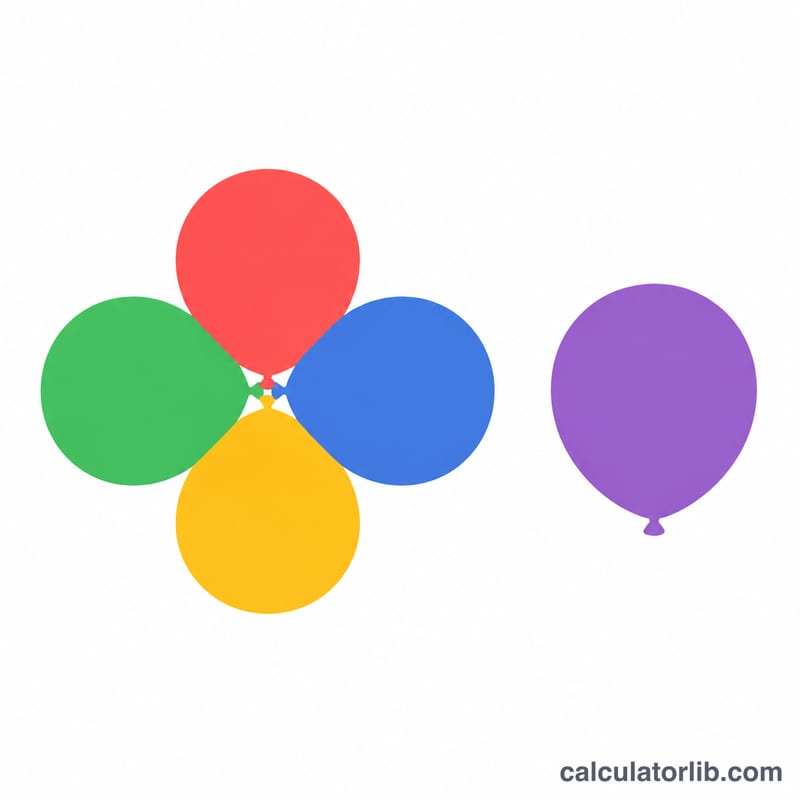
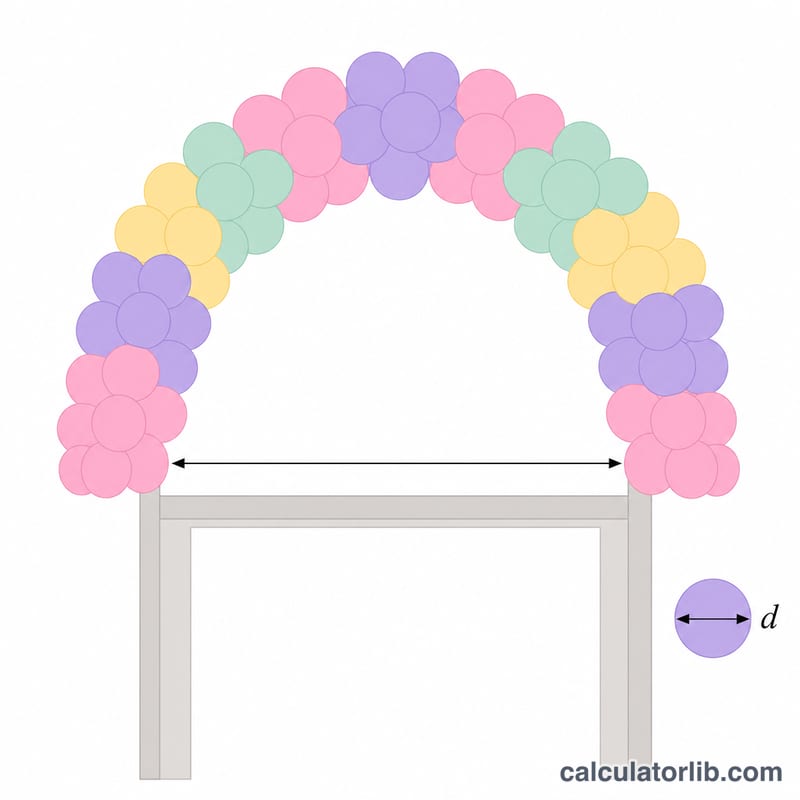
Enter three values: the arch length in feet (measure the path your arch will follow, not just the floor width — an arch curves upward), the balloon diameter in inches (the inflated size, commonly 5", 11", or 16"), and the number of balloons per cluster (a classic "balloon garland" uses 4 balloons per cluster). The calculator returns the total balloons needed, rounded up so you always have enough.
The Formula Explained
First the arch length is converted from feet to inches by multiplying by 12. Dividing that by the balloon diameter gives the number of clusters that fit along the arch. Multiplying clusters by balloons-per-cluster gives the total: $$\text{Balloons} = \left\lceil \frac{12 \times \text{Arch Length (ft)}}{\text{Balloon Diameter (in)}} \times \text{Balloons per Cluster} \right\rceil$$ The result is rounded up because you cannot buy a partial balloon.
Worked Example
Suppose you want a 10 ft arch using 11" balloons in clusters of 4. Convert: \(10 \times 12 = 120\) inches. Clusters: \(120 \div 11 \approx 10.9\), rounded up to 11. Balloons: \(10.9 \times 4 \approx 43.6\), rounded up to 44 balloons. Buying a few spares is always smart to cover pops.
Balloon Count by Arch Size and Balloon Diameter
The number of balloons required for an arch depends on three things: the length of the arch, the inflated diameter of each balloon, and how many balloons you group into each cluster. The estimator uses the formula:
$$\text{Balloons} = \left\lceil \frac{12 \times \text{Arch Length (ft)}}{\text{Balloon Diameter (in)}} \times \text{Balloons per Cluster} \right\rceil$$
The table below compares totals across common arch lengths and balloon diameters, all using a standard cluster of 4 balloons. Smaller balloons pack more clusters into the same span, so they always require more balloons than larger ones over the same length.
| Arch Length | 5" balloons | 11" balloons | 16" balloons |
|---|---|---|---|
| 6 ft | 58 | 27 | 18 |
| 8 ft | 77 | 35 | 24 |
| 10 ft | 96 | 44 | 30 |
| 15 ft | 144 | 66 | 45 |
For example, a 6 ft arch built from 5" balloons in clusters of 4 works out to \(\lceil (12 \times 6 / 5) \times 4 \rceil = \lceil 14.4 \times 4 \rceil = 58\) balloons.
Practical Recommendations
- Buy 10–15% extra. Balloons pop during assembly, deflate, or arrive defective. On a 50-balloon arch that means buying roughly 58 to be safe.
- Round up to whole packs. Latex balloons are usually sold in bags of 50 or 100. Always round your padded total up to the next full pack so you are not short mid-build.
- Mix sizes for an organic look. Combining 5", 11", and 16" balloons creates the popular "organic" or garland style. If you mix sizes, estimate each size separately and add the counts together.
- Measure the curved length, not the floor width. An arch that spans 8 ft along the ground follows a longer curved path. Measure (or estimate) the actual curve length and use that as your arch length, or your arch will look sparse.
- Account for fill type. Air-filled balloons hold shape on a frame indefinitely and are best for structured arches; helium-filled balloons float but deflate faster and are suited to free-standing or floating designs. This estimator counts balloons for a frame-style arch regardless of fill.
This is general planning guidance; actual counts vary with balloon brand, inflation level, and design density.
Standard Balloon Sizes and Typical Uses
Latex balloons are sold by their nominal flat size, but they are usually under-inflated for arch work so they last longer and pack tightly. The values below reflect typical inflated diameters and how many balloons it takes to cover one linear foot of arch in clusters of 4.
| Nominal Size | Typical Inflated Diameter | Common Use | Approx. Balloons per Foot of Arch (clusters of 4) |
|---|---|---|---|
| 5" | ~4–5 in | Filler balloons, organic clusters, detail accents | ~9.6 |
| 9" | ~8–9 in | General décor, smaller garlands | ~5.3 |
| 11" | ~10–11 in | Standard arch and garland base balloon | ~4.4 |
| 16" | ~14–16 in | Large accent balloons, statement focal points | ~3.0 |
| 36" | ~30–36 in | Giant feature balloons, arch endpoints | ~1.3 |
The balloons-per-foot figure is simply \(12 / \text{diameter} \times \text{cluster size}\); multiply it by your arch length in feet to estimate the total, then add spares.
FAQ
How many balloons per foot? With 11" balloons in clusters of 4, roughly 4-5 balloons per foot of arch.
Should I buy extra? Yes — add 10-15% for pops, deflation, and color mixing.
What size balloons are best? Mixing 5", 11", and 16" balloons gives the lush, organic look most popular for garland arches.