
What is the Base-N Conversion Calculator?
This tool converts a non-negative integer written in one numeral system into five common bases at once: decimal (base 10), hexadecimal (base 16), octal (base 8), senary (base 6), and binary (base 2). It is a pure mathematical converter with no region-specific rules, so it works the same anywhere. Programmers, students, and electronics hobbyists use it to quickly switch between representations of the same value.
How to use it
Type your number in the "Value (x)" box using digits that are valid for the base you select. Choose the input base with the radio buttons. For hexadecimal you may use the letters A–F (upper or lower case). For senary only 0–5 are valid, octal 0–7, and binary 0–1. Then read off all five equivalent representations. Supported range is 0 to \(2^{64} - 1\); only whole numbers are supported (no fractions or negative values).
The formula explained
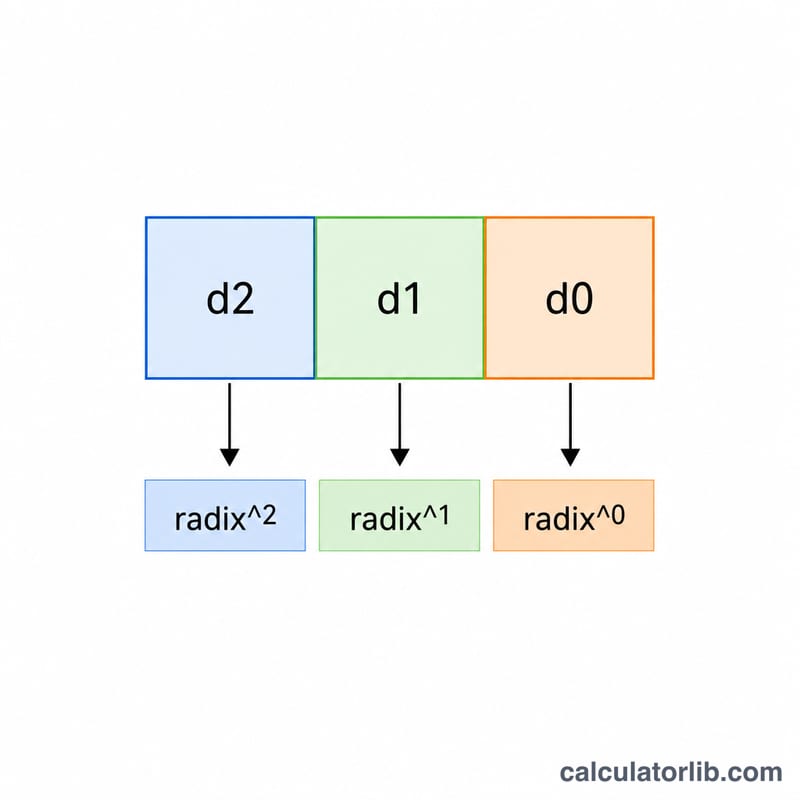
Parsing reads each digit from most significant to least: \(N = N \times \text{radix} + \text{digitValue(digit)}\), where 0–9 map to 0–9 and A–F map to 10–15. The general positional value is given by:
$$N_{10} = \sum_{i=0}^{k-1} d_i \cdot \text{Base}^{\,i} \qquad\text{where } d_i \text{ are the digits of } \text{Value (x)}$$
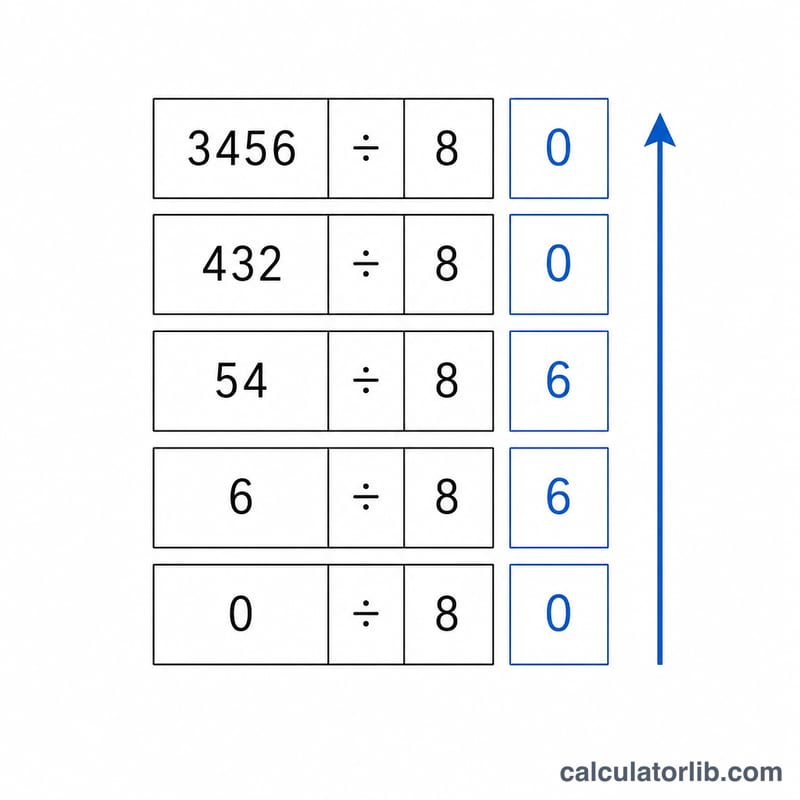
Formatting into a target base \(b\) uses repeated division: take \(r = N \bmod b\), record the digit, set \(N = N \div b\), and repeat until \(N = 0\); reverse the collected digits. Remainders 10–15 become A–F for hex.
Worked example
Enter 129 in decimal. Hexadecimal: \(129 = 8\times16 + 1 \to\) "81". Octal: \(129 = 2\times64 + 0\times8 + 1 \to\) "201". Senary: \(3\times36 + 3\times6 + 3 = 129 \to\) "333". Binary: \(128 + 1 \to\) "10000001".
Base Conversion Reference Table
The table below lists common non-negative integers expressed in five number systems: decimal (base 10), hexadecimal (base 16), octal (base 8), senary (base 6) and binary (base 2). Use it to spot-check the converter or to memorize the most frequently used boundary values such as 15, 16, 255 and the powers of two.
| Decimal (10) | Hexadecimal (16) | Octal (8) | Senary (6) | Binary (2) |
|---|---|---|---|---|
| 0 | 0 | 0 | 0 | 0 |
| 1 | 1 | 1 | 1 | 1 |
| 2 | 2 | 2 | 2 | 10 |
| 5 | 5 | 5 | 5 | 101 |
| 6 | 6 | 6 | 10 | 110 |
| 7 | 7 | 7 | 11 | 111 |
| 8 | 8 | 10 | 12 | 1000 |
| 10 | A | 12 | 14 | 1010 |
| 15 | F | 17 | 23 | 1111 |
| 16 | 10 | 20 | 24 | 10000 |
| 32 | 20 | 40 | 52 | 100000 |
| 64 | 40 | 100 | 144 | 1000000 |
| 100 | 64 | 144 | 244 | 1100100 |
| 255 | FF | 377 | 1103 | 11111111 |
Note that 255 (the largest value an 8-bit byte can hold) is FF in hexadecimal and eight 1s in binary, which is why a single hex pair maps cleanly onto one byte.
Definitions & Glossary
- Base / radix
- The number of distinct digit symbols a positional numeral system uses, and the factor by which place value increases from one column to the next. Base \(b\) uses digits \(0\) through \(b-1\).
- Decimal (base 10)
- The everyday number system using ten digits, 0–9. Each column is a power of 10: ones, tens, hundreds, and so on.
- Hexadecimal (base 16)
- A base-16 system using sixteen symbols 0–9 and A–F. Widely used in computing because each hex digit represents exactly four binary bits (a nibble).
- Octal (base 8)
- A base-8 system using digits 0–7. Each octal digit corresponds to exactly three binary bits; historically common in early computing and in Unix file permissions.
- Senary (base 6)
- A base-6 system using digits 0–5. Less common in practice but useful as a teaching tool and in certain mathematical contexts.
- Binary (base 2)
- The base-2 system using only the digits 0 and 1 (bits). It is the native language of digital electronics, where each bit is an on/off state.
- Digit value (A–F = 10–15)
- In bases above 10, letters extend the digit set beyond 9. In hexadecimal: A = 10, B = 11, C = 12, D = 13, E = 14 and F = 15.
- Positional notation
- A system in which a digit's contribution depends on its position. The value of a number is \(N_{10} = \sum_{i=0}^{k-1} d_i \cdot b^{\,i}\), where \(d_i\) is the digit in position \(i\) (counting from 0 on the right) and \(b\) is the base.
- Most significant digit (MSD)
- The leftmost digit of a number, carrying the highest place value and contributing the most to the overall magnitude.
- Least significant digit (LSD)
- The rightmost digit, occupying the ones place (\(b^0\)) and contributing the smallest amount to the value.
- Unsigned 64-bit range
-
An unsigned 64-bit integer can represent values from 0 up to \(2^{64}-1 = 18{,}446{,}744{,}073{,}709{,}551{,}615\), which is
FFFFFFFFFFFFFFFFin hexadecimal — sixteen F digits.
FAQ
Can it handle decimals like 12.5? No, only whole numbers are supported. Are negative numbers allowed? No; the range starts at 0. Is hex input case-sensitive? No — both "ff" and "FF" parse to 255, and output hex is always uppercase.