

What Is Caught Stealing Percentage?
Caught stealing percentage (also called the throw-out rate) measures how effective a baseball catcher is at preventing stolen bases. It is the fraction of runners who attempted to steal that the catcher put out with his own throw. The metric is universal across all levels of baseball and is not tied to any country or league.
How to Use This Calculator
Enter two whole-number counts: the number of runners the catcher threw out (Caught Stealing) and the total number of stolen base attempts against him (Stolen Base Attempts, which equals stolen bases allowed plus caught stealing). The calculator returns the rate as a baseball-style decimal (e.g. 0.333) and as a percentage (33.3%).
The Formula Explained
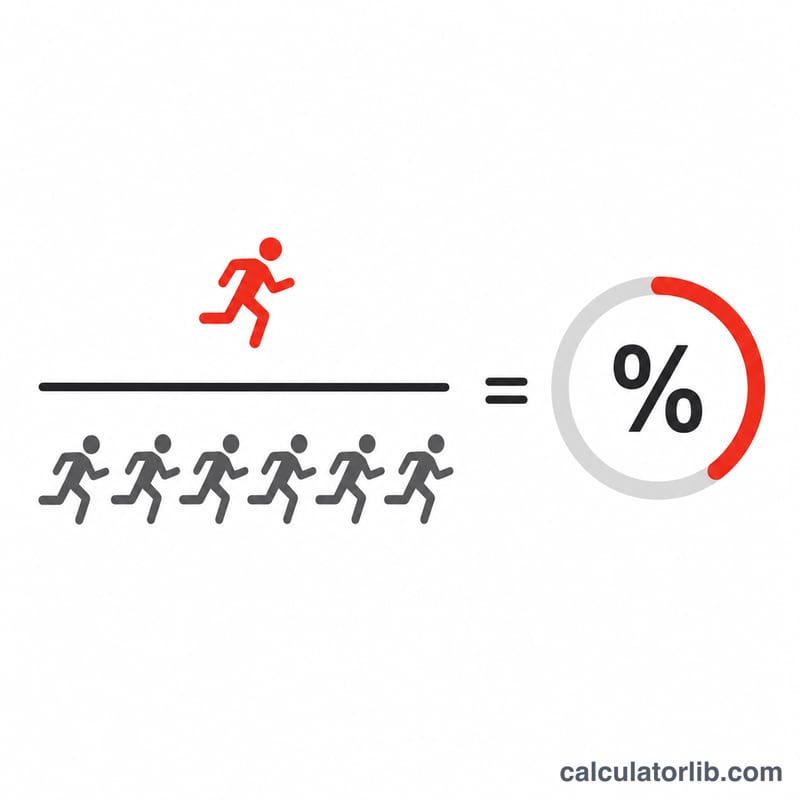
The rate is simply caught stealing divided by steal attempts: $$\text{CS\%} = \frac{\text{Caught Stealing}}{\text{Stolen Base Attempts}} \times 100\%$$ The result is conventionally rounded to three decimal places, matching how baseball displays rates. Because you cannot throw out more runners than attempted, the value always falls between 0 and 1. If there were zero attempts the rate is undefined, so the calculator reports an error instead of dividing by zero.
Worked Example
Suppose a catcher threw out 10 runners on 30 attempts. The rate is $$10 \div 30 = 0.33333\ldots$$ which rounds to 0.333, or 33.3%. In another case, 7 caught out of 16 attempts gives $$7 \div 16 = 0.4375$$ rounding to 0.438 (43.8%).
Interpreting Your Throw-Out Rate
A catcher's caught stealing percentage (CS%) measures how often the catcher and battery prevent stolen bases by throwing out the runner. It is calculated as runners caught stealing divided by total stolen base attempts against:
$$\text{CS\%} = \frac{\text{Caught Stealing}}{\text{Stolen Base Attempts}} \times 100\%$$
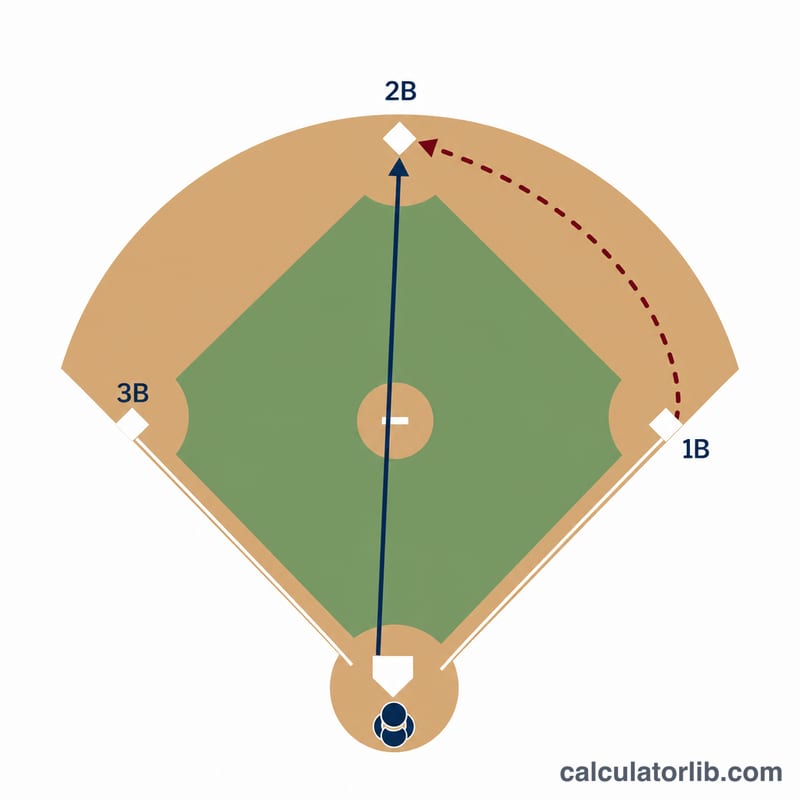
A higher CS% generally reflects a strong, accurate throwing arm and a quick pop time — the elapsed time from the ball hitting the catcher's mitt to it striking the fielder's glove at second base. Elite MLB catchers post pop times around 1.9 seconds or faster, which gives them a meaningful chance to retire even fast baserunners.
It is important to remember that CS% is not solely a measure of the catcher. The pitcher's hold time (delivery to the plate, slide step, and effectiveness of pickoff moves) heavily influences whether a runner is thrown out. A catcher with average arm strength can post a strong CS% behind pitchers who are quick to the plate, while a strong-armed catcher can look ordinary behind slow deliveries.
Because it is a rate statistic, CS% is volatile over small samples. With only a handful of attempts, a single result can swing the number dramatically — for example, going from 0-for-3 to 1-for-3 jumps the rate from 0% to 33.3%. Meaningful evaluation requires a full season or more of attempts.
For league context, MLB catchers as a group typically throw out roughly 25–30% of attempting baserunners. A CS% above 30% is considered above average, the mid-30s to 40s is excellent, and figures consistently below 20% suggest a weakness opposing teams will exploit.
CS% Across Sample Scenarios
The table below shows how the same formula plays out across different caught stealing totals and attempt counts. Note how small-sample rates (like 1 of 3) sit far from league norms simply due to limited attempts, while larger samples produce more stable, interpretable figures.
| Caught Stealing | Attempts | Decimal | CS% | Note |
|---|---|---|---|---|
| 5 | 20 | 0.250 | 25.0% | League-average ballpark |
| 10 | 30 | 0.333 | 33.3% | Above average |
| 7 | 16 | 0.438 | 43.8% | Excellent, but small sample |
| 20 | 60 | 0.333 | 33.3% | Above average, large sample |
| 1 | 3 | 0.333 | 33.3% | Tiny sample — unreliable |
The 7-of-16 line illustrates the small-sample caution: a 43.8% rate looks elite, but over only 16 attempts a couple of different outcomes would move it substantially. The 20-of-60 line gives the same conclusion as 10-of-30 (33.3%) but with far more confidence behind it.
FAQ
What counts as a stolen base attempt? It is the sum of stolen bases allowed and runners caught stealing — every time a runner tried to advance by stealing.
What is a good caught stealing percentage? Roughly 0.300 (30%) is considered solid at the professional level; elite throwing catchers reach 0.400 or higher.
Why is my result shown as undefined? The rate cannot be computed when there are zero attempts, when any count is negative, or when caught stealing exceeds the number of attempts.