
What is the Bath vs Shower Calculator?
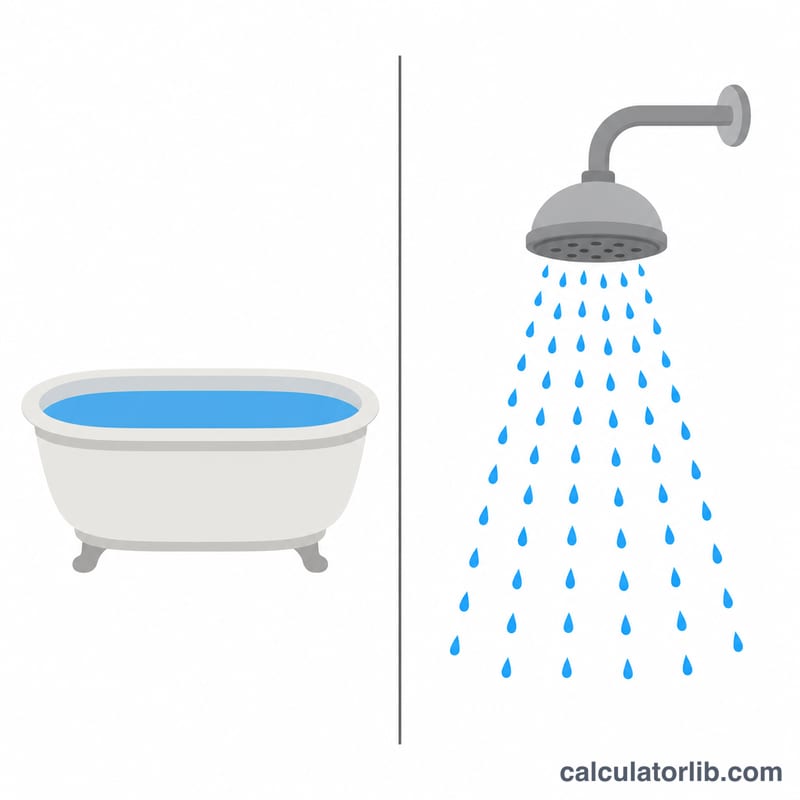
This calculator settles the age-old question: is a bath or a shower more economical and water-efficient? It works for any country — just enter your local water price per liter. A shower's water use depends entirely on how long you stand under it and how powerful the showerhead is, while a bath uses a fixed amount once filled. Long showers and high-flow heads can easily out-use a full tub.
How to use it
Enter your showerhead flow rate (typical heads are 6–12 liters per minute, low-flow ones around 6), your usual shower length in minutes, the volume of water you put in your bathtub when bathing (a typical bath is 100–180 liters), and the price you pay per liter of water. The calculator shows the water and cost for each option and tells you which is the more efficient choice.
The formula explained
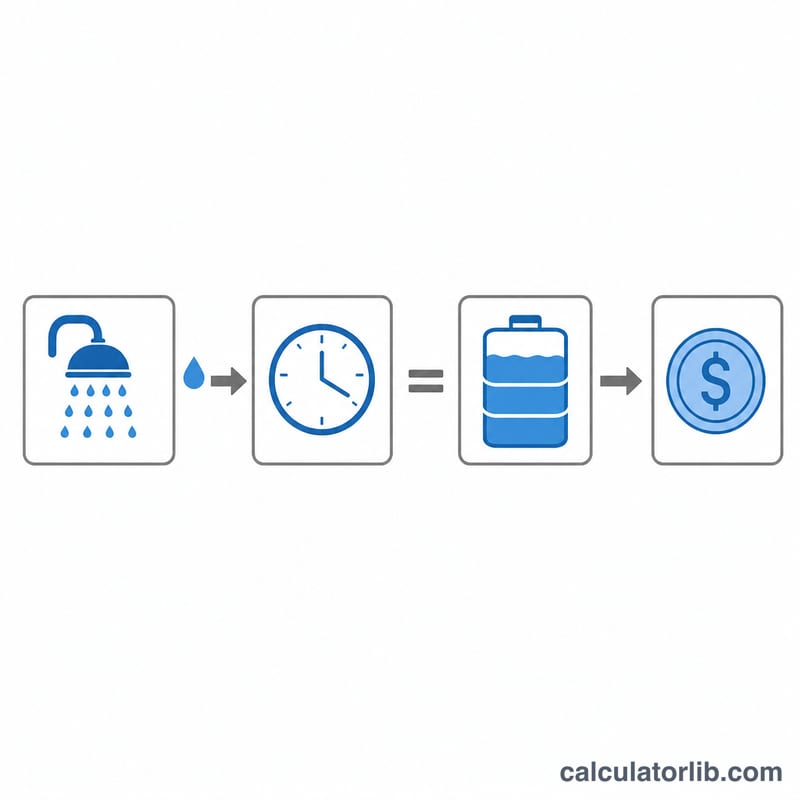
Shower water = flow_rate × shower_minutes. The cost of each option is simply liters × price_per_liter. The tool then compares the two volumes, reports the water and money saved by choosing a shower, and flags the more water-efficient option.
$$\Delta_{\text{water}} = \text{Bath (L)} - \left(\text{Flow (L/min)} \times \text{Minutes}\right)$$
$$\Delta_{\text{cost}} = \Delta_{\text{water}} \times \text{Price/L}$$
Worked example
Suppose your shower flows at 9 liters/minute for an 8-minute shower: that's \(9 \times 8 = 72\) liters. Your bathtub holds 150 liters. At a water price of 0.002 per liter, the shower costs \(72 \times 0.002 = 0.144\) and the bath costs \(150 \times 0.002 = 0.30\). The shower saves 78 liters and 0.156 in cost — so the shower wins here.
Typical Shower Flow Rates and Bath Volumes
Whether a shower or a bath uses less water comes down to two numbers: how fast your showerhead delivers water (its flow rate in litres per minute) and how full you fill the tub (in litres). The tables below give realistic ranges for both so you can pick sensible inputs for the comparison.
Showerhead flow rates
| Showerhead type | Flow rate (L/min) | Water in a 8-minute shower |
|---|---|---|
| Low-flow / aerating / WaterSense | ~6 | 48 L |
| Standard fixed head | 9–12 | 72–96 L |
| Power / rain / multi-jet head | 15–20+ | 120–160+ L |
For example, a standard 10 L/min head run for 8 minutes uses 80 litres of water.
Bath fill volumes
| Fill level | Volume (L) | Notes |
|---|---|---|
| Shallow / shower-over-bath splash | ~80 | Water just covers the base |
| Average comfortable bath | 100–150 | Most household soaks |
| Full / deep soaking tub | 160–200+ | Large or freestanding baths |
A tub's total capacity is larger than the volume you actually use, because your body displaces water and you rarely fill to the brim. Use the level you typically run, not the manufacturer's stated capacity.
Quick comparison
Comparing a 130 L average bath against the standard shower above, the shower saves 50 litres — but a 20 L/min power shower run for the same 8 minutes would use 160 L, more than the bath. Flow rate and time matter as much as which option you choose.
Practical Tips to Cut Bathroom Water Use
Small changes in how you shower or bathe add up across a year, lowering both your water bill and the energy needed to heat that water. Use the figures from your own comparison to set realistic targets.
- Fit a low-flow or aerating showerhead. Dropping from a 15 L/min head to a 6 L/min aerating head cuts water use by more than half while keeping decent pressure — often the single biggest saving available.
- Shorten your shower. Each minute saved at 10 L/min is 10 litres. Trimming a 10-minute shower to 6 minutes saves 40 litres every wash.
- Fill the tub less. Running a bath to 100 L instead of 160 L saves 60 litres per soak without much loss of comfort — many people fill far deeper than they need.
- Find your break-even shower length. Divide your usual bath volume by your shower flow rate to get the time at which the two are equal. For a 130 L bath and a 10 L/min head, that is 13 minutes — stay under it and the shower wins.
- Set a target shower time. Once you know the break-even point, aim well below it (for example, 8 minutes against a 13-minute break-even) so the shower reliably beats the bath. A simple timer or a favourite short song works well.
- Mind the hot-water cost too. Most of the expense of bathing is heating the water, not the water itself. Lower flow and shorter times cut your heating energy proportionally, so the savings on a gas or electric bill are larger than the water cost alone.
This is general guidance to help you compare options; your actual savings depend on your local water and energy prices, your equipment and your habits.
FAQ
What flow rate should I use? Check your showerhead's rating, or measure it: time how many seconds it takes to fill a 1-liter container, then divide 60 by that number.
How do I find my price per liter? Divide your total water bill (including any sewerage/volumetric charges) by the liters used in that period, shown on your meter or bill.
Does this include heating costs? No — it covers the water volume and water charge only. Heating costs scale roughly with volume too, so the more efficient option here is usually cheaper to heat as well.