
What This Calculator Does
Choosing a bathroom mirror that fits your vanity is largely a matter of proportion. A mirror that is too wide overhangs the counter and looks bulky, while one that is too narrow looks lost above a wide sink. This calculator turns three simple measurements — your vanity width, the gap you want on each side, and the available wall height — into clean width and height suggestions in inches.
How to Use It
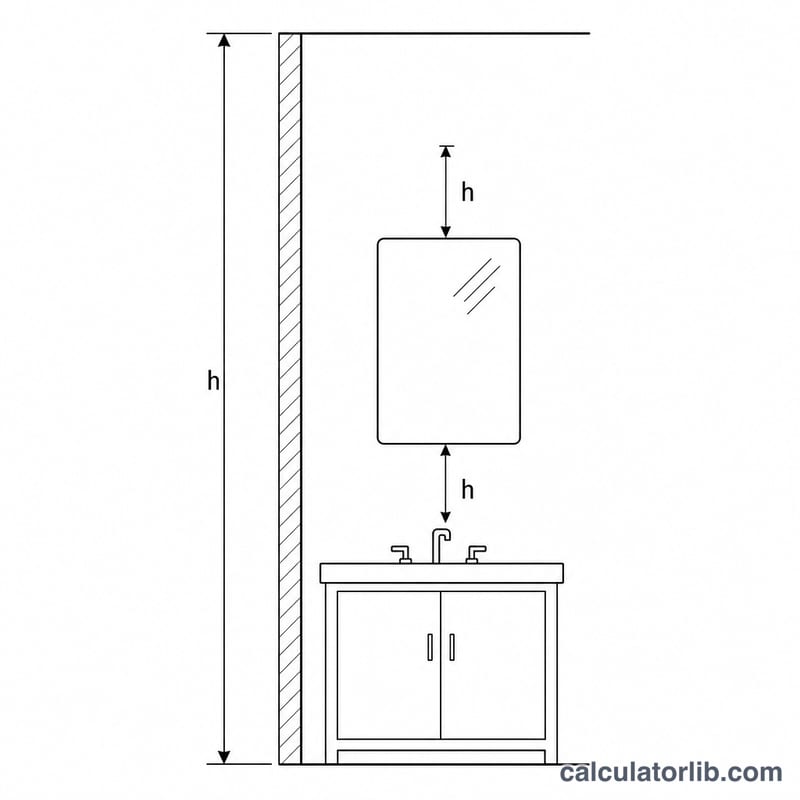
Measure the full width of your vanity or sink counter. Decide how much breathing room you want on each side (1–3 inches is typical). Then measure the open wall space above the vanity, from the top of the backsplash to where the mirror should stop below the ceiling or light fixture. Enter all three values and read off the suggested dimensions.
The Formula Explained
The maximum mirror width is simply the vanity width minus twice the side gap. The recommended width is 90% of the vanity width — a designer rule of thumb that keeps the mirror centered and visually balanced. The suggested height is about 65% of the usable wall space, leaving margin top and bottom so the mirror does not crowd lights or the backsplash.
$$\text{Mirror Width} = \text{Vanity Width} - 2 \times \text{Side Gap}$$$$\text{Recommended Width} = 0.9 \times \text{Vanity Width}$$$$\text{Mirror Height} = 0.65 \times \text{Wall Height}$$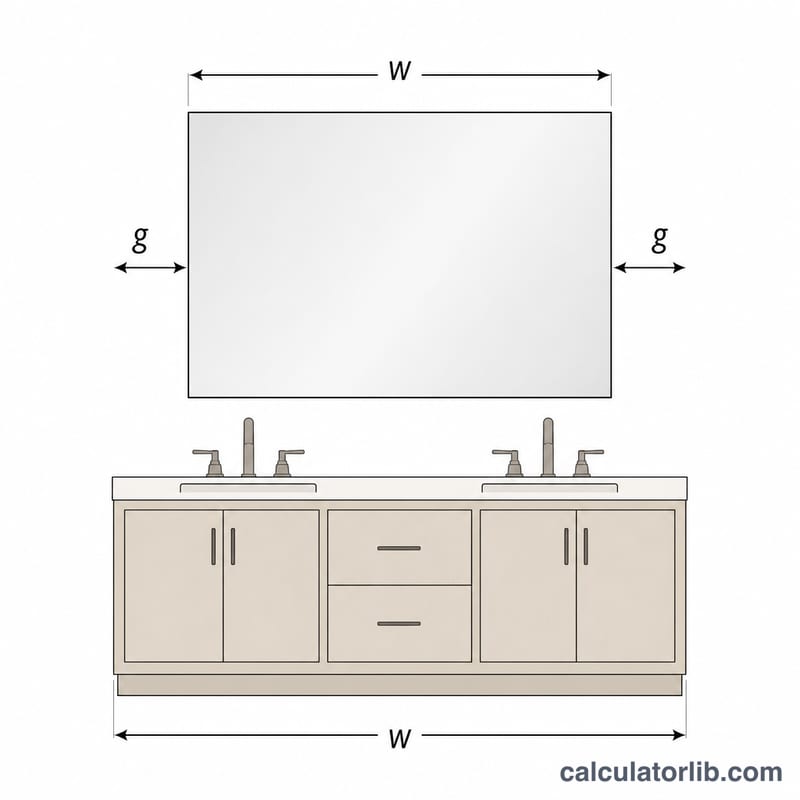
Worked Example
Suppose your vanity is 36 inches wide, you want a 2-inch gap on each side, and you have 40 inches of wall above it. Mirror width = $$36 - (2 \times 2) = 32$$ inches. Recommended width = $$36 \times 0.9 = 32.4$$ inches. Suggested height = $$0.65 \times 40 = 26$$ inches. A roughly 32 × 26 inch mirror would suit this vanity nicely.
Standard Bathroom Mirror & Vanity Sizes
Bathroom mirrors are usually sized to fit just inside the footprint of the vanity below them, leaving a small reveal of countertop on each side. The table below maps common vanity widths to the standard mirror sizes most often sold for them. Frameless mirrors and medicine cabinets are frequently a bit narrower than the vanity, while framed mirrors are typically chosen 2–4 in narrower to leave room for the frame and side lighting.
| Vanity width (in) | Typical mirror width (in) | Typical mirror height (in) | Notes |
|---|---|---|---|
| 24 | 20–24 | 28–30 | Small powder rooms; single sink |
| 30 | 24–28 | 30–36 | Most common single vanity |
| 36 | 30–34 | 30–40 | Single sink with extra counter |
| 48 | 40–46 | 30–42 | One large mirror or two 22–24 in mirrors |
| 60 | 52–58 | 30–42 | Double vanity; one wide mirror or two mirrors |
| 72 | 64–70 | 30–42 | Double vanity; usually two mirrors over each sink |
Mirror heights are more flexible than widths because they depend on ceiling height, backsplash height and how much wall you want above the faucet. A common rule of thumb is a mirror height of roughly 65% of the available wall height between the backsplash and the ceiling.
Mirror Sizes for Common Vanities
The scenarios below assume a 2 in gap on each side of the mirror (a 4 in total reveal) and use the tool's formulas: maximum width equals the vanity width minus twice the side gap, and suggested height equals 0.65 times the wall height available for the mirror. The recommended width rounds the maximum down to a convenient stock size that also leaves a little extra breathing room.
| Vanity width (in) | Side gap (in) | Wall height (in) | Max mirror width (in) | Recommended width (in) | Suggested height (in) |
|---|---|---|---|---|---|
| 30 | 2 | 48 | 26 | 24 | 31 |
| 36 | 2 | 50 | 32 | 30 | 33 |
| 48 | 2 | 52 | 44 | 42 | 34 |
| 60 | 2 | 54 | 56 | 54 | 35 |
For the 30 in vanity the maximum width is \(30 - 2 \times 2 = 26\) in, and the suggested height is \(0.65 \times 48 = 31.2\) in, which rounds to about 31 in. On a double vanity you can either install one wide mirror near the recommended width or split the space into two equal mirrors centered over each sink.
Practical Mounting & Sizing Tips
- Round to a stock size. Once you have a calculated maximum width, round down to the nearest readily available size (commonly 24, 28, 30, 36, 42 or 48 in) so the mirror fits comfortably within the vanity footprint with the side reveal intact. Custom-cut mirrors cost more, so matching a stock size saves money.
- Leave room for light fixtures. If you mount sconces or a vanity light bar above or beside the mirror, reduce the mirror dimensions so it doesn't crowd the fixtures. Allow at least a few inches of clearance above the mirror for a top-mounted light and on each side for wall sconces.
- Watch the framing. Heavy framed mirrors and medicine cabinets should be anchored to wall studs. Studs are typically spaced 16 in on center, so confirm your mounting points land on framing or use appropriate wall anchors for tile and drywall.
- Center over the sink, not the vanity edge. On a single-sink vanity, line the mirror's center up with the faucet and drain rather than the geometric center of the countertop, especially if the sink is offset. A centered mirror reads as intentional even when the cabinet is asymmetric.
- Hang it at eye level. Aim for the vertical center of the mirror around 60–65 in from the floor, and keep the bottom edge a few inches above the backsplash or faucet so water spots are minimized. Adjust upward in households with taller users.
- Double vanity guidance. For two sinks, either install one large mirror spanning most of the counter or two matching mirrors each centered over its own sink. Two mirrors usually look best when each is sized to its half of the vanity with equal gaps between and outside them.
These are general guidelines; actual fit depends on your plumbing layout, lighting, tile lines and ceiling height, so measure your space before ordering.
FAQ
Should the mirror be as wide as the sink or the whole vanity? A common guideline is to match the sink width or keep the mirror slightly narrower than the vanity — about 90% — so it doesn't overhang.
How high should I hang it? Center the mirror at eye level, generally 5–10 inches above the faucet, so the top sits a little above the tallest user's eye line.
Are these exact requirements? No — they are proportional recommendations. Adjust for lighting fixtures, framing, and personal taste.