
What Is the Battery Life Calculator?
This calculator estimates how long a battery will power a device based on three values: the battery's capacity in milliamp-hours (mAh), the device's average current draw or load in milliamps (mA), and an efficiency factor that accounts for real-world losses. It's handy for sizing battery packs for IoT sensors, flashlights, drones, power banks, and DIY electronics projects.
How to Use It
Enter the battery capacity (printed on most cells and packs, e.g. 2000 mAh), the device's current draw in mA, and an efficiency percentage. Use 100% for a theoretical maximum, but 80–90% is more realistic because of voltage conversion losses, heat, and the fact that batteries rarely deliver full rated capacity. The result shows runtime in hours and a friendly hours-and-minutes breakdown.
The Formula Explained
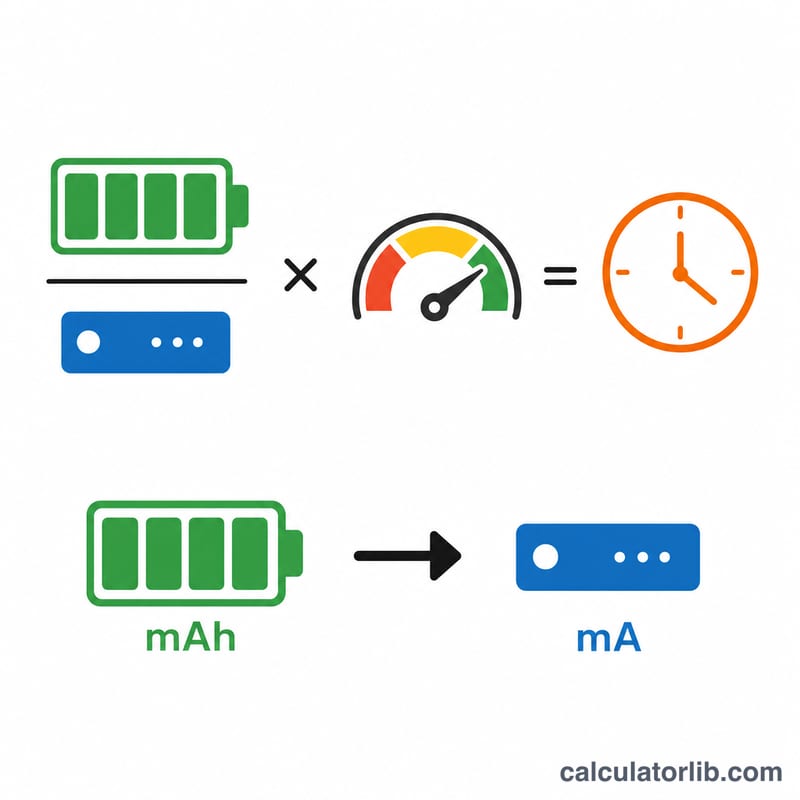
Runtime is calculated as $$\text{hours} = \frac{\text{capacity\_mAh}}{\text{load\_mA}} \times \text{efficiency}$$. Because capacity is in milliamp-hours and load is in milliamps, dividing them yields hours directly. The efficiency term (entered as a percentage and converted to a fraction) scales the ideal result down to a practical estimate.
Worked Example
A 2000 mAh battery powers a device drawing 100 mA at 85% efficiency: $$(2000 \div 100) \times 0.85 = 20 \times 0.85 = 17 \text{ hours}$$. That's about 17 h 0 min, or 1020 total minutes of runtime.
Runtime Across Common Scenarios
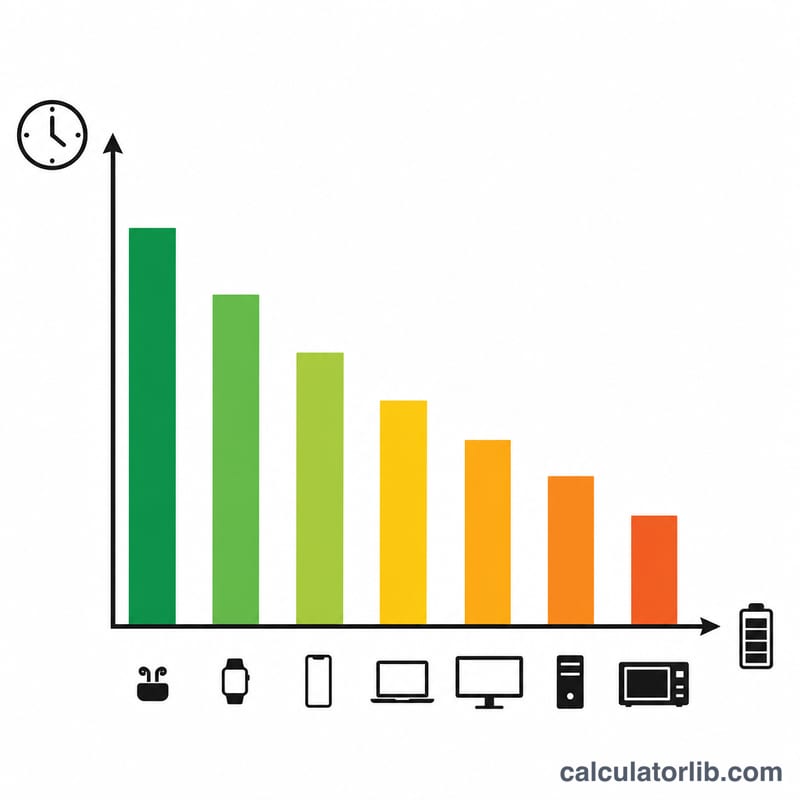
The table below shows estimated runtime for three capacities (1000, 2000 and 5000 mAh) against three loads (10, 100 and 500 mA), all at a realistic 85% efficiency. Efficiency accounts for losses such as voltage conversion, self-discharge and the fact that usable capacity is below the rated figure. The runtime formula is:
$$\text{Runtime (h)} = \frac{\text{Capacity (mAh)}}{\text{Load (mA)}} \times \frac{85}{100}$$| Capacity (mAh) | Load (mA) | Runtime (hours) | Runtime (h:min) |
|---|---|---|---|
| 1000 | 10 | 85.0 | 85 h 00 min |
| 1000 | 100 | 8.5 | 8 h 30 min |
| 1000 | 500 | 1.7 | 1 h 42 min |
| 2000 | 10 | 170.0 | 170 h 00 min |
| 2000 | 100 | 17.0 | 17 h 00 min |
| 2000 | 500 | 3.4 | 3 h 24 min |
| 5000 | 10 | 425.0 | 425 h 00 min |
| 5000 | 100 | 42.5 | 42 h 30 min |
| 5000 | 500 | 8.5 | 8 h 30 min |
Notice runtime scales directly with capacity and inversely with load: doubling capacity doubles runtime, while raising the load tenfold cuts runtime to one-tenth. High loads relative to capacity can also reduce efficiency below 85% due to higher internal voltage sag.
mAh, Wh and Current Conversions
mAh measures charge, not energy. To compare batteries at different voltages you convert to watt-hours (Wh). The key relationships are:
$$1\ \text{A} = 1000\ \text{mA} \qquad \text{Wh} = \frac{\text{mAh} \times \text{Voltage}}{1000} \qquad \text{mAh} = \frac{\text{Wh} \times 1000}{\text{Voltage}}$$Amps to milliamps
| Amps (A) | Milliamps (mA) |
|---|---|
| 0.01 | 10 |
| 0.1 | 100 |
| 0.5 | 500 |
| 1 | 1000 |
| 2 | 2000 |
mAh to Wh at common voltages
| Capacity (mAh) | Voltage | Energy (Wh) |
|---|---|---|
| 2000 | 3.7 V | 7.4 |
| 2000 | 5 V | 10.0 |
| 2000 | 12 V | 24.0 |
| 3000 | 3.7 V | 11.1 |
| 5000 | 3.7 V | 18.5 |
| 10000 | 3.7 V | 37.0 |
Example capacity conversions
A typical 18650 cell rated at 3000 mAh and 3.7 V stores about 11.1 Wh of energy. The same 11.1 Wh expressed at 5 V (a USB output) corresponds to 2220 mAh, which is why a 10000 mAh power bank delivers noticeably less than 10000 mAh at its 5 V USB port once you account for the voltage step-up and conversion losses.
FAQ
Why include an efficiency factor? Real batteries lose energy to internal resistance, voltage regulators, and temperature, so actual runtime is usually 80–90% of the theoretical value.
What if my device uses amps, not milliamps? Multiply amps by 1000 to convert to mA before entering the load (\(1\,\text{A} = 1000\,\text{mA}\)).
Does this account for voltage differences? No. mAh-based estimates assume the device and battery share a compatible voltage. For cross-voltage sizing, convert capacity to watt-hours (Wh) instead.