
What is the Battery Runtime Calculator?
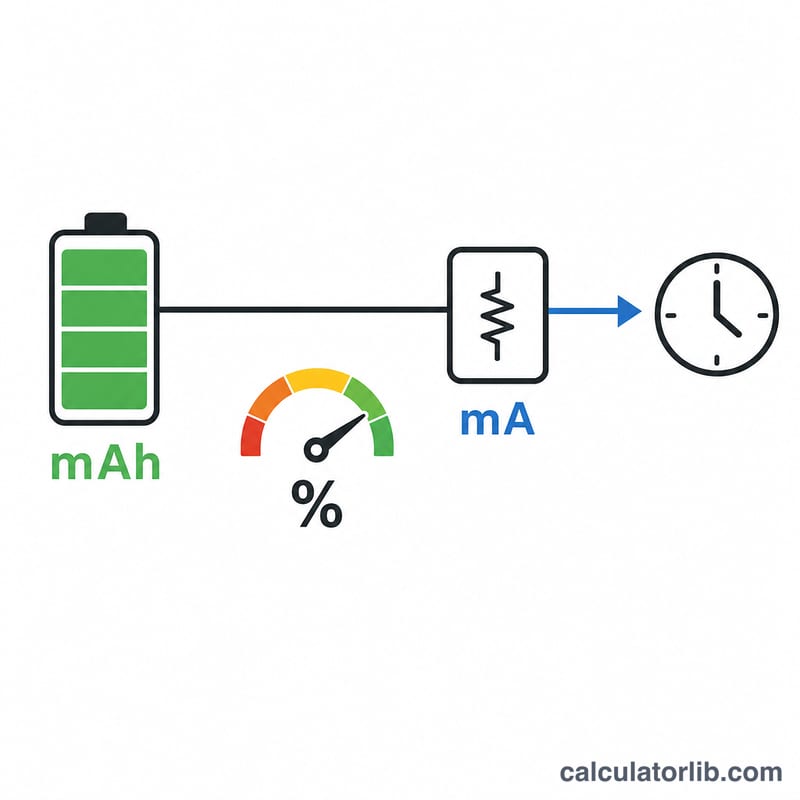
This tool estimates how long a battery will power a device before it needs recharging. It uses three inputs: the battery's rated capacity in milliamp-hours (mAh), the device's average current draw or load in milliamps (mA), and an efficiency factor that accounts for real-world losses such as heat, voltage regulation, and discharge curve inefficiencies. The result is an estimated runtime in hours and minutes.
How to use it
Enter your battery capacity (printed on most cells and power banks, e.g. 3000 mAh). Enter the current the device draws while running — check its datasheet or measure it with a USB power meter. Finally set an efficiency percentage; 100% is the ideal theoretical maximum, but 80–90% is realistic for most electronics. Press calculate to see your estimated runtime.
The formula explained
The core relationship is $$\text{Runtime} = \left(\frac{\text{Capacity}}{\text{Load}}\right) \times \text{Efficiency}$$. Capacity in mAh divided by load in mA gives the theoretical runtime in hours. Multiplying by the efficiency factor (a decimal between 0 and 1) reduces that figure to a realistic estimate. For example, a battery that theoretically lasts 15 hours at 85% efficiency will realistically last about 12.75 hours.
Worked example
Suppose you have a 3000 mAh battery powering a device that draws 200 mA, at 85% efficiency. The calculation is $$\left(\frac{3000}{200}\right) \times 0.85 = 15 \times 0.85 = 12.75 \text{ hours},$$ which is roughly 12 hours and 45 minutes.
Typical Battery Capacities and Device Current Draws
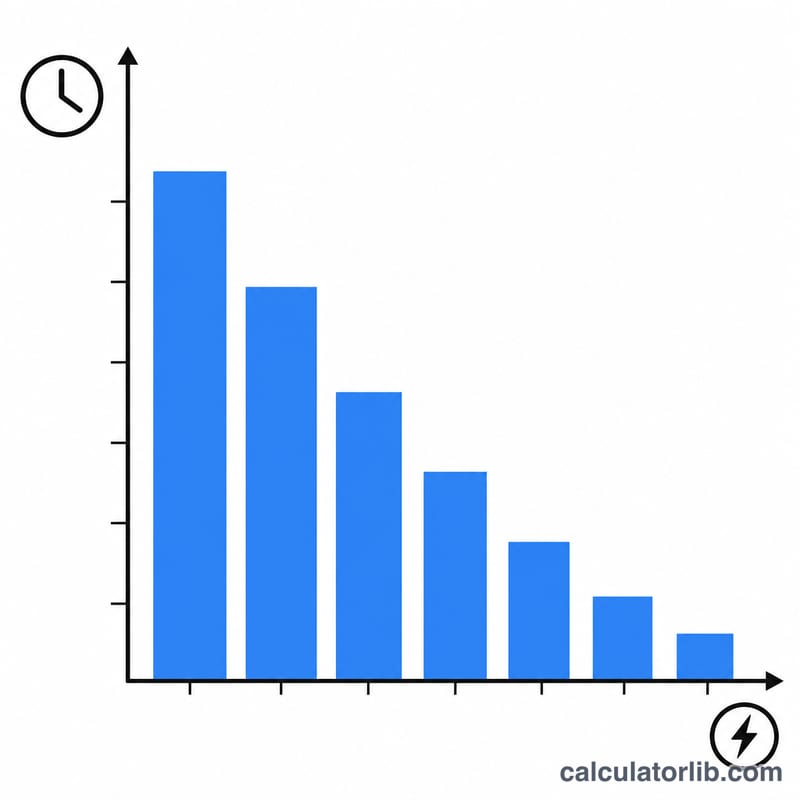
To estimate runtime you need two numbers: the battery's capacity in mAh and the device's average current draw (load) in mA. The tables below give realistic ranges so you can plug sensible values into the calculator. Always use the average current draw — many devices spike briefly but spend most of their time near idle.
Common battery capacities
| Battery type | Typical capacity (mAh) | Nominal voltage |
|---|---|---|
| AAA alkaline | ~1000–1200 | 1.5 V |
| AA alkaline | ~2000–3000 | 1.5 V |
| AA NiMH rechargeable | ~1900–2500 | 1.2 V |
| 18650 Li-ion cell | ~3000–3500 | 3.7 V |
| 21700 Li-ion cell | ~4000–5000 | 3.7 V |
| Smartphone battery | ~3000–5000 | 3.7–3.85 V |
| Tablet battery | ~6000–10000 | 3.7–3.85 V |
| Power bank | 10000–20000 | 3.7 V (cells) |
Typical current draw of common devices
| Device / load | Typical average draw (mA) |
|---|---|
| Standard indicator LED | ~20 |
| Bluetooth Low Energy (BLE) sensor | ~5–15 |
| Real-time clock / sleeping MCU | ~0.01–1 |
| ESP32 (Wi-Fi active) | ~120–240 |
| ESP32 (deep sleep) | ~0.01–0.15 |
| GPS tracker (active fix) | ~40–100 |
| Small DC hobby motor | ~100–500 |
| 5 V USB device @ 1 W (referred to 3.7 V cell) | ~270 |
Because Li-ion cells, power banks and phone batteries are rated at different voltages, comparing their capacities fairly often means converting mAh to watt-hours first — see the conversion section below.
Runtime Across Common Scenarios
Runtime is found by dividing capacity by load and then scaling by the efficiency factor:
$$\text{Runtime (h)} = \frac{\text{Capacity (mAh)}}{\text{Load (mA)}} \times \frac{\text{Efficiency (\%)}}{100}$$The efficiency factor (typically 80–90%) accounts for voltage conversion losses, self-discharge and the fact that you rarely extract 100% of rated capacity. Worked example for the first row: \( \frac{2000}{50} \times \frac{85}{100} = 40 \times 0.85 = 34 \) hours.
| Capacity (mAh) | Load (mA) | Efficiency | Runtime (h) | Hours + minutes |
|---|---|---|---|---|
| 2000 | 50 | 85% | 34.0 | 34 h 0 min |
| 3000 | 20 | 90% | 135.0 | 135 h 0 min |
| 5000 | 200 | 90% | 22.5 | 22 h 30 min |
| 10000 | 500 | 80% | 16.0 | 16 h 0 min |
| 3500 | 240 | 85% | 12.4 | 12 h 24 min |
| 10000 | 15 | 85% | 566.7 | 566 h 40 min |
Higher efficiency and lower load both extend runtime. For a deeper discharge-only model that uses depth-of-discharge instead of an efficiency factor, the same capacity-over-load relationship applies.
mAh, Wh and Voltage Conversions
Milliamp-hours only describe charge — they are not comparable across batteries of different voltage. To compare a 3.7 V phone cell with a 5 V USB rating or an 11.1 V pack, convert to watt-hours (Wh), which measure energy:
$$\text{Wh} = \frac{\text{Capacity (mAh)} \times \text{Voltage (V)}}{1000}$$| Capacity (mAh) | Voltage (V) | Energy (Wh) |
|---|---|---|
| 3000 | 3.7 | 11.1 |
| 5000 | 3.7 | 18.5 |
| 10000 | 3.7 | 37.0 |
| 2000 | 5.0 | 10.0 |
| 2200 | 11.1 | 24.42 |
Converting mAh from one voltage to another
When a power bank is rated at its internal cell voltage (3.7 V) but you charge a device at a higher output voltage (5 V), the usable mAh at the higher voltage drops in proportion to the voltage ratio (energy is conserved, minus conversion losses):
$$\text{mAh}_{V_2} = \text{mAh}_{V_1} \times \frac{V_1}{V_2}$$| Rated capacity | At voltage \(V_1\) | Converted to \(V_2\) | Equivalent capacity |
|---|---|---|---|
| 10000 mAh | 3.7 V | 5.0 V | 7400 mAh |
| 20000 mAh | 3.7 V | 5.0 V | 14800 mAh |
| 3000 mAh | 3.7 V | 5.0 V | 2220 mAh |
For example, a 10000 mAh power bank holds \(10000 \times 3.7 = 37000\) mWh of energy; delivered at 5 V that is \(37000 / 5 = 7400\) mAh before efficiency losses. After typical 85–90% conversion efficiency the figure that actually reaches your phone is lower still — which is why a 10000 mAh bank rarely charges a 4000 mAh phone more than about twice. You can reverse the process with a Wh-to-Ah conversion when a label only gives watt-hours.
FAQ
Why use an efficiency factor? Real batteries never deliver 100% of their rated capacity to the load. Conversion losses, voltage cutoffs, and self-discharge all reduce usable energy, so an efficiency of 80–90% gives more realistic numbers.
Does this account for voltage differences? No — this is a simple mAh-based estimate. If your battery and load operate at different voltages, convert to watt-hours (Wh) for an accurate comparison.
Can I use it for power banks and laptops? Yes for any device where you know capacity and average current draw. For laptops, capacity is often given in Wh; divide by the operating voltage to convert to mAh first.