
What is the Biologically Effective Dose?
The Biologically Effective Dose (BED) is a quantity used in radiation oncology to compare radiotherapy treatment schedules that differ in the number of fractions and the dose delivered per fraction. Because biological damage depends not only on the total physical dose but also on how that dose is split over time, BED provides a common scale for evaluating tumour control and normal-tissue effects. It is derived from the linear-quadratic (LQ) model of cell survival.
How to use this calculator
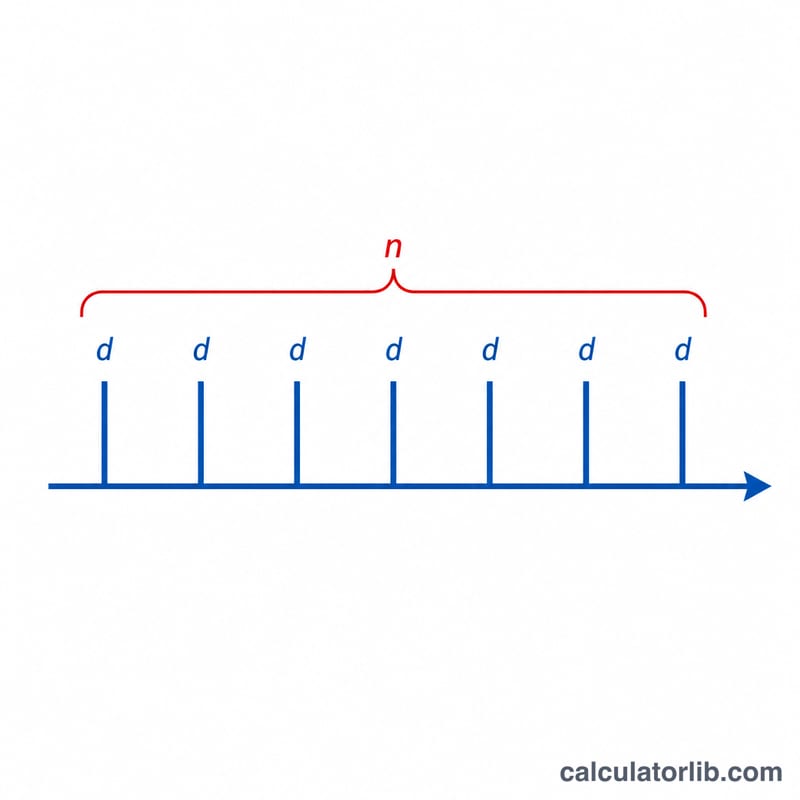
Enter the number of fractions (n), the dose delivered per fraction (d) in gray (Gy), and the α/β ratio for the tissue of interest. Typical α/β values are around 10 Gy for many tumours and acutely responding tissues, and 2–3 Gy for late-responding normal tissues. The calculator returns the BED, the total physical dose (\(n \times d\)), and the EQD2 — the equivalent dose if the treatment had instead been delivered in standard 2 Gy fractions.
The formula explained
The core equation is $$\text{BED} = \text{n} \cdot \text{d} \left(1 + \frac{\text{d}}{\text{α/β}}\right)$$ The term \(n \cdot d\) is the total physical dose, while the factor \(\left(1 + \frac{d}{\text{α/β}}\right)\) accounts for the extra biological effect of larger doses per fraction. EQD2 is obtained by dividing BED by \(\left(1 + \frac{2}{\text{α/β}}\right)\).
Worked example
Consider a common prostate-conventional schedule: 25 fractions of 2 Gy with α/β = 10 Gy. $$\text{BED} = 25 \times 2 \times \left(1 + \frac{2}{10}\right) = 50 \times 1.2 = 60 \text{ Gy}$$ The total physical dose is 50 Gy, and the $$\text{EQD2} = \frac{60}{1 + \frac{2}{10}} = 50 \text{ Gy}$$ confirming that a 2 Gy/fraction schedule equals its own EQD2.
Typical α/β Ratios by Tissue Type
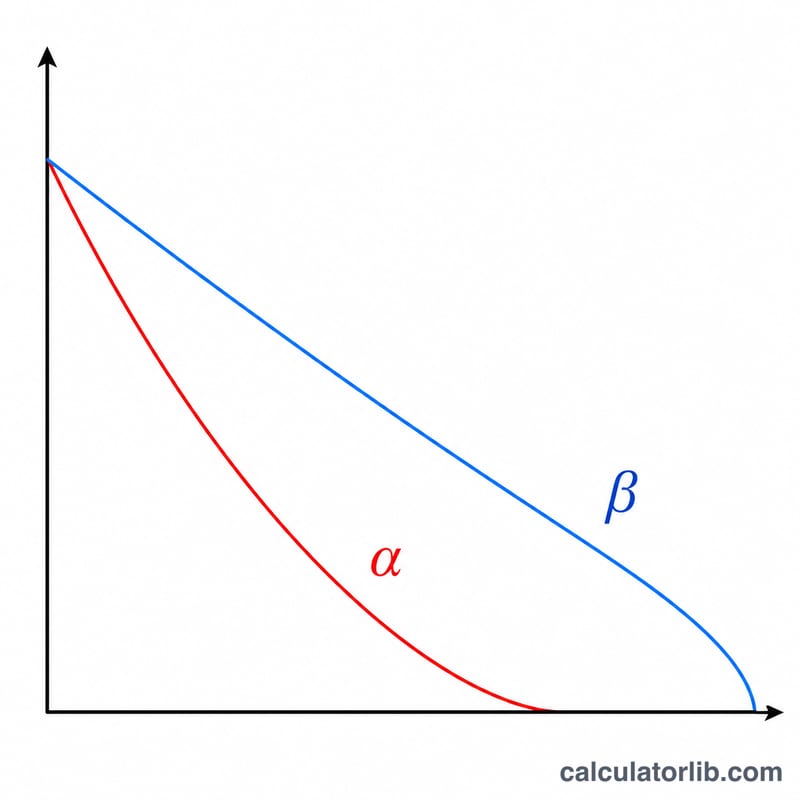
The α/β ratio (in gray, Gy) describes how sensitive a tissue is to changes in dose per fraction within the linear-quadratic model. A high α/β (≈10 Gy) is typical of tumours and acute (early)-responding tissues, which are relatively insensitive to fraction size. A low α/β (≈2–3 Gy) characterises late-responding normal tissues, which are more strongly affected by large fractions. The values below are widely cited clinical estimates and should be treated as approximate; published ranges vary between studies and individual patients.
| Tissue / endpoint | Response type | Typical α/β (Gy) |
|---|---|---|
| Most tumours / acute mucosa / skin | Acute (early) | ≈ 10 |
| Generic late normal tissue | Late | ≈ 2–3 |
| Prostate carcinoma | Tumour (low α/β) | ≈ 1.5 |
| Breast (tumour & cosmesis) | Mixed | ≈ 4 |
| Spinal cord (myelopathy) | Late | ≈ 2 |
| Lung (pneumonitis / fibrosis) | Late | ≈ 3 |
| Head & neck squamous cell carcinoma | Tumour | ≈ 10 |
| Brain (necrosis) | Late | ≈ 2–3 |
Note: These figures are clinical estimates used for planning comparisons, not exact biological constants. Always use the α/β value your institution adopts for a given endpoint.
Comparing Fractionation Schedules
The same total physical dose can produce very different biological effects depending on how it is divided into fractions. The table below uses the linear-quadratic formula \( \text{BED} = n\,d\left(1 + \dfrac{d}{\alpha/\beta}\right) \) with \(\alpha/\beta = 10\) Gy (tumour effect), and converts to the equivalent dose in 2 Gy fractions, \( \text{EQD2} = \text{BED} \big/ \left(1 + \dfrac{2}{\alpha/\beta}\right) \).
| Schedule (n × d) | Total dose (Gy) | BED₁₀ (Gy) | EQD2 (Gy, α/β=10) | Context |
|---|---|---|---|---|
| 25 × 2 Gy | 50 | 60 | 50 | Conventional fractionation |
| 15 × 2.67 Gy | 40.05 | 50.7 | 42.3 | Hypofractionated (e.g. breast) |
| 5 × 7 Gy | 35 | 59.5 | 49.6 | SBRT (moderate) |
| 3 × 18 Gy | 54 | 151.2 | 126 | SBRT (ablative, e.g. lung) |
| 1 × 24 Gy | 24 | 81.6 | 68 | Single-fraction SRS |
Notice that 25 × 2 Gy and 5 × 7 Gy deliver almost identical tumour BED (≈60 Gy) despite different total physical doses — the larger fraction size compensates for fewer fractions. Ablative SBRT schedules push BED far higher. Because late-responding tissues have a low α/β, the same large fractions raise their biological dose even more steeply, which is why normal-tissue constraints must be checked separately.
Key Terms & Variables
- BED (Biologically Effective Dose) — A measure of the true biological effect of a course of radiotherapy, computed as \( \text{BED} = n\,d\left(1 + \dfrac{d}{\alpha/\beta}\right) \). It allows different fractionation schedules to be compared on a common biological scale and is expressed in Gy (sometimes written Gy₁₀ to show the α/β used).
- EQD2 (Equivalent Dose in 2 Gy fractions) — The dose, given in standard 2 Gy fractions, that would produce the same biological effect: \( \text{EQD2} = \text{BED} \big/ \left(1 + \dfrac{2}{\alpha/\beta}\right) \). It is often more intuitive for clinicians than raw BED.
- n (number of fractions) — How many separate treatment sessions the total dose is divided into.
- d (dose per fraction) — The absorbed dose delivered in a single fraction, in Gy. Total physical dose = \( n \times d \).
- α/β ratio — The dose (in Gy) at which the linear (α) and quadratic (β) components of cell killing contribute equally. High values (~10 Gy) indicate acute/tumour tissue; low values (~2–3 Gy) indicate late-responding tissue.
- Linear-quadratic (LQ) model — The radiobiological model underlying BED, describing cell survival as \( S = e^{-(\alpha d + \beta d^2)} \), where the α term scales linearly with dose and the β term scales with the square of dose.
- Total physical dose — The simple sum of delivered dose, \( n \times d \) in Gy, without any biological weighting. Two schedules with equal total dose can differ greatly in BED.
- Late vs. acute responding tissue — Acute (early)-responding tissues (mucosa, skin, most tumours) react quickly and have high α/β. Late-responding tissues (spinal cord, lung, brain) show damage months to years later and have low α/β, making them more sensitive to large fraction sizes.
FAQ
What α/β should I use? Use the value appropriate to the tissue you are evaluating — roughly 10 Gy for tumours/acute tissues and 2–3 Gy for late-reacting tissues. Always confirm with clinical references.
Why is EQD2 useful? It lets you compare unconventional fractionation schemes against the widely used 2 Gy-per-fraction standard.
Is this a medical tool? This calculator is for educational and planning support only and does not replace clinical judgement or validated treatment-planning systems.