
What Is the Beer ABV Calculator?
This tool estimates the alcohol by volume (ABV) of beer, mead, cider, or wine from two hydrometer readings: the original gravity (OG) taken before fermentation and the final gravity (FG) taken after fermentation completes. It uses the most widely used homebrew formula and also reports apparent attenuation, a measure of how much sugar the yeast converted.
How to Use It
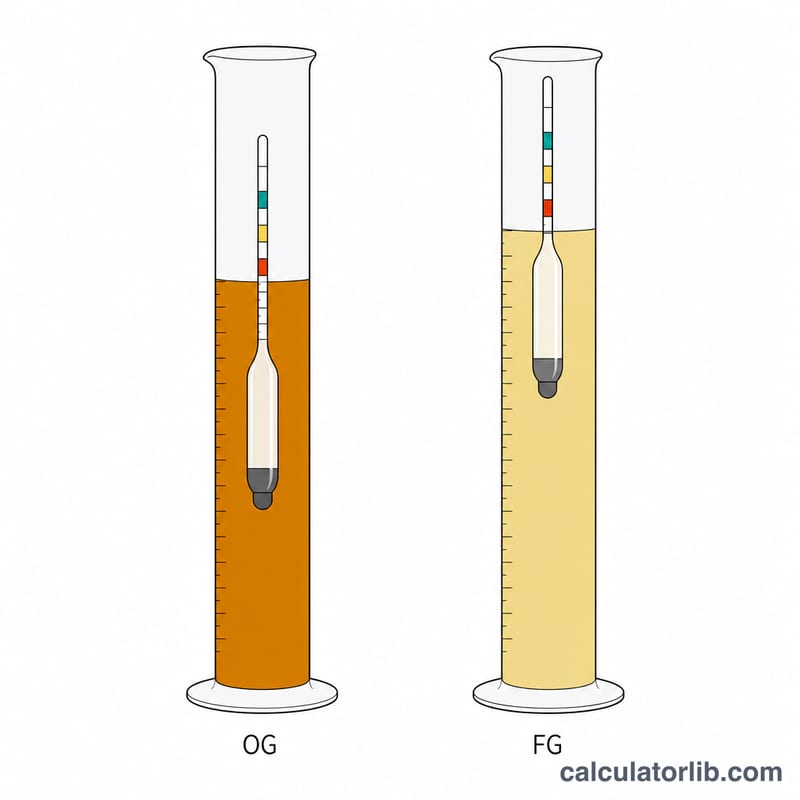
Take a gravity reading of your wort or must before pitching yeast — this is your OG (e.g. 1.050). After fermentation finishes, take another reading — this is your FG (e.g. 1.010). Enter both values and the calculator returns your estimated ABV. Make sure your hydrometer samples are at the calibration temperature for accuracy.
The Formula Explained
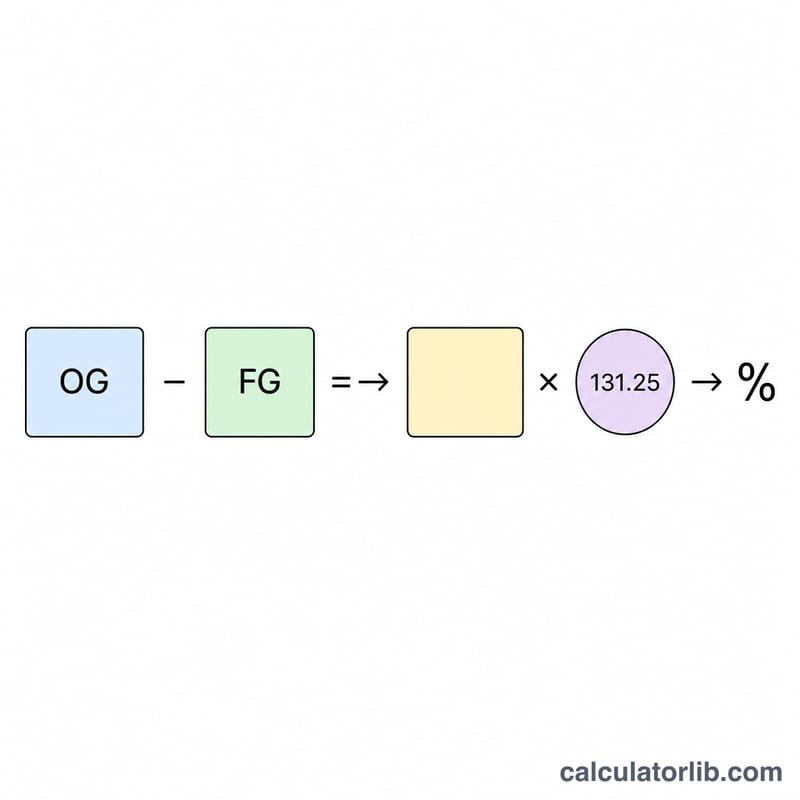
The standard equation is $$\text{ABV\%} = \left(\text{OG} - \text{FG}\right) \times 131.25$$. The constant 131.25 converts the drop in specific gravity into a percentage of alcohol. A larger gap between OG and FG means more sugar was fermented and therefore more alcohol. This simple formula is accurate to within a few tenths of a percent for most beers under about 7% ABV; stronger beers may read slightly low.
Worked Example
Suppose your beer started at OG 1.060 and finished at FG 1.012. $$\text{ABV\%} = \left(1.060 - 1.012\right) \times 131.25 = 0.048 \times 131.25 = 6.30\%\ \text{ABV}$$ The apparent attenuation is \(\frac{0.060 - 0.012}{0.060 - 0.000} \times 100 \approx 80\%\), a healthy figure for an ale.
Typical OG, FG and ABV Ranges by Beer Style
The original gravity (OG) is the density of the wort before fermentation, while the final gravity (FG) is the density after the yeast has converted most fermentable sugars into alcohol and CO₂. The difference between them, multiplied by 131.25, gives the approximate alcohol by volume. The table below lists representative gravity and ABV ranges for several well-known beer styles. Individual recipes vary, so treat these as broad guides rather than strict limits.
| Beer Style | Typical OG | Typical FG | Typical ABV |
|---|---|---|---|
| American Light Lager | 1.028–1.040 | 0.998–1.008 | 2.8–4.2% |
| American Lager | 1.040–1.050 | 1.004–1.010 | 4.2–5.3% |
| Pale Ale | 1.045–1.060 | 1.010–1.015 | 4.4–6.2% |
| IPA | 1.056–1.070 | 1.008–1.014 | 5.5–7.5% |
| Double / Imperial IPA | 1.065–1.085 | 1.008–1.018 | 7.5–10.0% |
| Porter | 1.048–1.065 | 1.012–1.016 | 4.5–6.5% |
| Dry Stout | 1.036–1.050 | 1.007–1.011 | 4.0–5.0% |
| Imperial Stout | 1.075–1.115 | 1.018–1.030 | 8.0–12.0% |
| Barleywine | 1.080–1.120 | 1.016–1.030 | 8.0–12.0%+ |
As a worked check, a Pale Ale fermented from an OG of 1.052 down to an FG of 1.012 yields \((1.052 - 1.012) \times 131.25 = \) 5.25% ABV, squarely within the style range.
Interpreting Your ABV and Attenuation
Your calculated ABV tells you how the finished beer compares with the target for its style. If a recipe aims for a 5.5% IPA but you measure 4.6%, fermentation likely stalled or the wort started thinner than planned; if it reads 7%, the wort was stronger or attenuated further than expected. Small deviations of a few tenths of a percent are normal given hydrometer precision and temperature corrections.
Apparent attenuation describes how much of the original gravity the yeast consumed, calculated as \(\text{AA} = \dfrac{\text{OG} - \text{FG}}{\text{OG} - 1} \times 100\%\). It is a key indicator of fermentation completeness and beer character:
- Low (≈ 65% or below): The beer finished sweeter and fuller-bodied. This can be intentional (e.g. malty styles) or a sign of underpitched, stressed, or stalled yeast, low fermentation temperature, or a mash run too hot, leaving more unfermentable sugars.
- Typical (70–80%): A healthy, complete fermentation for most ale and lager strains, giving balanced body and the expected ABV.
- High (80%+): A dry, crisp, thin-bodied beer. Common with highly attenuative yeasts, simple sugar additions, or low mash temperatures. Very high values may indicate a wild or diastatic contamination if unexpected.
Note that the linear formula \(\text{ABV} = (\text{OG} - \text{FG}) \times 131.25\) is most accurate for ordinary-strength beers up to roughly 6–7% ABV. For high-gravity beers (big stouts, barleywines, double IPAs), it tends to read slightly low because the relationship between gravity drop and alcohol produced becomes non-linear at higher sugar concentrations. Brewers often switch to an alternative formula such as \(\text{ABV} = \dfrac{76.08 \, (\text{OG} - \text{FG})}{1.775 - \text{OG}} \times \dfrac{\text{FG}}{0.794}\) for those stronger beers, which can give a result a few tenths of a percent higher.
ABV Across Sample OG/FG Scenarios
The table below applies the standard formula \((\text{OG} - \text{FG}) \times 131.25\) to several realistic gravity pairs, alongside the apparent attenuation each represents. These illustrate how both a bigger gravity drop and a stronger starting wort push ABV upward.
| OG | FG | ABV% | Apparent Attenuation |
|---|---|---|---|
| 1.040 | 1.010 | 3.94% | 75.0% |
| 1.050 | 1.012 | 4.99% | 76.0% |
| 1.065 | 1.015 | 6.56% | 76.9% |
| 1.075 | 1.018 | 7.48% | 76.0% |
| 1.090 | 1.020 | 9.19% | 77.8% |
For example, the third row substitutes as \((1.065 - 1.015) \times 131.25 = 0.050 \times 131.25 = 6.5625\%\), rounding to 6.56% ABV, with an apparent attenuation of \(\dfrac{1.065 - 1.015}{1.065 - 1} \times 100\% = 76.9\%\). Remember that for the strongest example (1.090 → 1.020) the linear result of 9.19% may understate the true ABV slightly, so a high-gravity formula is worth checking for big beers.
FAQ
Why is 131.25 used? It is an empirical constant that converts gravity points to alcohol percentage and gives reliable results for typical beer strengths.
Is there a more accurate formula? For high-gravity beers, alternative formulas such as \(\text{ABV} = \left(\frac{76.08 \times \left(\text{OG} - \text{FG}\right)}{1.775 - \text{OG}}\right) \times \frac{\text{FG}}{0.794}\) reduce error. This calculator uses the standard linear formula favored for everyday brewing.
What is apparent attenuation? It is the percentage of the original sugars (gravity points above 1.000) that the yeast fermented, indicating how dry or sweet the beer finished.