

What is the binomial coefficient?
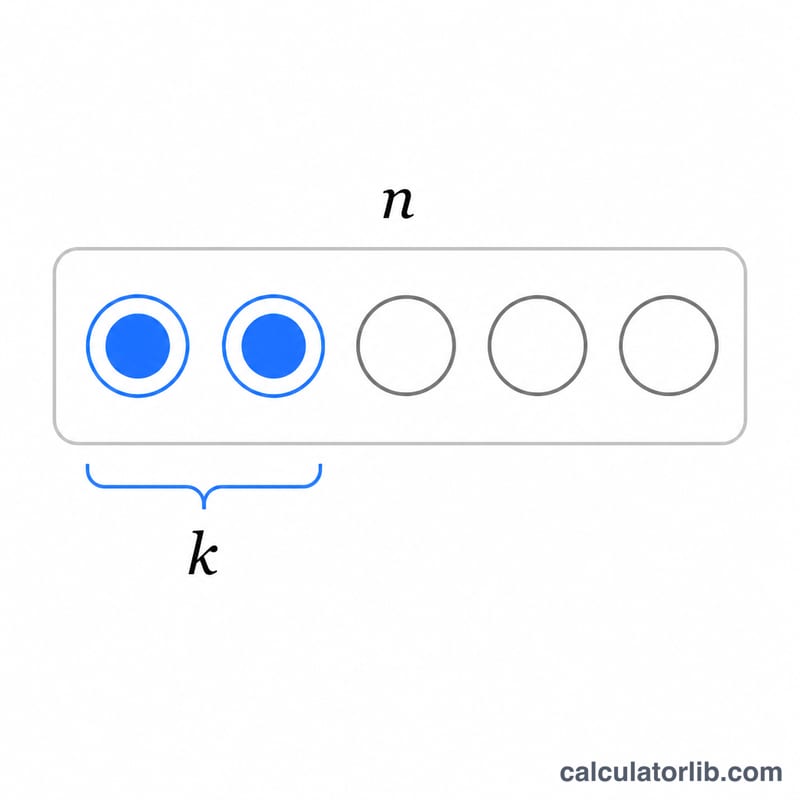
The binomial coefficient, written \(C(n, k)\) or "n choose k", counts the number of distinct ways to select k items from a set of n items when the order of selection does not matter. It is one of the most fundamental quantities in combinatorics and appears throughout probability, statistics, and algebra — including the binomial theorem, Pascal triangle, and the binomial probability distribution.
How to use this calculator
Enter the total number of items n and the number you want to choose k, then read off the result. The tool requires whole numbers with \(0 \le k \le n\). If k is larger than n, the coefficient is 0 because you cannot choose more items than exist.
The formula explained
The defining formula is $$C(n, k) = \frac{n!}{k!\left(n - k\right)!}$$ where "!" denotes the factorial. To avoid huge intermediate factorials, this calculator uses the efficient multiplicative form: it multiplies \((n - k + 1)\) through \(n\) and divides progressively by 1 through \(k\), and uses the symmetry \(C(n, k) = C(n, n - k)\) to keep the loop short.
Worked example
How many 3-card hands can be made from a 10-card deck? $$C(10, 3) = \frac{10!}{3! \cdot 7!} = \frac{10 \times 9 \times 8}{3 \times 2 \times 1} = \frac{720}{6} = \mathbf{120}$$ So there are 120 distinct combinations.
Pascal's Triangle Reference Table
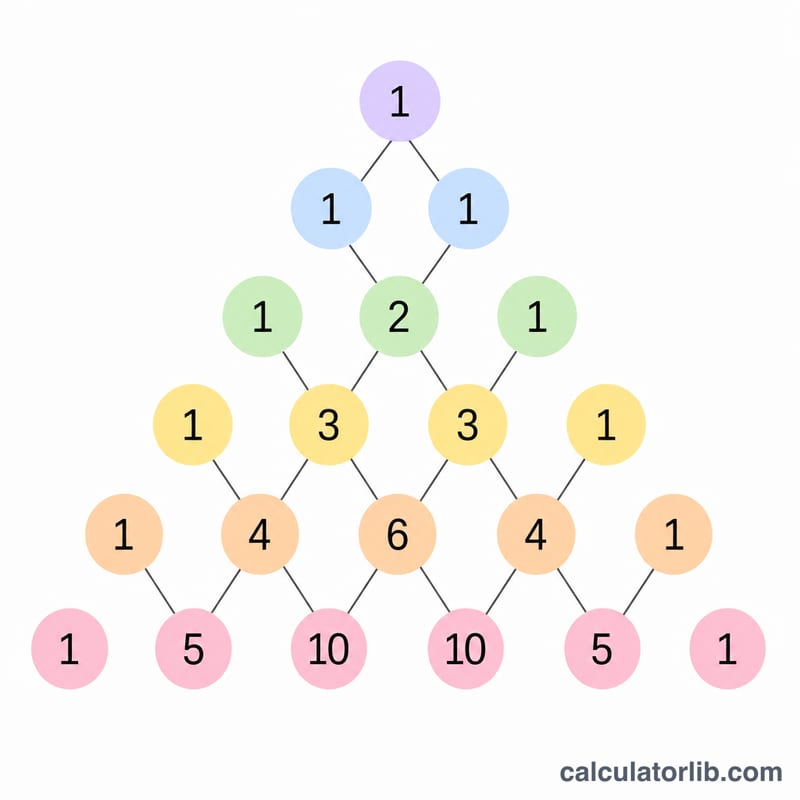
Each entry in Pascal's triangle is a binomial coefficient \(\binom{n}{k}\). Row \(n\) lists the values from \(k=0\) on the left to \(k=n\) on the right. Every interior value equals the sum of the two values directly above it, so \(\binom{n}{k}=\binom{n-1}{k-1}+\binom{n-1}{k}\). The rows below cover \(n=0\) through \(n=10\), letting you read off small coefficients directly.
| n | k=0 | 1 | 2 | 3 | 4 | 5 | 6 | 7 | 8 | 9 | 10 |
|---|---|---|---|---|---|---|---|---|---|---|---|
| 0 | 1 | ||||||||||
| 1 | 1 | 1 | |||||||||
| 2 | 1 | 2 | 1 | ||||||||
| 3 | 1 | 3 | 3 | 1 | |||||||
| 4 | 1 | 4 | 6 | 4 | 1 | ||||||
| 5 | 1 | 5 | 10 | 10 | 5 | 1 | |||||
| 6 | 1 | 6 | 15 | 20 | 15 | 6 | 1 | ||||
| 7 | 1 | 7 | 21 | 35 | 35 | 21 | 7 | 1 | |||
| 8 | 1 | 8 | 28 | 56 | 70 | 56 | 28 | 8 | 1 | ||
| 9 | 1 | 9 | 36 | 84 | 126 | 126 | 84 | 36 | 9 | 1 | |
| 10 | 1 | 10 | 45 | 120 | 210 | 252 | 210 | 120 | 45 | 10 | 1 |
Notice the symmetry: each row reads the same forwards and backwards because \(\binom{n}{k}=\binom{n}{n-k}\). The sum of every row \(n\) equals \(2^{n}\) — for example, row 10 sums to \(2^{10}=1024\).
More Worked Examples
These examples show full substitution into \(\binom{n}{k}=\dfrac{n!}{k!\,(n-k)!}\) so each result is easy to verify.
Example 1 — Poker hands: C(52,5)
How many distinct 5-card hands can be dealt from a 52-card deck? Order does not matter, so we use the binomial coefficient.
$$\binom{52}{5}=\frac{52!}{5!\,(52-5)!}=\frac{52\times51\times50\times49\times48}{5\times4\times3\times2\times1}=\frac{311{,}875{,}200}{120}$$
This gives 2,598,960 possible 5-card poker hands.
Example 2 — The boundary case C(6,6)
Choosing all 6 items from a set of 6 can be done in exactly one way — keep everything. Substituting \(k=n=6\):
$$\binom{6}{6}=\frac{6!}{6!\,(6-6)!}=\frac{6!}{6!\cdot 0!}=\frac{720}{720\times 1}=1$$
This relies on the convention \(0!=1\). The same logic gives \(\binom{n}{0}=1\) for any \(n\): there is exactly one way to choose nothing. So 1.
Example 3 — Symmetry: C(8,2) = C(8,6)
The identity \(\binom{n}{k}=\binom{n}{n-k}\) means choosing \(k\) items to include is equivalent to choosing the \(n-k\) items to leave out. Compute both sides for \(n=8\):
$$\binom{8}{2}=\frac{8!}{2!\,6!}=\frac{8\times7}{2\times1}=\frac{56}{2}=28$$
$$\binom{8}{6}=\frac{8!}{6!\,2!}=\frac{8\times7}{2\times1}=28$$
Both equal 28, confirming the symmetry property. Choosing 2 to keep from 8 is the same count as choosing the 6 to discard.
FAQ
Does order matter? No. For ordered selections (permutations) use \(\frac{n!}{(n-k)!}\) instead.
What is \(C(n, 0)\)? Always 1 — there is exactly one way to choose nothing.
What if \(k > n\)? The result is 0; you cannot choose more items than are available.