

What Is a Business Budget Calculator?
A business budget calculator helps you quickly see whether your company is operating at a profit or a loss. By entering your total revenue alongside your fixed and variable costs, it calculates your net budget — the cash remaining after every expense — and your profit margin as a percentage of revenue. This is useful for planning, forecasting, and spotting whether costs are eating into your bottom line.
How to Use It
Enter three numbers: Total Revenue (all income for the period), Fixed Costs (rent, salaries, insurance — costs that don't change with output), and Variable Costs (materials, shipping, commissions — costs that scale with activity). The calculator instantly returns your net budget and profit margin.
The Formula Explained
The math is straightforward:
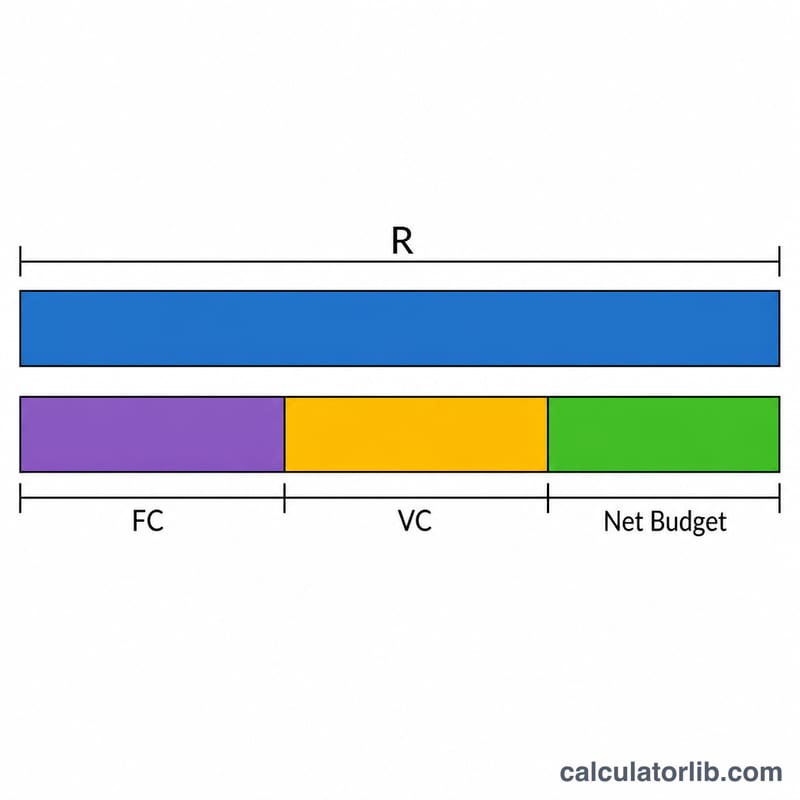
$$\text{Net Budget} = \text{Total Revenue} - \left(\text{Fixed Costs} + \text{Variable Costs}\right)$$
A positive result means profit; a negative result means a loss. The profit margin shows how much of every revenue dollar you keep:
$$\text{Profit Margin} = \left(\text{Net Budget} \div \text{Total Revenue}\right) \times 100$$
Worked Example
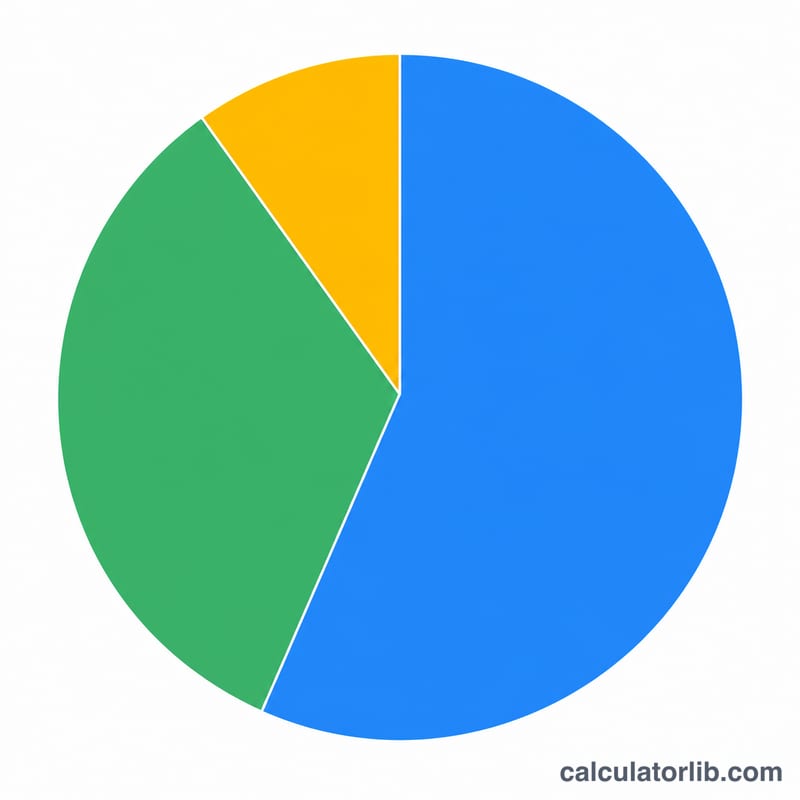
Suppose a small business earns $100,000 in revenue, with $40,000 in fixed costs and $25,000 in variable costs. Total costs are $65,000. Net budget = \(\$100{,}000 - \$65{,}000 = \$35{,}000\). Profit margin = \(\$35{,}000 \div \$100{,}000 \times 100 = 35\%\). The business keeps 35 cents of every dollar earned.
Profit Margin Across Business Scenarios
The net budget is found by subtracting total costs (fixed plus variable) from revenue, and the profit margin expresses that net budget as a percentage of revenue:
$$\text{Net Budget} = \text{Revenue} - (\text{Fixed Costs} + \text{Variable Costs})$$ $$\text{Profit Margin \%} = \frac{\text{Net Budget}}{\text{Revenue}} \times 100$$The table below shows four realistic business situations. For example, the high-margin service business earns \(120{,}000 - (30{,}000 + 18{,}000) = \) $72,000 net budget, which is a 60% margin.
| Scenario | Revenue | Fixed Costs | Variable Costs | Net Budget | Profit Margin % |
|---|---|---|---|---|---|
| High-margin service business | $120,000 | $30,000 | $18,000 | $72,000 | 60.0% |
| Low-margin retailer | $500,000 | $60,000 | $420,000 | $20,000 | 4.0% |
| Break-even startup | $90,000 | $40,000 | $50,000 | $0 | 0.0% |
| Loss-making business | $80,000 | $45,000 | $50,000 | −$15,000 | −18.75% |
Typical Profit Margins by Industry
Net profit margins vary widely by industry because of differences in cost structure, competition and capital intensity. The ranges below are broad, widely cited benchmarks to help you judge whether your calculated margin is typical for your sector. Actual results vary considerably by company size, region and business model.
| Industry | Typical net profit margin | Notes |
|---|---|---|
| Restaurants & food service | ~3% – 9% | High variable costs (food, labor); thin margins. |
| Retail (general) | ~2% – 6% | High cost of goods sold; volume-driven. |
| Grocery / supermarkets | ~1% – 3% | Very low margin, very high turnover. |
| Construction & contracting | ~3% – 7% | Project-based; material and labor heavy. |
| Professional services (legal, accounting, consulting) | ~10% – 20% | Labor-driven, low material cost. |
| Software / SaaS | ~15% – 30%+ | Low marginal cost per customer once built. |
Use these only as a rough yardstick. A margin below your industry range may signal pricing or cost problems, while one well above may reflect a strong niche, low overhead, or differences in how costs are categorized.
Interpreting Your Net Budget & Profit Margin
Positive vs. negative net budget
A positive net budget means revenue exceeds the sum of fixed and variable costs — the business has money left over (a surplus or profit) for that period. A net budget of zero is the break-even point: revenue exactly covers costs. A negative net budget means costs exceed revenue, producing a deficit (loss) that must be covered by reserves, financing or future profits.
What the margin percentage signifies
The profit margin restates the net budget relative to revenue, which makes businesses of different sizes comparable.
- Negative margin: the business loses money on its overall activity for the period.
- Low margin (roughly 0%–5%): little buffer; small increases in cost or drops in revenue can push the business into a loss. Common in high-volume, low-markup industries such as grocery and general retail.
- Moderate margin (roughly 5%–15%): a healthy cushion for many established businesses.
- High margin (roughly 15%+): strong profitability, often seen in software, licensing, or specialized services with low marginal costs.
Net budget vs. gross and operating margin
These terms measure profitability at different levels and are not interchangeable:
- Gross margin subtracts only the direct cost of goods or services (COGS) from revenue. It ignores overhead.
- Operating margin subtracts COGS plus operating expenses (overhead, salaries, rent) but typically excludes interest and taxes.
- Net budget / net margin as computed here subtracts all fixed and variable costs you enter, giving the bottom-line surplus or deficit. A true accounting net margin also accounts for items like interest, taxes and depreciation.
Because the gross figure only removes direct costs, gross margin is always equal to or higher than the net result. If your calculated net budget is positive but small, comparing it with your gross margin can show how much overhead is consuming.
This is general educational information, not professional financial advice. Consult a qualified accountant or financial advisor for decisions specific to your business.
FAQ
What's the difference between fixed and variable costs? Fixed costs stay the same regardless of sales volume (e.g. rent), while variable costs rise and fall with production or sales (e.g. raw materials).
What is a good profit margin? It varies by industry, but a net margin above 10% is generally considered healthy for many small businesses.
What if my net budget is negative? A negative net budget means your costs exceed revenue — you are operating at a loss and should review pricing or cut expenses.