

What Is the Annual Salary to Monthly Pay Calculator?
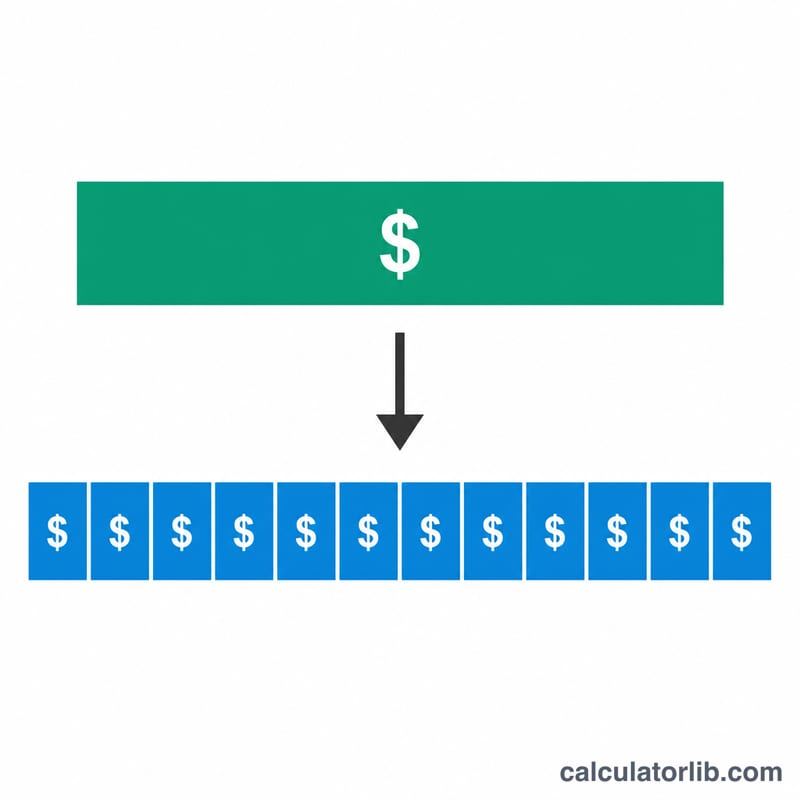
This calculator converts a yearly salary into the amount you earn each month. Many job offers and contracts state pay as an annual figure, but budgeting happens monthly. By dividing your annual salary by 12, you get a clear picture of your gross monthly income — the amount before taxes, insurance, and retirement deductions. The tool also shows biweekly and weekly equivalents so you can match it to your actual pay schedule.
How to Use It
Enter your gross annual salary and the calculator instantly displays your monthly pay, along with biweekly (26 pay periods per year) and weekly (52 weeks per year) breakdowns. These are pre-tax (gross) figures; your take-home pay will be lower after deductions, which vary by location and personal circumstances.
The Formula Explained
The core calculation is simple division:
$$\text{Monthly Pay} = \frac{\text{Annual Salary}}{12}$$
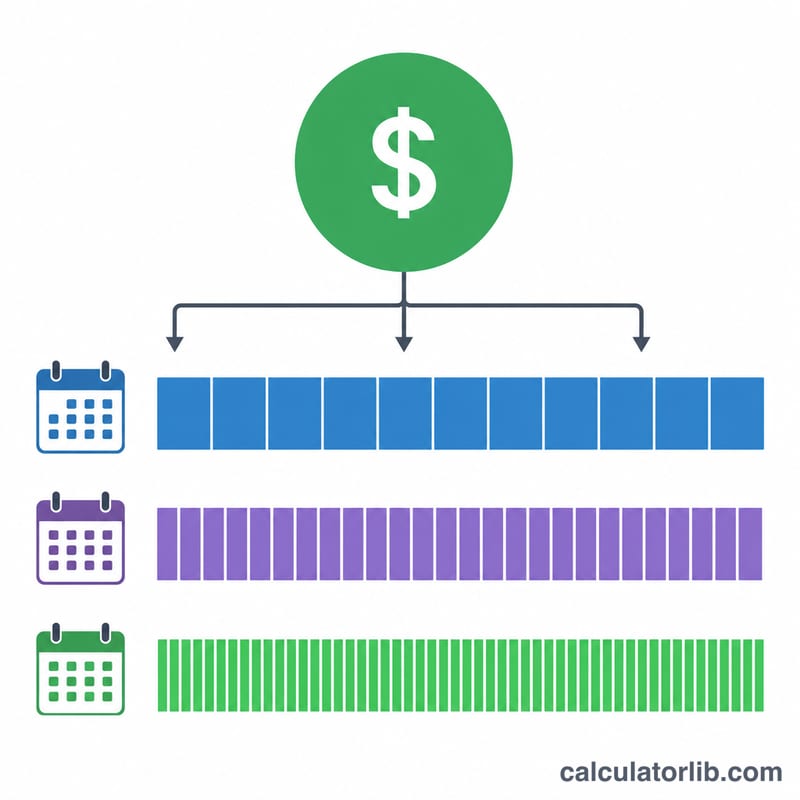
For other schedules we divide by the number of periods in a year: biweekly uses 26 (a pay date every two weeks), and weekly uses 52. Some employers use 24 semi-monthly periods instead of 26 biweekly — choose the breakdown that matches your payslip.
Worked Example
Suppose your annual salary is $60,000. Monthly pay = \(60{,}000 \div 12 = \mathbf{\$5{,}000}\). Biweekly pay = \(60{,}000 \div 26 \approx \mathbf{\$2{,}307.69}\). Weekly pay = \(60{,}000 \div 52 \approx \mathbf{\$1{,}153.85}\). These are gross amounts before any withholding.
FAQ
Is this my take-home pay? No. These are gross figures before taxes and deductions. Net pay depends on your tax bracket, benefits, and jurisdiction.
Why is biweekly not exactly half the monthly amount? Because there are 26 biweekly periods but only 12 months — biweekly pay is annual \(\div\) 26, which differs slightly from half of the monthly figure.
Can I go from monthly back to annual? Yes — just multiply your monthly pay by 12 to recover the annual salary.