
What This Calculator Does
The Discount Percentage Calculator tells you how much of a discount you are getting when you know the original (regular) price and the reduced (sale) price. Instead of guessing whether a "Was $80, Now $60" deal is a good one, you get the exact percent off and the dollar amount you save. This is useful for shoppers comparing deals, sellers setting promotions, and anyone reverse-engineering a markdown.
How to Use It
Enter the Regular Price (the price before any reduction) and the Sale Price (the price you actually pay). The calculator subtracts the two, divides by the regular price, and multiplies by 100 to express the saving as a percentage. It also shows the absolute amount saved.
The Formula Explained
The discount percentage is calculated as:
$$\text{discount\%} = \frac{\text{Regular Price} - \text{Sale Price}}{\text{Regular Price}} \times 100$$
The numerator is how much money you save, and dividing by the regular price expresses that saving relative to where the price started. Multiplying by 100 converts the decimal fraction into a percentage.
Worked Example
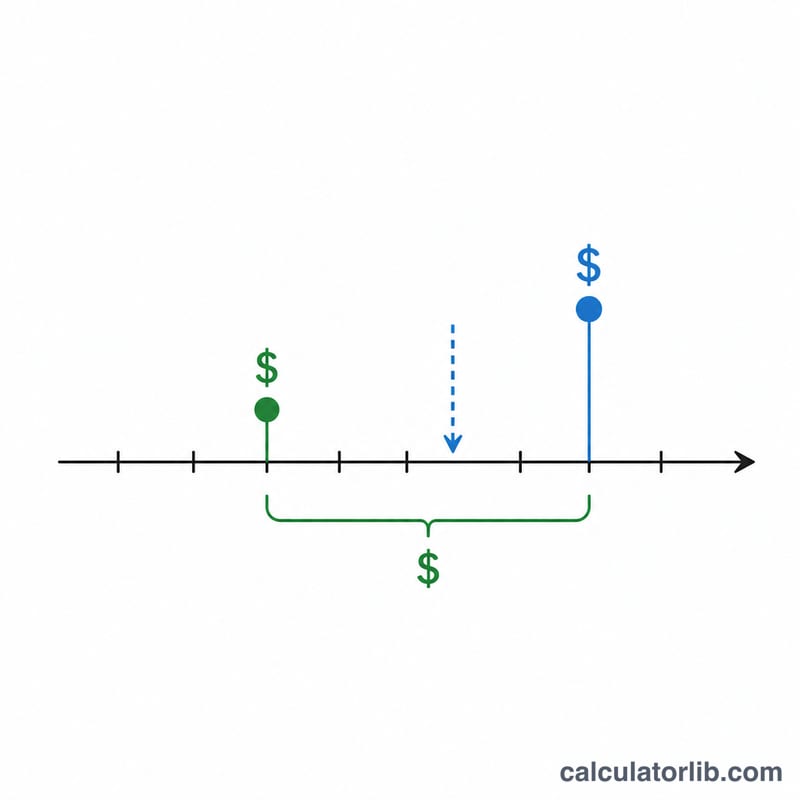
Suppose an item is normally $120 and is on sale for $90. The saving is \(\$120 - \$90 = \$30\). Dividing by the regular price gives \(\$30 / \$120 = 0.25\), and multiplying by 100 gives a 25% discount. So you are saving $30, which is a quarter off the original price.
FAQ
What if the sale price is higher than the regular price? The result will be negative, indicating a price increase (markup) rather than a discount.
Does this work in any currency? Yes. The percentage is currency-independent because it is a ratio; just keep both prices in the same currency.
Why divide by the regular price and not the sale price? A discount is always measured against the starting (original) price, so the regular price is the correct base.