
What This Percent Off Calculator Does
The Percent Off Calculator works out how much you save and what you actually pay when an item is discounted by a percentage. You enter two values — the original price and the discount percentage — and the tool instantly returns the dollar amount of the discount and your final price. It is ideal for sale shopping, clearance tags, coupon codes and quick mental-maths checks at the register.
The Two Inputs You Provide
- Original Price ($): the full, pre-discount price of the item. This must be zero or positive.
- Discount Percentage (%): the size of the markdown, entered as a number between 0 and 100. A "30% off" sticker means you enter 30.
If you enter a negative price, a negative percentage, or a percentage above 100, the calculator rejects the input as invalid, since none of those describe a real discount.
The Formula Explained
The calculator uses two simple steps:
- $$\text{Discount Amount} = \text{Original Price} \times \left(\frac{\text{Discount Percentage}}{100}\right)$$
- $$\text{Final Price} = \text{Original Price} - \text{Discount Amount}$$
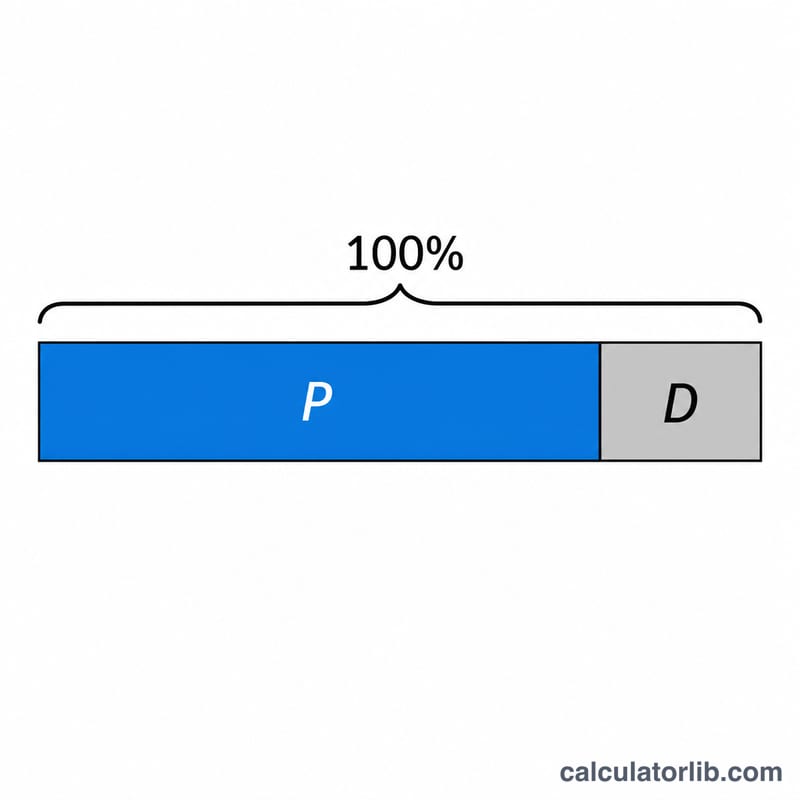
In other words, it converts the percentage to a decimal, multiplies it by the price to find your savings, then subtracts that from the original to give the price you pay.
Worked Example
Suppose a jacket is priced at $80 and is marked 25% off:
- $$\text{Discount Amount} = 80 \times \left(\frac{25}{100}\right) = 80 \times 0.25 = \$20$$
- $$\text{Final Price} = 80 - 20 = \$60$$
So you save $20 and pay $60. The calculator returns the original price, the discount percentage, the discount amount and the final price together so you can see the full breakdown at a glance.
Common Percent-Off Discounts at a Glance
The table below shows how common discount percentages reduce a handful of reference prices. Each cell pair lists the discount amount (what you save) and the final price (what you pay). The final price is found with \(\text{Final} = \text{Price} \times (1 - \frac{\text{Discount}}{100})\).
| Percent Off | $20 (save / pay) | $50 (save / pay) | $100 (save / pay) | $200 (save / pay) |
|---|---|---|---|---|
| 10% | $2.00 / $18.00 | $5.00 / $45.00 | $10.00 / $90.00 | $20.00 / $180.00 |
| 15% | $3.00 / $17.00 | $7.50 / $42.50 | $15.00 / $85.00 | $30.00 / $170.00 |
| 20% | $4.00 / $16.00 | $10.00 / $40.00 | $20.00 / $80.00 | $40.00 / $160.00 |
| 25% | $5.00 / $15.00 | $12.50 / $37.50 | $25.00 / $75.00 | $50.00 / $150.00 |
| 30% | $6.00 / $14.00 | $15.00 / $35.00 | $30.00 / $70.00 | $60.00 / $140.00 |
| 40% | $8.00 / $12.00 | $20.00 / $30.00 | $40.00 / $60.00 | $80.00 / $120.00 |
| 50% | $10.00 / $10.00 | $25.00 / $25.00 | $50.00 / $50.00 | $100.00 / $100.00 |
| 70% | $14.00 / $6.00 | $35.00 / $15.00 | $70.00 / $30.00 | $140.00 / $60.00 |
For example, a $100 item at 70% off leaves a final price of $30.00, with $70 in savings.
Comparing Discounts Across Scenarios
A higher percentage does not always mean a bigger dollar saving — the original price matters just as much. The scenarios below show how the same formula plays out across different real-world purchases.
| Scenario | Original Price | Percent Off | Discount Amount | Final Price |
|---|---|---|---|---|
| Mid-range item, moderate sale | $80.00 | 25% | $20.00 | $60.00 |
| Larger item, deep clearance | $120.00 | 40% | $48.00 | $72.00 |
| Half-price flash deal | $50.00 | 50% | $25.00 | $25.00 |
| Big-ticket, small discount | $200.00 | 15% | $30.00 | $170.00 |
Notice that the $200 item at only 15% off saves $30 — more in absolute dollars than the $80 item at 25% off, which saves $20. Verify the first row: \(80 \times (1 - \frac{25}{100}) = 80 \times 0.75 = 60\), a final price of $60.00.
Definitions & Glossary
Understanding a percent-off calculation is easier once the core terms are clear. The table and notes below define the quantities used by the Percent Off Calculator and a few closely related pricing terms.
| Term | Definition |
|---|---|
| Original price (list price) | The full, pre-discount price of an item before any reduction is applied. Also called the list price, regular price, or sticker price. In the formula this is the value entered in the price field. |
| Discount percentage | The rate of reduction expressed as a percent of the original price, entered in the discount field. A 25% discount means the price is cut by one quarter of its original value. |
| Discount amount (savings) | The dollar (or currency) value removed from the original price. It is found by multiplying the original price by the discount percentage divided by 100: \(\text{Savings} = \text{Price} \times \frac{\text{Discount}}{100}\). |
| Final price (sale price) | The amount you actually pay after the discount is subtracted. It equals the original price minus the discount amount, or equivalently \(\text{Price} \times \left(1 - \frac{\text{Discount}}{100}\right)\). For example, a $80 item at 25% off has a final price of $60. |
| Markdown | A retailer's term for a reduction from the original selling price, usually to clear inventory or run a promotion. A markdown expressed as a percentage of the original price is mathematically identical to a percent-off discount. |
| Net price | The price remaining after all applicable discounts have been deducted. With a single discount, the net price equals the final/sale price; with several stacked discounts it is the price after each has been applied in turn. |
| Percent off | The phrase used in advertising ("30% off") to describe the discount percentage applied to the original price. |
Note that a discount percentage is taken off the original price, not added back the same way: an item marked up 25% and then 25% off does not return to its starting price, because each percentage is applied to a different base amount.
Frequently Asked Questions
Does this include sales tax? No. The result is the pre-tax discounted price. Any local sales tax is applied on top of the final price shown here.
Can I enter a discount greater than 100%? No. The percentage must be between 0 and 100. A 100% discount makes the item free (final price $0), and anything higher is not a valid discount.
How do I find the percentage off if I only know the prices? This tool calculates the final price from a percentage, not the reverse. To find the percentage manually, divide the discount amount by the original price and multiply by 100 — for example, $20 saved on $80 equals 25% off.