
Use this easy-to-understand calculator to find the percentage difference between two numbers. Perfect for comparing values and seeing how much they have increased or decreased.
What Is Percentage Difference?
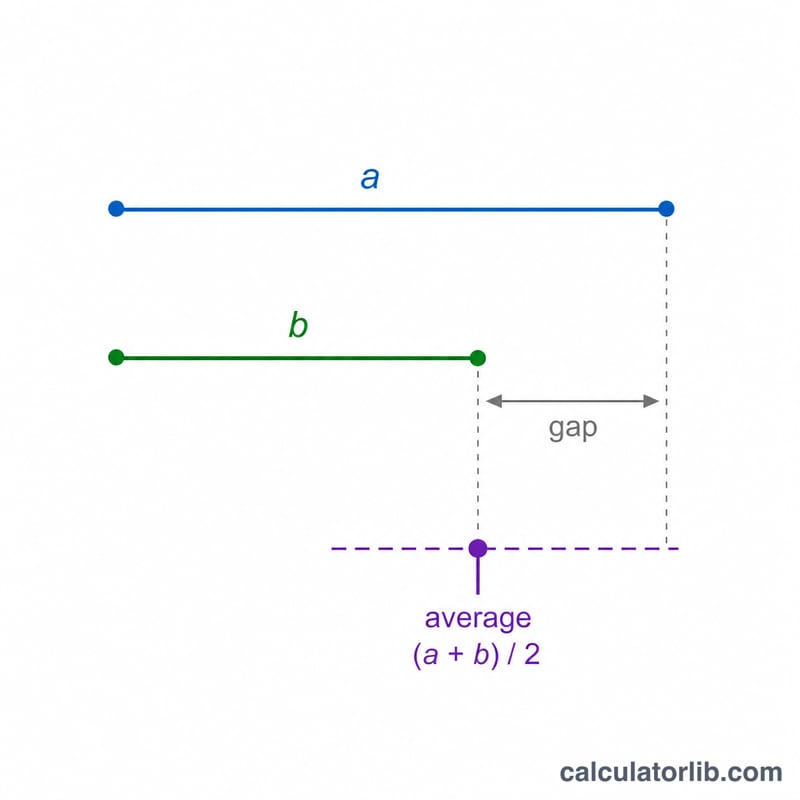
Percentage difference shows how two numbers differ, based on their average. It's helpful when measuring changes over time, such as growth or decline in data, prices, or values.
How to Calculate Percentage Difference
Follow these simple steps to calculate percentage difference:
- Find the average of the two numbers.
- Subtract the smaller number from the larger one to find the difference.
- Divide the difference by the average. This gives you a fraction of 100.
- Multiply the result by 100 (or times 100) to get the final percentage difference.
Example
Let’s say you want to compare 20 and 30:
- Average = \((20 + 30) \div 2 = 25\)
- Difference = \(30 - 20 = 10\)
- Fraction of 100 = \(10 \div 25 = 0.4\)
- Percentage Difference = \(0.4 \times 100 =\) 40%
Percentage Difference Formula
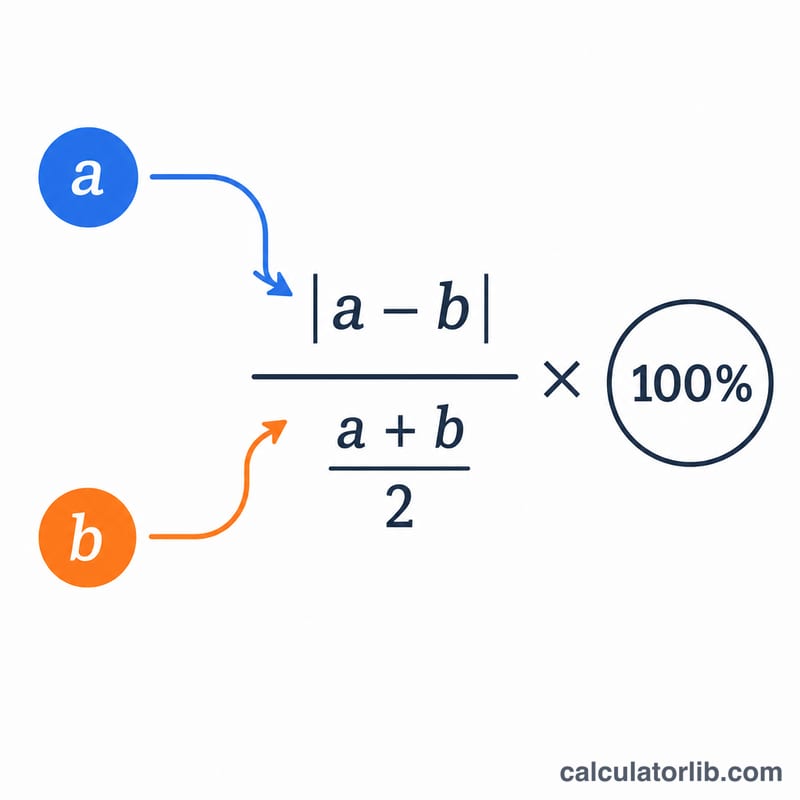
The standard percentage difference formula is:
$$\text{Difference} = \frac{\left| \text{Value}_1 - \text{Value}_2 \right|}{\dfrac{\text{Value}_1 + \text{Value}_2}{2}} \times 100\%$$This is also known as the percent change formula when comparing how much something has changed over time.
Why Use This Calculator?
This tool is helpful when you want to:
- Compare two numbers
- Understand the concept of percentages
- See if a value has increased or decreased
- Calculate growth or decline between two values
- Use it as a percent error calculator in scientific or financial applications
Common Use Cases
Whether you're a student trying to solve math problems, a business owner comparing profits, or someone analyzing data, this calculator makes it simple.
FAQ
What does “multiplied by 100” or “times 100” mean?
After dividing the difference by the average, we multiply that number by 100 to convert it into a percentage.
What does "fraction of 100" mean?
It's the decimal result you get before multiplying by 100. For example, 0.4 is a fraction of 100 that becomes 40% when multiplied.
Can this calculator handle negative and positive numbers?
Absolutely. It works with both negative and positive numbers. The calculation uses absolute values to give you a clear percentage difference, no matter the sign of the numbers.
Related Tools
More Worked Examples
Each example uses the average-based percentage difference formula:
$$\text{Difference} = \frac{\left| \text{Value}_1 - \text{Value}_2 \right|}{\dfrac{\text{Value}_1 + \text{Value}_2}{2}} \times 100\%$$Example 1 — A near-equal pair (50 and 52)
- Average: \((50 + 52) / 2 = 102 / 2 = 51\)
- Absolute difference: \(|50 - 52| = 2\)
- Division: \(2 / 51 = 0.03922\)
- Final percentage: \(0.03922 \times 100\% \approx\) 3.92%
Because the two numbers are close, the percentage difference is small.
Example 2 — A moderate pair (120 and 150)
- Average: \((120 + 150) / 2 = 270 / 2 = 135\)
- Absolute difference: \(|120 - 150| = 30\)
- Division: \(30 / 135 = 0.22222\)
- Final percentage: \(0.22222 \times 100\% \approx\) 22.22%
Example 3 — A widely-separated pair (10 and 90)
- Average: \((10 + 90) / 2 = 100 / 2 = 50\)
- Absolute difference: \(|10 - 90| = 80\)
- Division: \(80 / 50 = 1.6\)
- Final percentage: \(1.6 \times 100\% =\) 160%
When the two values are far apart, the percentage difference can easily exceed 100%.
Interpreting Your Percentage Difference
It is symmetric (order-independent). Because the formula divides the absolute difference by the average of the two numbers, swapping Value₁ and Value₂ gives exactly the same answer. There is no "first" or "reference" value — the two inputs are treated equally. This makes percentage difference ideal when neither number is more authoritative than the other, such as comparing two independent measurements or two readings of the same quantity.
It uses the average as the base, so it differs from percentage change. Percentage change (or percent increase/decrease) divides by a single starting value, so it answers "how much did this grow or shrink from the original?" and depends on which number you call the original. Percentage difference divides by the midpoint of the two values, so it answers "how far apart are these two values relative to their typical size?" For the pair 120 and 150, the percentage difference is about 22.2%, while the percentage increase from 120 to 150 is 25% and the percentage decrease from 150 to 120 is 20% — three different numbers describing the same pair from different viewpoints.
It can exceed 100%. When the two values are very far apart, the absolute difference can be larger than their average, pushing the result above 100% — as in 10 vs. 90, which gives 160%. The theoretical limit approaches 200%, which occurs as one value approaches zero while the other stays positive. A large percentage difference simply signals that the two values are very dissimilar relative to their average.
Frequently Asked Questions
What is the formula for percentage difference?
Percentage difference equals the absolute difference between two values divided by their average, multiplied by 100. Written out: |A − B| ÷ ((A + B) ÷ 2) × 100. The average in the denominator means neither value is treated as a reference point, so the result is the same regardless of order.
How is percentage difference different from percentage change?
Percentage difference compares two values symmetrically using their average as the base, so order does not matter. Percentage change measures how much one value increased or decreased from a specific starting value, dividing by that original number. Use difference when neither value is the reference, and change when comparing a new figure to an old one.
Can percentage difference be more than 100%?
Yes. Because the result divides the gap by the average of the two numbers, values that are far apart produce large percentages. For example, comparing 10 and 90 gives a 160% difference. The theoretical maximum approaches 200% when one value is near zero and the other is positive.
Does this calculator work with negative numbers?
Yes, you can enter negative or positive values. The calculator uses the absolute value of the difference in the numerator. Be cautious when the two numbers have opposite signs, since their average can be small or zero, which inflates or makes the percentage difference undefined.
Can you give an example of calculating percentage difference?
Compare 40 and 60. The absolute difference is 20, and the average is (40 + 60) ÷ 2 = 50. Divide 20 by 50 to get 0.4, then multiply by 100 for a 40% difference. Swapping the inputs to 60 and 40 gives the identical 40% result.
What does multiplying by 100 do in the formula?
Dividing the difference by the average produces a decimal fraction, such as 0.4. Multiplying by 100 converts that fraction into a percentage, turning 0.4 into 40%. It simply rescales the proportion so it is expressed per hundred, which is easier to read and compare than a raw decimal.
Related percentage calculators
- Percent Change Calculator — increase or decrease from an old value to a new one.
- Percentage Increase Calculator — how much a value went up, in percent.
- Percentage Decrease Calculator — how much a value went down, in percent.
- Percent Error Calculator — measured value vs. a known true value.