What Is the Price per Weight Calculator?
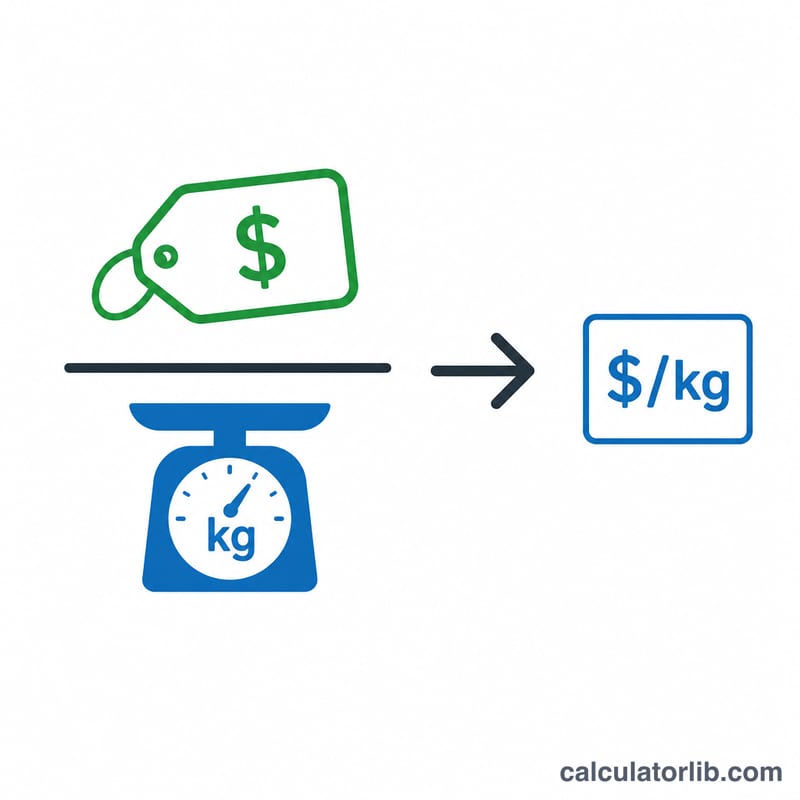
The Price per Weight Calculator converts a product's total price and total weight into a single, easy-to-compare unit cost — the price per kilogram, gram, pound, or ounce. It's the fastest way to answer the everyday shopping question: "Which package is actually cheaper?" Larger packs are not always better value, and this tool removes the guesswork.
How to Use It
Enter the total price you pay for the item, then enter how much it weighs and choose the matching weight unit. The calculator instantly returns the cost per single unit of that weight. To compare two products, run them separately and pick the one with the lower price per weight.
The Formula Explained
The math is a simple division:
$$\text{Price per Weight} = \frac{\text{Total Price}}{\text{Total Weight}}$$
If a 2 kg bag of rice costs $10, then the price per kilogram is \(10 \div 2 = 5\) per kg. Keep your price and weight in consistent units; the result is expressed per the unit you select.
Worked Example
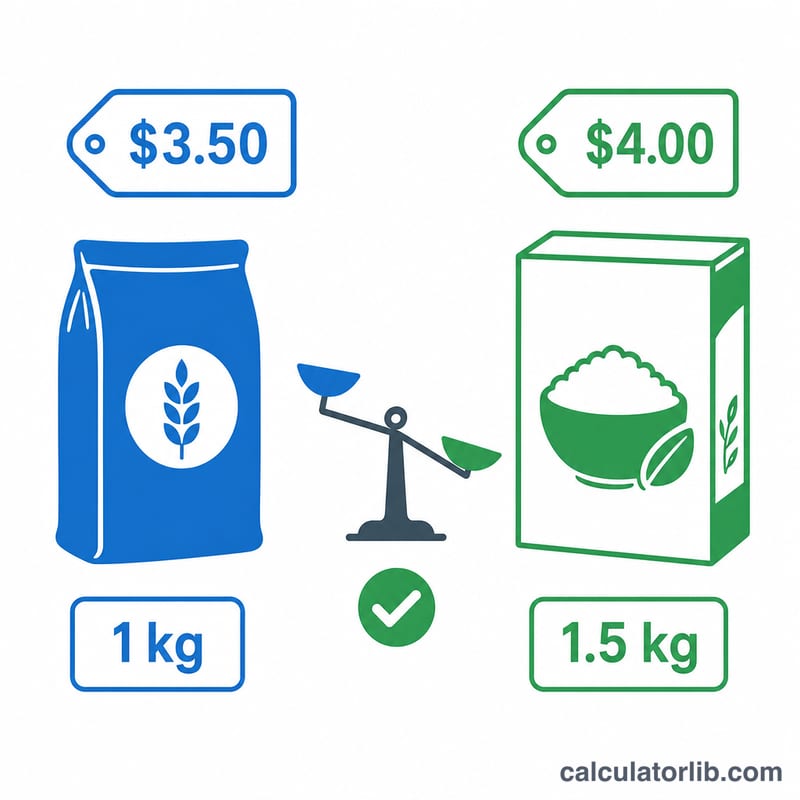
Suppose a block of cheese costs $7.50 and weighs 500 g. Enter 7.50 as the price, 500 as the weight, and select grams. The result is \(7.50 \div 500 = 0.015\) per gram (1.5 cents per gram). A competing 250 g block at $4.00 works out to \(0.016\) per gram — so the larger block is the better deal.
Weight Unit Conversion Table
Price per weight is only comparable when every figure is expressed in the same unit. The factors below are the internationally agreed values for the gram, kilogram and the avoirdupois ounce and pound (the ounce and pound used for food and general retail goods in the United States, the United Kingdom and other English-speaking markets — not the troy ounce used for precious metals).
| From | To | Multiply by | Notes |
|---|---|---|---|
| 1 kilogram (kg) | grams (g) | 1000 | Exact, by definition of the prefix kilo |
| 1 gram (g) | kilograms (kg) | 0.001 | Exact |
| 1 pound (lb) | ounces (oz) | 16 | Exact (avoirdupois) |
| 1 pound (lb) | grams (g) | 453.59237 | Exact, by international agreement (1959) |
| 1 ounce (oz) | grams (g) | 28.349523125 | Exact (453.59237 ÷ 16) |
| 1 kilogram (kg) | pounds (lb) | 2.20462 | Rounded; exact value is 1 ÷ 0.45359237 |
| 1 gram (g) | ounces (oz) | 0.035274 | Rounded |
| 1 kilogram (kg) | ounces (oz) | 35.27396 | Rounded |
Converting a price per unit
A unit price converts with the inverse logic of a weight. Because a kilogram contains 2.20462 pounds, one kilogram of a product costs 2.20462 times as much as one pound of it — so you multiply a price per pound by 2.20462 to get the price per kilogram:
$$\text{Price per kg} = \text{Price per lb} \times 2.20462$$| Have | Want | Operation | Example |
|---|---|---|---|
| Price per lb | Price per kg | × 2.20462 | $4.00/lb → $8.82/kg |
| Price per kg | Price per lb | × 0.453592 | $10.00/kg → $4.54/lb |
| Price per kg | Price per 100 g | ÷ 10 | $12.00/kg → $1.20/100 g |
| Price per 100 g | Price per kg | × 10 | $1.85/100 g → $18.50/kg |
| Price per kg | Price per g | ÷ 1000 | $16.00/kg → $0.016/g |
| Price per g | Price per kg | × 1000 | $0.0075/g → $7.50/kg |
| Price per lb | Price per oz | ÷ 16 | $3.20/lb → $0.20/oz |
| Price per oz | Price per lb | × 16 | $0.35/oz → $5.60/lb |
| Price per kg | Price per oz | ÷ 35.27396 | $14.00/kg → $0.397/oz |
Currency symbols are used here only to make the examples readable; the factors themselves are currency-independent.
Unit Cost Across Common Package Sizes
The prices below are illustrative examples chosen to show the arithmetic — they are not current market prices and will not match any particular shop, country or currency. Every unit cost is calculated directly from the stated price and weight, with pounds converted using the exact factor 1 lb = 0.45359237 kg.
| Item / package | Total price | Weight | Price per kg | Price per 100 g | Price per lb |
|---|---|---|---|---|---|
| Ground coffee, small bag | $8.99 | 500 g | $17.98 | $1.80 | $8.16 |
| Ground coffee, large bag | $16.50 | 1 kg | $16.50 | $1.65 | $7.48 |
| Block cheese, small | $4.00 | 250 g | $16.00 | $1.60 | $7.26 |
| Block cheese, large | $7.50 | 500 g | $15.00 | $1.50 | $6.80 |
| White rice, bag | $10.00 | 2 kg | $5.00 | $0.50 | $2.27 |
| All-purpose flour, bag | $4.29 | 5 lb (2.268 kg) | $1.89 | $0.19 | $0.858 |
| Honey, jar | $6.79 | 340 g | $19.97 | $2.00 | $9.06 |
| Honey, catering tub | $21.00 | 1 kg | $21.00 | $2.10 | $9.53 |
How two of these rows are calculated
Coffee, 500 g bag at $8.99. Convert the weight to kilograms first (500 g = 0.5 kg), then divide:
$$\text{Price per kg} = \frac{\$8.99}{0.5\ \text{kg}} = \$17.98\ \text{per kg}$$Dividing by 10 gives \(\$1.798 \approx \$1.80\) per 100 g, and multiplying the price per kg by 0.453592 gives \(\$17.98 \times 0.453592 = \$8.16\) per lb.
Flour, 5 lb bag at $4.29. Here the price per pound is the direct division, and the metric figures follow from the conversion:
$$\text{Price per lb} = \frac{\$4.29}{5\ \text{lb}} = \$0.858\ \text{per lb}$$$$\text{Price per kg} = \$0.858 \times 2.20462 = \$1.89\ \text{per kg}$$Note what the table shows about pack size. In these examples the bigger coffee bag, the bigger cheese block and the bigger rice bag all cost less per kilogram — but the 1 kg honey tub costs more per kilogram ($21.00) than the 340 g jar ($19.97). A larger package is not automatically the lower unit price, which is exactly why the calculation is worth doing.
Interpreting Your Price per Weight
The result answers one narrow question: how much currency you are paying for one unit of weight. For identical goods, a lower price per weight means you receive more product per unit of money. That is the whole of what the number tells you — everything else about the purchase sits outside the formula.
When the comparison is valid
Two unit prices can only be set side by side when four things match:
- Unit. A figure per 100 g and a figure per kilogram differ by a factor of 10; a figure per pound and one per kilogram differ by 2.20462. Convert before you compare.
- Currency. Unit prices in different currencies are not comparable until converted at a single exchange rate, and cross-border comparisons are also affected by local taxes and deposit schemes.
- Product form. Dry pasta, rice or beans weigh a fraction of their cooked weight; a concentrate or powder makes several times its own weight in ready-to-use product; frozen goods carry ice glaze. Comparing a concentrate per kilogram against a ready-to-drink product per kilogram is not a like-for-like comparison.
- Which weight is quoted. For canned goods in brine or syrup, the net weight and the drained weight can differ substantially, and only one of them is the food you eat.
Net, gross and shipping weight
Net weight is the contents alone and excludes the jar, tin, bag or tray. Gross weight (and the dimensional or shipping weight used to price freight) includes packaging, and for online orders may include filler and the outer carton. Unit prices built on a gross or shipping weight understate the real cost of the product itself, so use the declared net weight from the label wherever it is available.
Cross-checking against the shelf label
Many jurisdictions require retailers to display a unit price next to the selling price, which gives you a ready cross-check on your own calculation. In the European Union, Directive 98/6/EC requires the unit price to be indicated for products sold by weight or volume, typically per kilogram in metric markets, with per-100-g labelling common for small packs. Australia's Unit Pricing Code obliges large grocery retailers to show a unit price. In the United States there is no single federal grocery unit-pricing mandate; requirements are set state by state, with many following the model unit-pricing regulation published in NIST Handbook 130, and shelf tags are usually expressed per pound or per ounce. Rules, rounding conventions and the reference quantity used all vary by country, so check the tag's stated unit before assuming it matches your own.
What the number leaves out
Unit cost is blind to quality, grade, cut, origin, nutritional content and taste. It is also blind to freshness and shelf life: a cheaper price per kilogram is no saving if part of the quantity spoils, goes stale, or is thrown away as trim, bone, peel or other waste. Perishable goods, storage space, and whether the larger quantity will genuinely be used before its date all sit outside the calculation. For that reason, treat the figure as one input among several rather than a verdict.
This section explains what the calculation does and does not measure. It is general information only and is not purchasing, dietary or financial advice; decisions about what to buy remain yours.
FAQ
Can I compare different weight units? Convert both items to the same unit first (e.g. both per kg), or run each and mentally adjust. For a true comparison the units must match.
Does it handle any currency? Yes. The result is in whatever currency you enter for the price; the tool is currency-agnostic.
What if the weight is zero? Division by zero is undefined, so enter a positive weight greater than zero to get a meaningful result.