

What Is the Absence Percentage Calculator?
The Absence Percentage Calculator works out what proportion of your scheduled working days you were away from work. It is a simple but widely used metric in human resources, schools, and payroll for tracking absenteeism, monitoring attendance trends, and supporting Bradford Factor or return-to-work reviews. The tool is universal — it works for any country, role, or time period because it relies only on two raw counts.
How to Use It
Enter the number of days absent during the period and the total working days scheduled for the same period. The calculator instantly returns your absence percentage, your attendance percentage, and the number of days present. You can use any consistent time frame — a month, a quarter, or a full year — as long as both figures cover the same window.
The Formula Explained
The core calculation is straightforward:
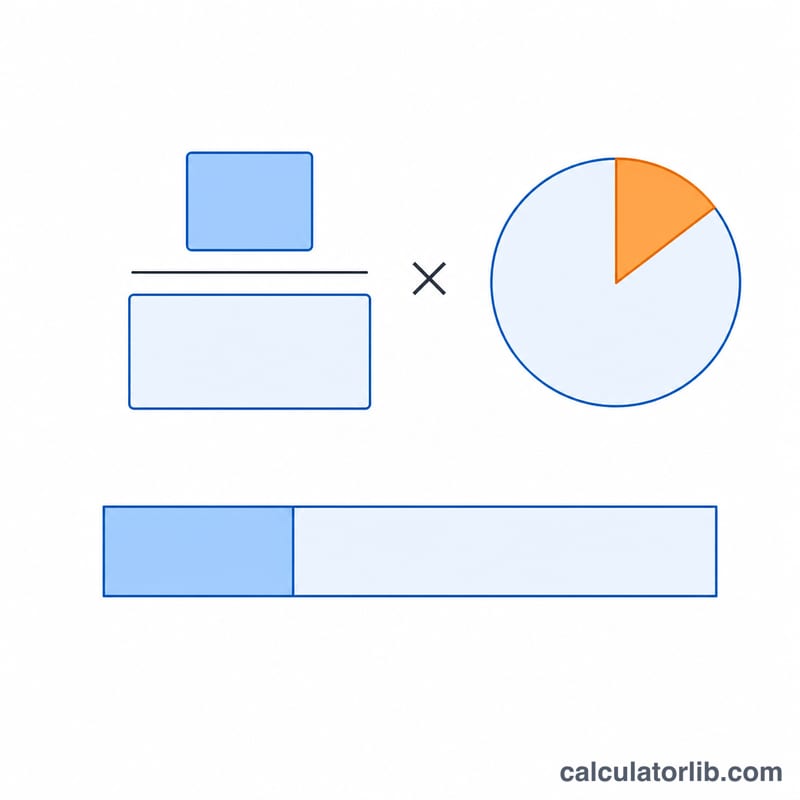
$$\text{Absence \%} = \frac{\text{Days Absent}}{\text{Total Working Days}} \times 100$$
Dividing absent days by the total scheduled days gives a fraction, and multiplying by 100 converts it to a percentage. The attendance percentage is simply \(100 - \text{Absence \%}\), and days present equals total working days minus days absent.
Worked Example
Suppose an employee was absent for 5 days out of 220 working days in a year. The absence percentage is $$(5 \div 220) \times 100 = 2.27\%.$$ That means attendance was 97.73%, with 215 days present. Most organisations consider an annual absence rate below about 2–3% to be healthy.
Absence Rate Across Common Scenarios
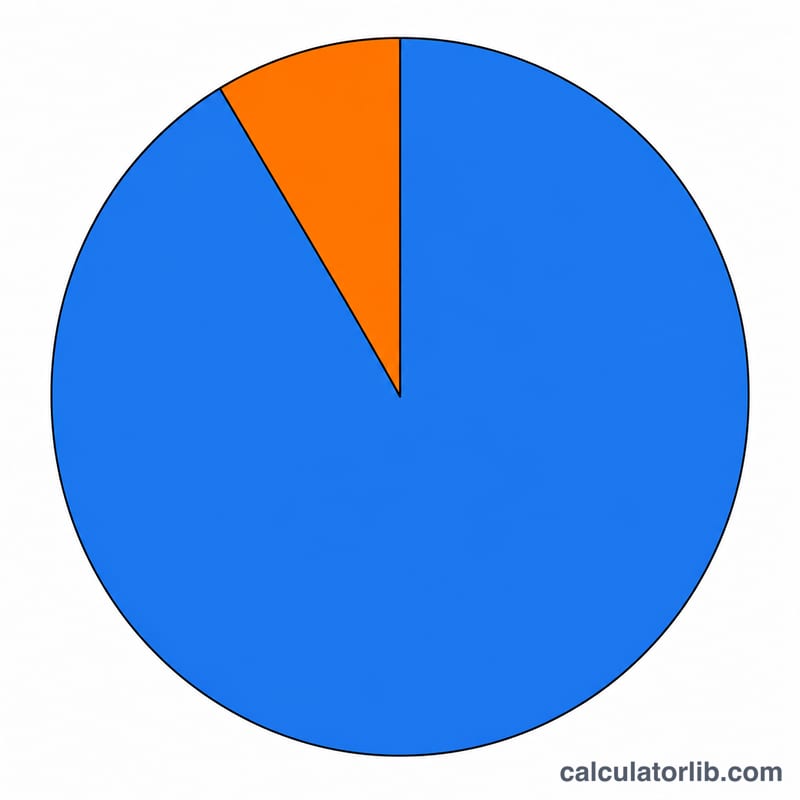
The absence percentage is the share of scheduled working days that an employee missed, calculated as days absent divided by total working days, multiplied by 100. The attendance rate is simply its complement (100% − absence %), and days present is total working days minus days absent. The table below works through four realistic cases — a short month, a full year, a near-full year, and a part-period example.
| Days Absent | Total Working Days | Absence % | Attendance % | Days Present |
|---|---|---|---|---|
| 2 | 22 | 9.09% | 90.91% | 20 |
| 5 | 220 | 2.27% | 97.73% | 215 |
| 12 | 250 | 4.80% | 95.20% | 238 |
| 0.5 | 20 | 2.50% | 97.50% | 19.5 |
For the year-long case of 5 days absent out of 220 working days, the calculation is:
$$\text{Absence \%} = \frac{5}{220} \times 100 = 2.27\%$$Half-day absences are handled the same way — 0.5 absent days out of 20 gives \(\frac{0.5}{20}\times100 = 2.50\%\), leaving 19.5 days present. Always use the same unit (whole days or fractional days) for both the numerator and the denominator.
FAQ
What counts as a working day? Only days you were actually scheduled to work. Weekends, public holidays, and contractual days off are usually excluded from the total.
Should I include partial days? Yes — you can enter decimals such as 2.5 days absent if your records track half-days.
What is a good absence percentage? It varies by industry, but national averages often sit around 2–4%. Lower is generally better, though context such as long-term illness matters.