
What Is the ABV from Gravity Calculator?
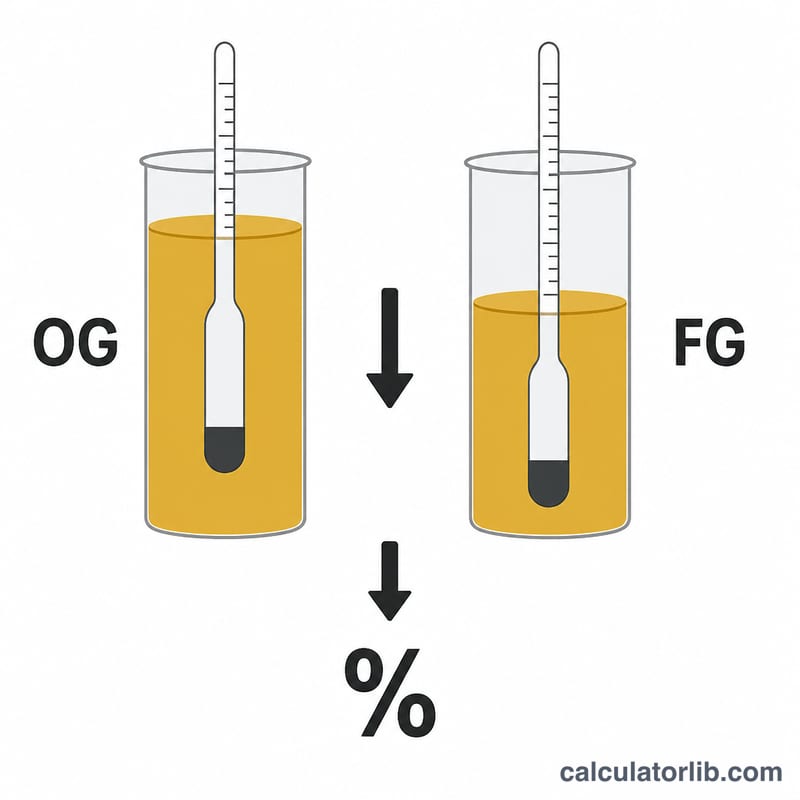
This tool estimates the alcohol by volume (ABV%) of a fermented beverage — beer, wine, mead, or cider — using two hydrometer readings: the original gravity (OG) taken before fermentation and the final gravity (FG) taken after fermentation completes. As yeast convert sugar into alcohol and CO₂, the density of the liquid drops, and the size of that drop tells you roughly how much alcohol was produced.
How to Use It
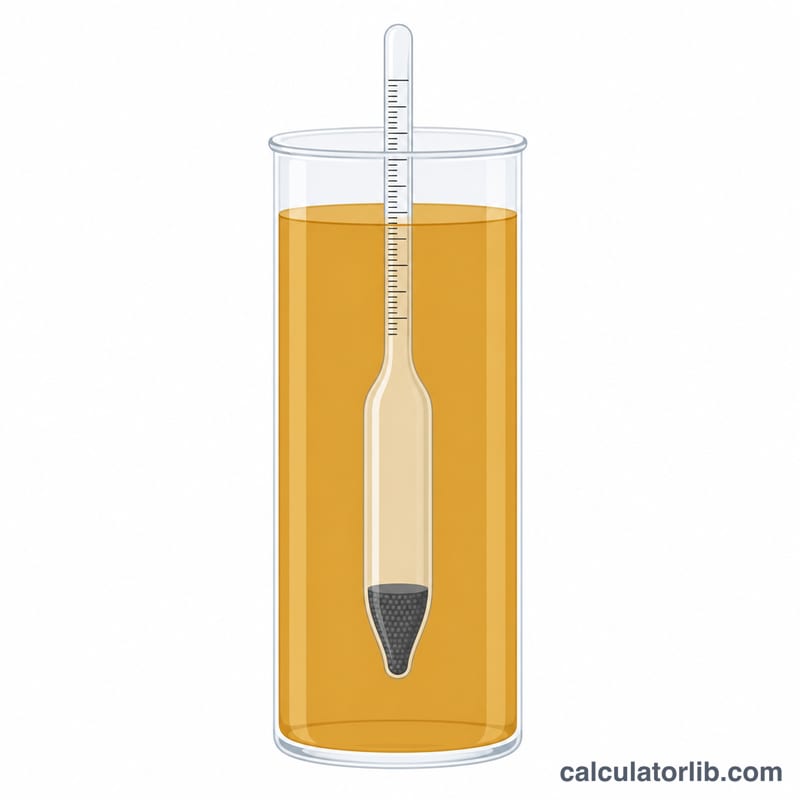
Take a hydrometer reading of your unfermented wort or must and enter it as the Original Gravity (for example, 1.050). After fermentation, take a second reading and enter it as the Final Gravity (for example, 1.010). The calculator returns the estimated ABV instantly.
The Formula Explained
The widely used homebrew formula is $$\text{ABV\%} = (\text{OG} - \text{FG}) \times 131.25$$. The constant 131.25 converts the change in specific gravity into a percentage of alcohol by volume. It is a simple linear approximation that works well for typical beer and wine ranges; very strong brews may benefit from more advanced equations, but this version is the industry standard for quick estimates.
Worked Example
Suppose your OG was 1.055 and your FG finished at 1.012. The gravity drop is \(1.055 - 1.012 = 0.043\). Multiply by 131.25: $$0.043 \times 131.25 \approx 5.64\% \text{ ABV}$$ That is a typical strength for a pale ale.
Typical OG, FG & ABV Ranges by Beverage Style
The simple formula \(\text{ABV} = (\text{OG} - \text{FG}) \times 131.25\) estimates alcohol by volume directly from your hydrometer readings. Different beverage styles start at characteristic original gravities (OG) and finish at characteristic final gravities (FG), producing the ABV ranges below. Values are typical guidelines; individual recipes vary.
| Style | Typical OG | Typical FG | Typical ABV% |
|---|---|---|---|
| Session / pale ale | 1.040 – 1.050 | 1.008 – 1.012 | 3.8% – 5.5% |
| IPA | 1.055 – 1.075 | 1.010 – 1.016 | 5.5% – 7.5% |
| Stout | 1.045 – 1.075 | 1.010 – 1.020 | 4.5% – 7.5% |
| Dry wine | 1.080 – 1.100 | 0.990 – 0.998 | 11% – 14% |
| Sweet wine | 1.090 – 1.130 | 1.010 – 1.030 | 9% – 14% |
| Mead | 1.090 – 1.140 | 0.995 – 1.020 | 10% – 18% |
| Cider | 1.045 – 1.065 | 0.998 – 1.005 | 5% – 8.5% |
For example, a pale ale fermenting from OG 1.048 to FG 1.010 yields \((1.048 - 1.010) \times 131.25 = \) 4.99% ABV.
ABV Across Different OG/FG Scenarios
The table below applies \(\text{ABV} = (\text{OG} - \text{FG}) \times 131.25\) to a range of realistic gravity pairs, from a light session beer up through a strong wine or mead. The gravity drop is simply \(\text{OG} - \text{FG}\).
| OG | FG | Gravity drop (OG − FG) | ABV% | Example beverage |
|---|---|---|---|---|
| 1.040 | 1.008 | 0.032 | 4.20% | Session beer |
| 1.050 | 1.010 | 0.040 | 5.25% | Standard ale |
| 1.090 | 1.020 | 0.070 | 9.19% | Strong ale / sweet mead |
| 1.110 | 1.000 | 0.110 | 14.44% | High-gravity wine / dry mead |
Notice that doubling the gravity drop roughly doubles the ABV — the relationship is linear under this estimator. The \(\times 131.25\) constant is an empirical factor that works well up to about 6–7% ABV; for very high-gravity brews (above ~1.090 OG), a more refined formula tends to give slightly higher, more accurate results.
Attenuation and Its Effect on ABV
Attenuation describes how much of the original sugar the yeast consumed during fermentation. Apparent attenuation is calculated from your gravity readings as:
$$\text{Apparent Attenuation} = \frac{\text{OG} - \text{FG}}{\text{OG} - 1} \times 100\%$$Because the numerator (OG − FG) is the same gravity drop that drives the ABV formula, attenuation and ABV move together: a more attenuated fermentation finishes at a lower FG, producing a larger gravity drop and therefore a higher ABV.
| OG | FG | Apparent attenuation | ABV% | Interpretation |
|---|---|---|---|---|
| 1.050 | 1.018 | 64% | 4.20% | Under-attenuated — high residual sweetness |
| 1.050 | 1.012 | 76% | 4.99% | Well-attenuated — balanced |
| 1.050 | 1.008 | 84% | 5.51% | Highly attenuated — dry finish |
As a rough guide, an apparent attenuation under about 65% is considered under-attenuated and may taste sweet or under-fermented, while a typical, well-attenuated beer lands in the 75–85% range. Highly attenuated drinks (above ~85%) finish dry. If your FG stalls higher than expected, both your attenuation and your ABV will be lower than the recipe target.
FAQ
What does specific gravity mean? It is the density of your liquid compared to water (1.000). Sugary wort is denser than water, so readings are above 1.000.
Why is my reading higher than a lab result? The 131.25 constant is an approximation. Temperature, sampling, and hydrometer calibration all introduce small errors.
Can I use this for wine and mead? Yes. The same OG/FG formula applies to any sugar-based fermentation, though higher-gravity batches may read slightly low.