
What Is the AI Water Footprint Calculator?
Running large AI models consumes electricity, and the data centers that host them use significant amounts of water for cooling. Every prompt you send to a chatbot or image generator carries a small but real water cost. This calculator estimates the total water footprint of your AI usage based on the number of queries you make and an estimated amount of water consumed per query.
How to Use It
Enter the total number of AI queries (prompts) you want to estimate, then enter the water consumed per query in milliliters (mL). Published estimates vary widely depending on the model, hardware, and data-center location, but a commonly cited figure is roughly 10–50 mL per query (the default here is 30 mL). The calculator returns the total water footprint in liters, the raw amount in milliliters, and an equivalent count of 500 mL bottles.
The Formula Explained
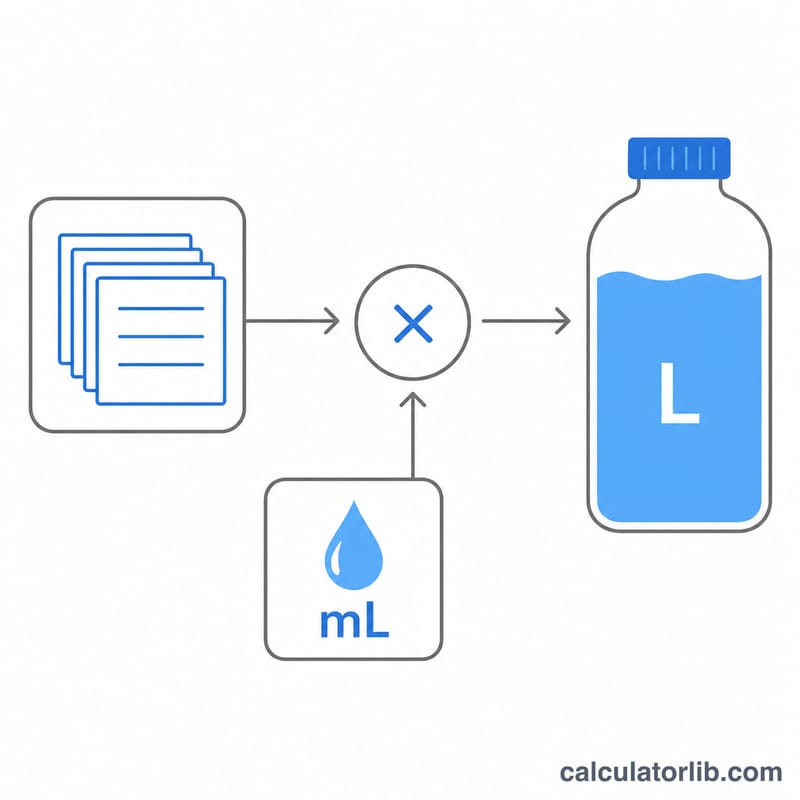
The math is straightforward: multiply the number of queries by the water used per query (in mL), then divide by 1000 to convert milliliters to liters.
$$\text{Water (L)} = \dfrac{\text{queries} \times \text{water per query (mL)}}{1000}$$
The bottle equivalent simply divides the liter result by 0.5, since a standard small water bottle holds 500 mL.
$$\text{Bottles} = \dfrac{\text{Water (L)}}{0.5}$$
Worked Example
Suppose you make 1,000 queries and assume each uses 30 mL of water. Then: \(1{,}000 \times 30 = 30{,}000\) mL, divided by 1000 = 30 liters. That is equivalent to \(30 \div 0.5 = 60\) standard 500 mL bottles of water.
Estimated Water Use Per Query by Model Type
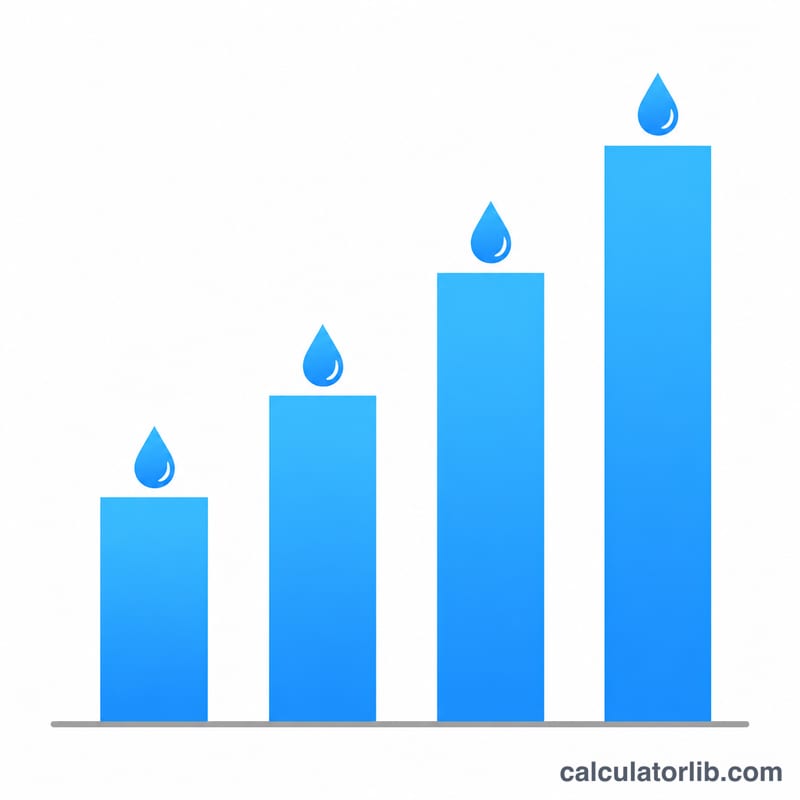
The water footprint of an AI query comes mainly from two sources: the water evaporated to cool the data-center servers (on-site) and the water used to generate the electricity that powers them (off-site). Published estimates vary widely because they depend on the model size, the request length, the local climate, and how efficiently the facility recovers heat. The most commonly cited figures for a typical text exchange fall in the 10–50 mL range — the equivalent of roughly a tablespoon to a small shot glass of water per interaction.
The values below are order-of-magnitude estimates intended for rough planning only. They are not precise measurements, and a single query can plausibly fall outside these bands.
| Query type | Efficient data center (mL) | Typical data center (mL) | Less efficient / hot climate (mL) |
|---|---|---|---|
| Short text prompt (a few words, brief reply) | 5 | 15 | 30 |
| Standard chatbot query (a paragraph in, a paragraph out) | 10 | 25 | 50 |
| Longer conversation / document analysis | 30 | 60 | 120 |
| Image generation (single image) | 40 | 80 | 150 |
As a worked example, sending 200 standard chatbot queries at 25 mL each consumes \( \frac{200 \times 25}{1000} = \) 5 liters. The same 200 queries on an efficient facility at 10 mL each would use only 2 liters — illustrating how strongly the per-query assumption drives the total.
Interpreting Your Result
Your result is the estimated total water associated with the queries you entered, expressed in liters. To put liters into everyday terms: a standard single-use water bottle holds about 0.5 L, so a result of 5 L is roughly ten bottles, and a 1.5 L result is about three bottles. Many guidelines suggest an adult drinks on the order of 2–3 L of water per day, so you can also compare your figure against a day or two of personal drinking water to get an intuitive sense of scale.
Keep three things in mind when reading the number:
- It is an order-of-magnitude estimate. The per-query water value is an assumption, not a meter reading. Doubling or halving that input directly doubles or halves your total, so the result is best treated as a rough range rather than a precise quantity.
- Location and model matter enormously. A query served from a cool-climate, water-efficient facility can use a small fraction of the water of the same query in a hot region that relies on evaporative cooling. The specific model and request length also change the underlying energy — and therefore the water — considerably.
- The figure includes more than cooling. A complete water footprint reflects both the water evaporated for on-site cooling and the water embedded in generating the electricity the servers consume. The split between these depends on the local power grid and climate.
Because so much of the impact traces back to electricity, the same activity also carries a carbon footprint. If you want to explore the energy side, you can estimate the emissions of the electricity involved with an electricity carbon footprint calculator once you have an estimated kWh figure.
This tool provides general informational estimates only and is not a substitute for measured data from a specific provider or facility.
FAQ
How much water does one AI query really use? Estimates differ a lot by source and model. Figures from around 10 mL to 50 mL per query are commonly cited, so treat this as an order-of-magnitude estimate rather than an exact value.
Why does AI use water at all? Data centers use water mainly for cooling servers, and electricity generation also consumes water upstream. Both contribute to the footprint.
Can I lower my AI water footprint? Making fewer, more efficient queries and using smaller models when possible reduces compute, which reduces both energy and water demand.