
What is the ABV Calculator?
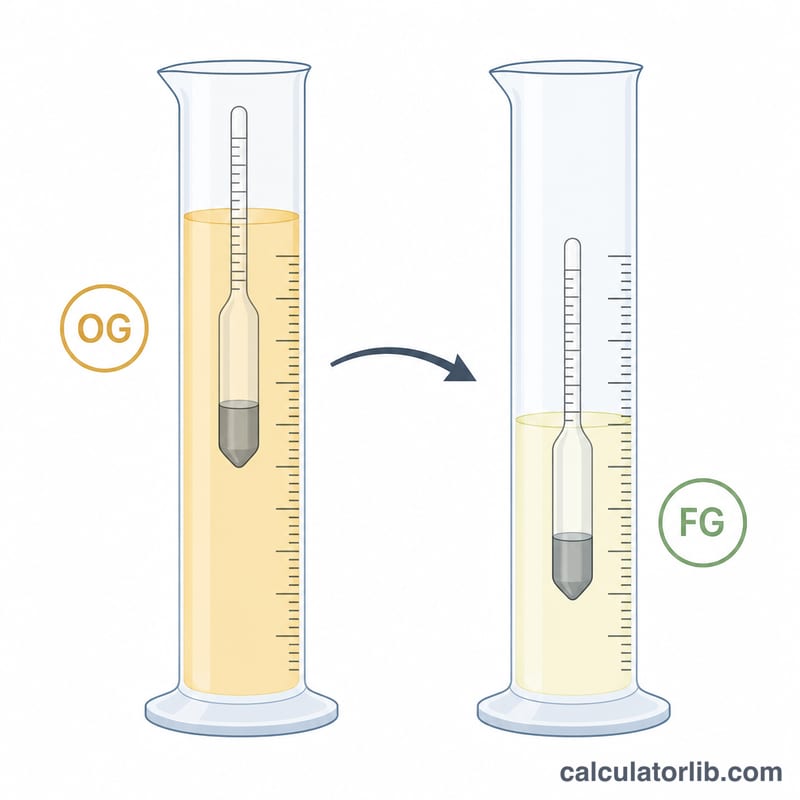
The Alcohol By Volume (ABV) calculator estimates the percentage of alcohol in a fermented beverage — beer, wine, cider, or mead — based on two hydrometer readings: the original gravity (OG) taken before fermentation and the final gravity (FG) taken after fermentation. As yeast consumes sugar and produces alcohol, the density of the liquid drops, and that change reveals how much alcohol was created.
How to use it
Take an OG reading with a hydrometer or refractometer before pitching yeast (e.g. 1.050). After fermentation completes, take an FG reading (e.g. 1.010). Enter both values and the calculator returns the estimated ABV percentage along with apparent attenuation, which shows how much of the available sugar was fermented.
The formula explained
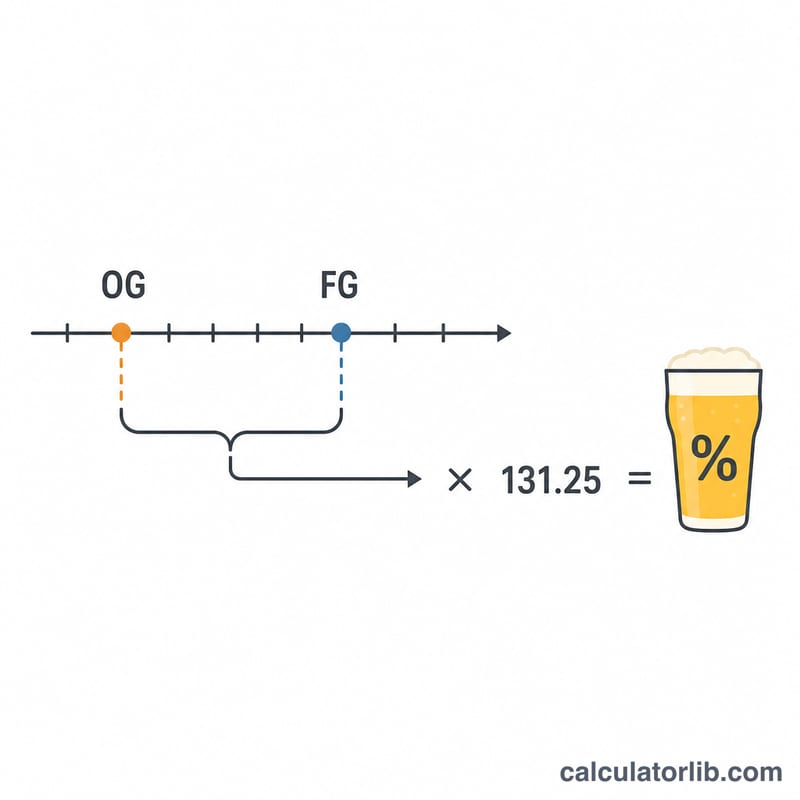
The widely used standard formula is $$\text{ABV\%} = (\text{OG} - \text{FG}) \times 131.25$$. The constant 131.25 converts the gravity difference into a percentage of alcohol by volume. This simple equation is accurate for typical homebrew beers up to around 6–7% ABV; stronger brews may use slightly more complex corrections, but 131.25 remains the popular industry shortcut.
Worked example
Suppose your beer started at an OG of 1.050 and finished at an FG of 1.010. The gravity drop is \(1.050 - 1.010 = 0.040\). Multiplying by 131.25 gives $$0.040 \times 131.25 = 5.25\% \text{ ABV}$$ Apparent attenuation is \((0.040 \div 0.050) \times 100 = 80\%\), meaning 80% of the fermentable sugars were consumed.
Typical ABV Ranges by Beverage Style
The values below are approximate, widely-cited ranges for each style. Original gravity (OG) measures the sugar content of the wort or must before fermentation, while final gravity (FG) reflects the residual sugar after the yeast has finished. The resulting ABV follows the standard estimate \(\text{ABV} = (\text{OG} - \text{FG}) \times 131.25\).
| Beverage style | Typical OG | Typical FG | Typical ABV |
|---|---|---|---|
| Light lager | 1.035–1.045 | 1.006–1.010 | 3.8–5.0% |
| Pale ale | 1.045–1.055 | 1.010–1.014 | 4.5–5.9% |
| IPA | 1.055–1.075 | 1.010–1.016 | 5.9–8.5% |
| Stout | 1.045–1.075 | 1.010–1.022 | 4.0–8.5% |
| Cider | 1.045–1.065 | 1.000–1.010 | 4.6–8.5% |
| Wine | 1.075–1.105 | 0.990–1.000 | 10.0–15.1% |
| Mead | 1.090–1.140 | 0.995–1.020 | 9.2–19.0% |
Note that fully fermented dry wines and meads can finish below 1.000 because alcohol is less dense than water, which pushes the gravity reading under that of pure water.
ABV Across Different Gravity Readings
The table below shows several realistic OG/FG pairs along with the gravity drop, the estimated ABV, and the apparent attenuation. Apparent attenuation is the percentage of original gravity points consumed during fermentation, calculated as \(\frac{\text{OG} - \text{FG}}{\text{OG} - 1} \times 100\%\).
| OG | FG | Gravity drop | ABV | Apparent attenuation |
|---|---|---|---|---|
| 1.040 | 1.010 | 0.030 | 3.94% | 75.0% |
| 1.050 | 1.012 | 0.038 | 4.99% | 76.0% |
| 1.060 | 1.012 | 0.048 | 6.30% | 80.0% |
| 1.075 | 1.015 | 0.060 | 7.88% | 80.0% |
| 1.090 | 1.020 | 0.070 | 9.19% | 77.8% |
| 1.100 | 0.998 | 0.102 | 13.39% | 102.0% |
When FG falls below 1.000, apparent attenuation can exceed 100% — a normal result for very dry wines and meads where residual alcohol lowers the density below that of water.
How to Calculate ABV by Hand
Estimating alcohol by volume from hydrometer readings takes just a few steps. The example below uses an OG of 1.060 and an FG of 1.012.
- Record the original gravity (OG). Take a hydrometer reading of the wort or must before pitching yeast — for example, \(\text{OG} = 1.060\).
- Record the final gravity (FG). After fermentation completes, take another reading at the same temperature — for example, \(\text{FG} = 1.012\).
- Subtract FG from OG. \(1.060 - 1.012 = 0.048\). This is the gravity drop caused by sugar being converted to alcohol.
- Multiply by 131.25. \(0.048 \times 131.25 = 6.30\), so the beverage is about 6.30% ABV.
- (Optional) Compute apparent attenuation. Divide the gravity drop by the original gravity points: \(\frac{1.060 - 1.012}{1.060 - 1.000} \times 100\% = \frac{0.048}{0.060} \times 100\% = 80\%\). This tells you what fraction of the available sugar the yeast fermented.
The factor 131.25 is an empirical constant that converts the gravity difference into volume-percent alcohol. It is most accurate for beers in the typical 1.040–1.075 OG range; for very high-gravity worts, refined formulas give a slightly more accurate result.
FAQ
Why is OG always higher than FG? Sugar makes the wort denser than water (gravity above 1.000). As sugar turns to alcohol — which is lighter than water — the gravity falls, so FG is lower than OG.
Is this exact? No method is perfectly exact. The × 131.25 formula is a reliable estimate for most brews. For very high-alcohol beverages, expect a slight underestimate.
What is apparent attenuation? It is the proportion of original sugars the yeast fermented, expressed as a percentage. Most ales reach 70–80% apparent attenuation.