
What this calculator does
The Time to Sober Up Calculator estimates how long it takes for your blood alcohol concentration (BAC) to fall from its current level back to 0.00%. Alcohol leaves the bloodstream at a fairly steady, linear rate once peak absorption is reached, so a simple division gives a useful estimate of the waiting time.
How to use it
Enter your current BAC as a percentage (for example, 0.08 for the common legal driving limit) and the elimination rate per hour. Most adults clear alcohol at about 0.015% BAC per hour, which is the default value. Click calculate to see the total hours, broken down into whole hours and minutes.
The formula explained
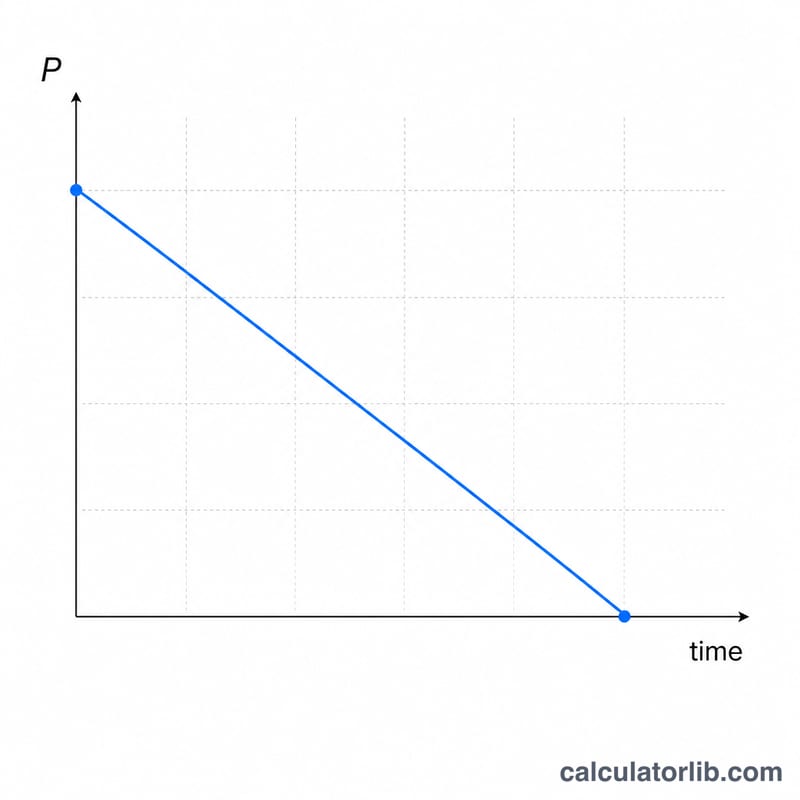
The model is $$\text{Hours} = \dfrac{\text{Current BAC}}{\text{Elimination Rate}}$$ Because the liver metabolizes alcohol at a near-constant rate, BAC declines in a straight line over time. A higher elimination rate (faster metabolism) shortens the time; a lower rate lengthens it. The calculator divides your starting BAC by the per-hour rate to find when BAC reaches zero.
Worked example
Suppose your BAC is 0.08% and you use the average rate of 0.015% per hour. Then $$0.08 \div 0.015 = 5.33 \text{ hours}$$ or roughly 5 hours and 20 minutes before your BAC returns to 0.00%.
BAC Levels and Their Effects
Blood alcohol concentration (BAC) is the percentage of alcohol in the bloodstream by volume (% w/v). The effects below are typical documented ranges; actual impairment varies between individuals, but impairment begins well before any legal limit is reached.
| BAC (%) | Typical effects |
|---|---|
| 0.02 | Some loss of judgment; relaxation, slight mood change; mild decline in visual function and ability to divide attention. |
| 0.05 | Lowered alertness and inhibition; reduced coordination, slower eye-tracking and response to emergencies. |
| 0.08 | Common US legal driving limit. Impaired muscle coordination, balance, speech, reaction time and self-control; concentration impaired. |
| 0.15 | Far less muscle control than normal; major loss of balance; substantial impairment of vehicle control and information processing. |
| 0.30 | Severe intoxication; confusion, stupor, possible loss of consciousness. Approaching levels associated with life-threatening alcohol poisoning. |
In all US states the per se limit for drivers age 21 and over is 0.08%, while commercial drivers (0.04%) and drivers under 21 (zero-tolerance, often 0.01–0.02%) face stricter limits.
Time to Sober Up at Different BAC Levels
Using the population-average elimination rate of 0.015% per hour, the time to return to 0.00% is \(\text{Hours} = \frac{\text{Current BAC}}{0.015}\). For example, a BAC of 0.08% takes \(0.08 \div 0.015 = \) 5.33 hours (about 5 hours 20 minutes).
| Starting BAC (%) | Hours to 0.00% | Hours:Minutes |
|---|---|---|
| 0.02 | 1.33 | 1:20 |
| 0.05 | 3.33 | 3:20 |
| 0.08 | 5.33 | 5:20 |
| 0.12 | 8.00 | 8:00 |
| 0.20 | 13.33 | 13:20 |
These figures assume no further drinking and that all alcohol has already been absorbed. Reported elimination rates range roughly 0.010–0.020%/hr, so individual times may be shorter or longer than the average estimate above.
Interpreting Your Result
The number this calculator returns is the theoretical time for your BAC to fall to 0.00%, based on the population-average elimination rate of 0.015% per hour. It is an estimate, not a precise measurement.
- Legal and impairment thresholds are reached earlier. If you start at 0.12%, you fall below the 0.08% US driving limit after roughly 2.7 hours — long before reaching 0.00%. Meaningful impairment of judgment, coordination and reaction time can persist even at low BAC.
- Peak absorption affects timing. BAC continues to rise for up to 30–90 minutes after your last drink as alcohol is absorbed from the stomach and small intestine. If you have not yet peaked, your true "current" BAC — and the time to sober up — is higher than a single early reading suggests.
- Individual factors shift the rate. Sex, body composition, liver function, food in the stomach, medications, genetics and chronic drinking history all change how fast alcohol is cleared. The fixed 0.015%/hr rate is an average and cannot capture these differences.
- Nothing speeds up elimination. Coffee, cold showers, exercise and water do not increase the rate the liver metabolizes alcohol; only time lowers BAC.
This estimate is not a fitness-to-drive indicator. You may still be impaired or over a legal limit even when the calculator suggests your BAC is low. This is general educational information, not medical, legal or professional advice — never use it to decide whether it is safe to drive or operate machinery.
FAQ
Is this accurate enough to drive? No. This is an educational estimate only. Real elimination varies by person, food, medication, and health. Never use it to decide whether you are safe or legal to drive.
Why 0.015% per hour? It is a widely cited population average. Individual rates commonly range from about 0.010% to 0.020% per hour.
Does coffee or a cold shower speed it up? No. Only time lowers BAC; the liver sets the pace and nothing reliably accelerates it.