
What Is the Amps to Volts Calculator?
Amperes (amps, A) measure electric current — the rate of flow of charge — while volts (V) measure the electrical potential, or "pressure," that pushes that current through a circuit. You cannot convert amps directly into volts because they measure different things. To find voltage you also need a second quantity: either the power (in watts) or the resistance (in ohms). This calculator does both conversions for you.
How to Use It
Choose your method. If you know the power consumption, pick From Power and enter current and power. If you know the resistance, pick From Resistance and enter current and resistance. The calculator instantly returns the voltage in volts.
The Formula Explained
Two relationships from basic circuit theory let you solve for voltage:
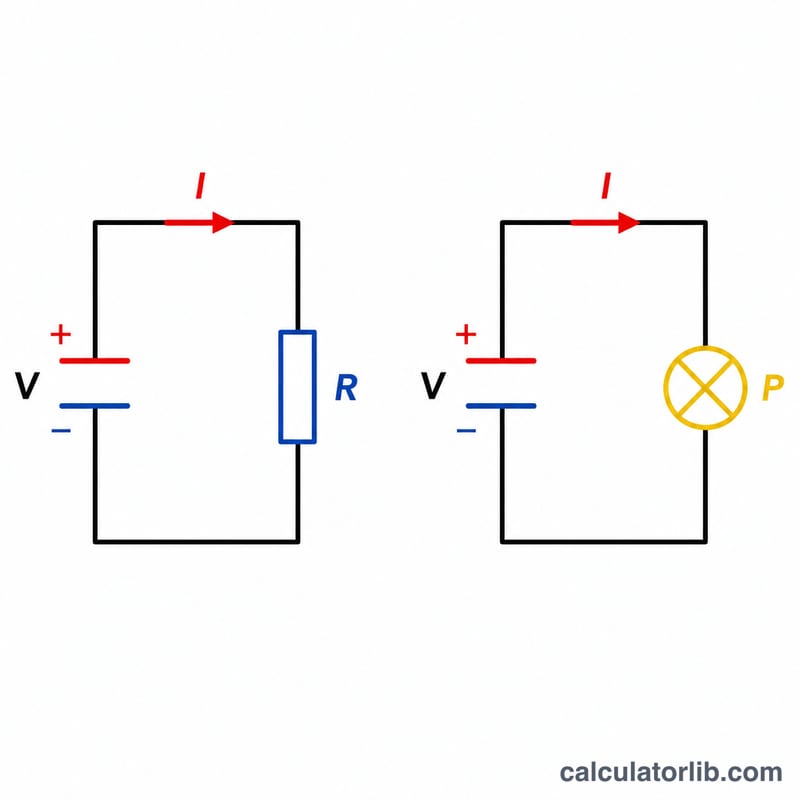
1. Using power: Power equals voltage times current, \(P = V \times I\). Rearranged to solve for voltage gives \(V = \dfrac{P}{I}\). So if a device draws 2 amps and consumes 24 watts, \(V = 24 / 2 = 12\) volts.
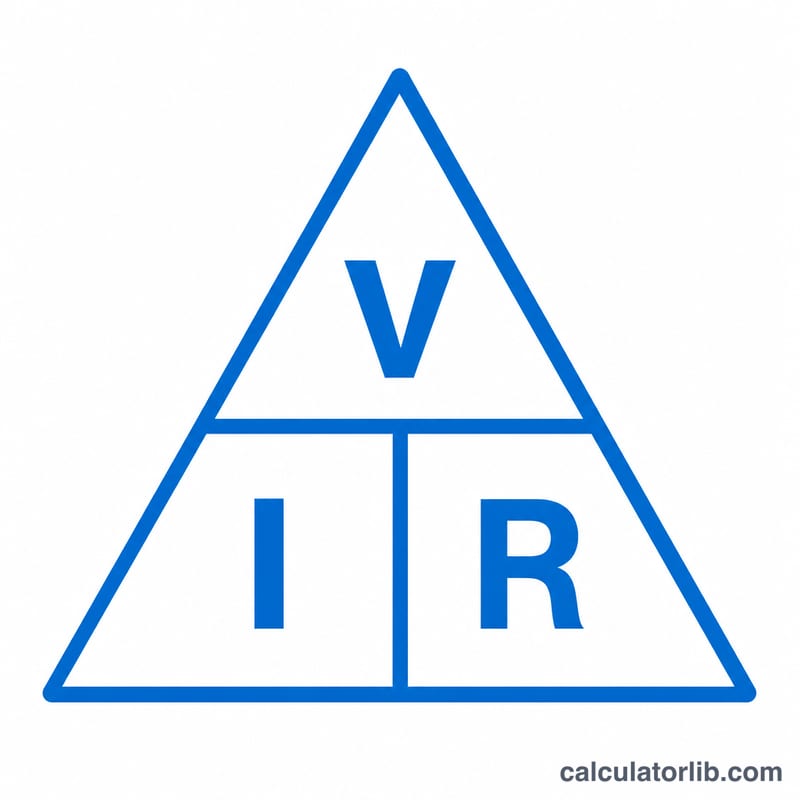
2. Using resistance (Ohm's Law): Voltage equals current times resistance, \(V = I \times R\). A current of 2 amps through a 6-ohm resistor produces \(V = 2 \times 6 = 12\) volts.
Worked Example
An LED strip pulls 0.5 A and is rated at 6 W. Using the power method: $$V = \frac{P}{I} = \frac{6}{0.5} = 12 \text{ volts}$$ This confirms it is a 12 V strip. Alternatively, if you measured its resistance as 24 Ω at 0.5 A: $$V = I \times R = 0.5 \times 24 = 12 \text{ volts}$$ — the same answer.
Standard Voltage Levels Reference
Voltage (V) is the electrical potential difference that drives current through a circuit. The amps-to-volts calculator finds voltage from either power and current (\(V = P/I\)) or current and resistance (\(V = I \times R\)). The table below lists nominal voltage levels you will commonly encounter, so you can sanity-check a calculated result against the system you are actually working with.
| Nominal Voltage | Type | Typical Use |
|---|---|---|
| 1.5 V | DC | AA / AAA alkaline battery cell |
| 3.3 V | DC | Microcontroller and logic-level circuits |
| 5 V | DC | USB power, logic boards, single-board computers |
| 12 V | DC | Automotive systems, LED strips, small pumps |
| 24 V | DC | Industrial control, PLCs, sensors, relays |
| 120 V | AC (single phase) | US / North American mains outlets |
| 230 V | AC (single phase) | European / UK mains outlets |
| 400 V | AC (three phase) | European three-phase line-to-line supply |
For example, a 60 W device drawing 5 A operates at \(V = 60 \div 5 = 12\,\text{V}\), matching the automotive / LED range — 12 V. AC mains values shown are RMS (root-mean-square) nominal voltages; actual local voltage may vary by a few percent depending on the regional standard.
FAQ
Can I convert amps to volts with just current? No. You need a second value (power or resistance) because amps and volts measure different physical quantities.
Does this work for AC and DC? The formulas apply directly to DC. For AC, \(P = V \times I\) assumes a power factor of 1; with reactive loads use apparent power (VA) or include the power factor.
What if my current is zero? Division by zero is undefined, so the power method requires a non-zero current. The calculator guards against this and returns 0.