
What is the AND Probability?
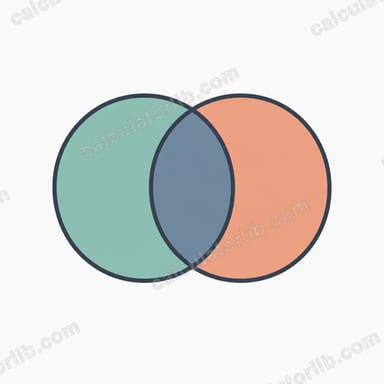
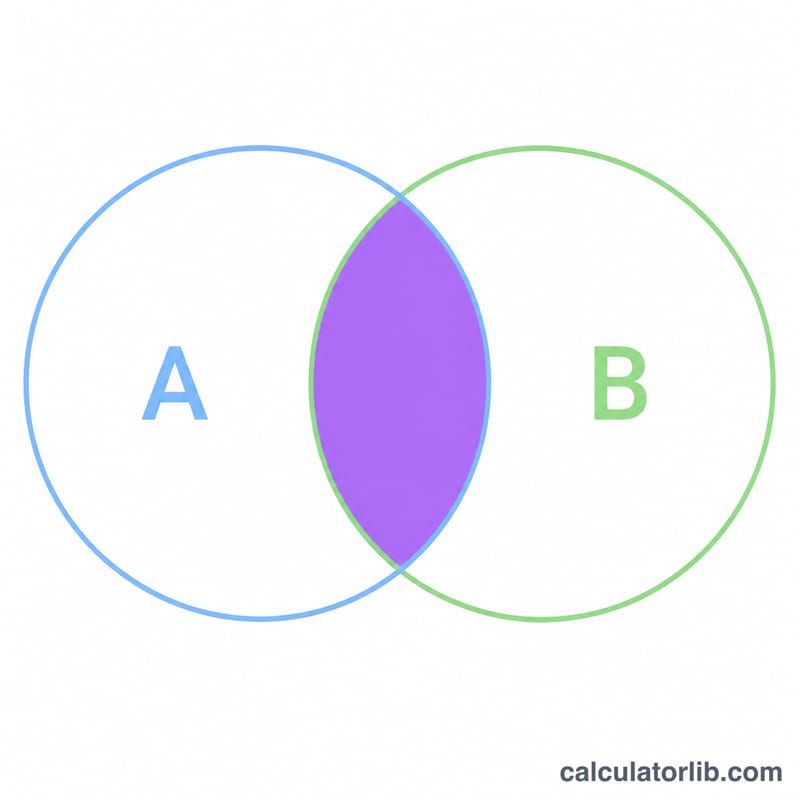
The AND probability, written P(A and B) or \(P(A \cap B)\), is the chance that two events both occur. It answers questions like "what is the probability that I roll a 6 and flip heads?" Probabilities must lie between 0 (impossible) and 1 (certain), so the joint probability of both events is always less than or equal to either individual probability.
How to use this calculator
Choose whether your events are independent or dependent. For independent events, enter P(A) and P(B). For dependent events, enter P(A) and the conditional probability \(P(B \mid A)\) — the chance of B happening given that A already happened. The calculator multiplies the two values and shows the result as both a decimal and a percentage.
The formula explained
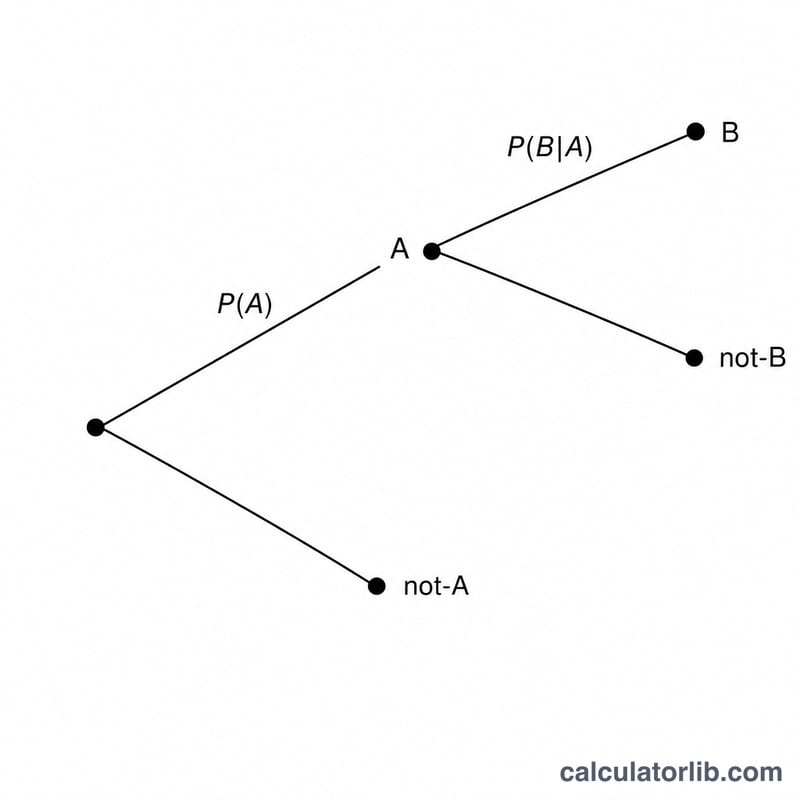
For independent events the multiplication rule is $$P(A \cap B) = P(A) \times P(B)$$ For dependent events one outcome changes the odds of the other, so we use the general multiplication rule $$P(A \cap B) = P(A) \times P(B \mid A)$$ Mathematically the calculation is identical — you simply supply \(P(B \mid A)\) instead of \(P(B)\) — which is why this tool multiplies your two inputs in both modes.
Worked example
Suppose the chance of rain is \(P(A) = 0.4\) and, independently, the chance your bus is late is \(P(B) = 0.25\). The probability of both happening is $$0.4 \times 0.25 = 0.10$$ or a 10% chance. If instead the events were dependent and rain raised the chance of a late bus to \(P(B \mid A) = 0.6\), then $$P(A \cap B) = 0.4 \times 0.6 = 0.24$$ a 24% chance.
Independent vs Dependent: Scenario Comparison
The probability that both events occur, written \(P(A \cap B)\), depends on whether the events are independent (one does not affect the other) or dependent (the outcome of A changes the probability of B). For independent events you multiply \(P(A) \times P(B)\); for dependent events you multiply \(P(A) \times P(B \mid A)\), where \(P(B \mid A)\) is the conditional probability of B given that A already happened.
| P(A) | P(B) or P(B\|A) | Mode | P(A and B) | Notes |
|---|---|---|---|---|
| 0.5 | 0.5 | Independent | 0.25 | Two fair coins both heads |
| 0.5 | 0.8 | Dependent | 0.40 | P(B\|A) is higher because A makes B more likely |
| 0.1667 | 0.1667 | Independent | 0.0278 | Rolling two sixes on fair dice (1/36) |
| 0.25 | 0.20 | Dependent | 0.05 | Draw two specific cards in sequence |
| 0.6 | 0.0 | Mutually exclusive | 0.0 | Events cannot both occur, so P(A and B)=0 |
| 1.0 | 0.3 | Independent | 0.30 | A is certain, so the result equals P(B) |
Notice that \(P(A \cap B)\) is always less than or equal to the smaller of the two probabilities. For mutually exclusive events, both cannot happen at once, so \(P(A \cap B) = 0\). For closely related events you may also want the reverse direction, \(P(A \mid B)\), which a conditional probability calculator gives from \(P(A \cap B)\) and \(P(B)\).
How to Calculate P(A and B) by Hand
Use these steps for any pair of events. The only decision that changes the arithmetic is whether the events are independent or dependent.
- Decide if the events are independent or dependent. Independent means knowing A occurred tells you nothing about B (e.g. two coin flips). Dependent means A changes the odds of B (e.g. drawing cards without replacement).
- Write down \(P(A)\). Express it as a decimal between 0 and 1. For example, a fair coin gives \(P(A) = 0.5\).
- Write down the second probability. For independent events use \(P(B)\). For dependent events use the conditional probability \(P(B \mid A)\) — the probability of B after A has happened.
- Multiply the two values. $$P(A \cap B) = P(A) \times P(B) \quad \text{or} \quad P(A) \times P(B \mid A)$$ For two fair coins: \(0.5 \times 0.5 = 0.25\).
- Convert the decimal to a percentage by multiplying by 100. Here \(0.25 \times 100 = 25\%\).
Sanity check: the answer must be no larger than either input, because requiring both events to occur can only make an outcome rarer (or equally likely). If your result exceeds \(P(A)\) or \(P(B)\), you have made an arithmetic error. A quick worked example: drawing a red card then a spade illustrates the dependent case, while two independent dice each showing a six gives \(0.1667 \times 0.1667 = 0.0278\), matching the 1-in-36 chance from a dice probability calculator.
FAQ
What does \(P(B \mid A)\) mean? It is the probability of event B occurring given that event A has already occurred — read "probability of B given A".
What if the events are mutually exclusive? Then they cannot both happen, so \(P(A \text{ and } B) = 0\).
How is this different from OR probability? AND uses multiplication for "both", while OR uses addition (minus the overlap) for "at least one".