

What Is the PTO Cash Value Calculator?
This calculator estimates the cash value of your unused paid time off (PTO) or vacation days. Whether you are leaving a job, considering a PTO payout, or simply curious about what your accrued leave is worth, it converts your annual salary into a daily rate and multiplies it by the number of unused days. The tool is universal and works with any currency — just enter the figures in your own currency.
How to Use It
Enter three numbers: your gross annual salary, the number of days you actually work in a year, and the number of PTO or vacation days you want to value. A typical full-time schedule is around 260 working days (52 weeks \(\times\) 5 days), though this varies if you work part-time or a different week. The calculator instantly returns your daily pay rate and the total cash value of the entered leave.
The Formula Explained
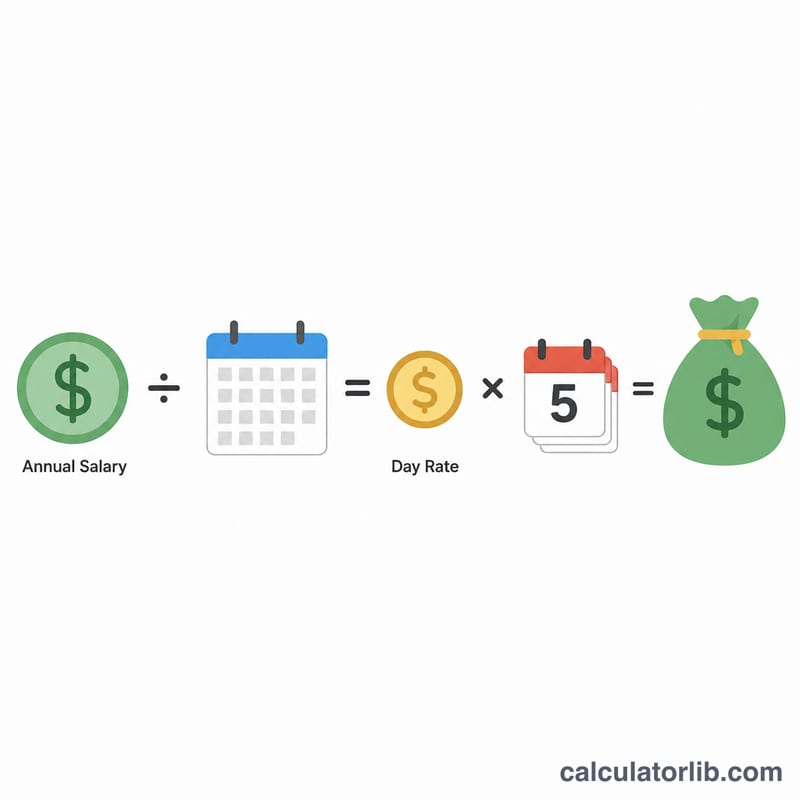
The math is simple. First, your daily rate equals annual salary divided by work days per year. Then, the PTO value equals that daily rate multiplied by the number of PTO days. In symbols: $$\text{PTO Value} = \frac{\text{Annual Salary}}{\text{Work Days/Year}} \times \text{PTO Days}$$. Using work days (not all 365 calendar days) ensures the daily rate reflects what you actually earn per working day.
Worked Example
Suppose you earn $52,000 per year, work 260 days a year, and have 15 unused vacation days. Your daily rate is $$\$52{,}000 \div 260 = \$200 \text{ per day}.$$ Your PTO cash value is $$\$200 \times 15 = \$3{,}000.$$ $3,000. That is the gross value of your accrued leave before any taxes.
Interpreting Your PTO Cash Value
The figure this calculator returns is a gross, pre-tax estimate. It represents the value of your unused leave days based on your daily earnings, before any deductions are applied. The underlying math is simply your annual salary divided by the number of days you actually work, multiplied by the days you have banked:
$$\text{PTO Value} = \frac{\text{Annual Salary}}{\text{Work Days/Year}} \times \text{PTO Days}$$
For example, a $65,000 salary spread over 260 working days gives a daily rate of $250, so 5 unused PTO days are worth $1,250 gross.
A few important points when reading your result:
- It is taxed — your net payout is lower. When an employer cashes out leave, the payment is usually treated as supplemental wages for tax purposes. In the United States, supplemental income is often withheld at a flat federal rate (commonly 22%), plus Social Security, Medicare, and any state or local tax. Your take-home amount can be meaningfully less than the gross figure shown here.
- Daily rate reflects working-day pay, not calendar-day pay. Because the salary is divided by work days (typically around 260 for a 5-day week, or fewer once paid holidays are excluded), each PTO day is valued at what you earn on a working day — not a fraction of all 365 calendar days. Using a smaller, more accurate work-day count produces a higher (and more correct) daily rate.
- Payout rules vary by jurisdiction and employer. Whether unused leave must be paid out at all — and at what point — depends on local law and company policy. Some places require accrued vacation to be paid on termination; others leave it to the employer. Many employers also impose use-it-or-lose-it rules or annual caps that can forfeit days that are never cashed out.
Treat this number as a planning estimate. Confirm your employer's written policy and your local labor rules to know what you are actually entitled to receive.
Key Terms Explained
- PTO (Paid Time Off)
- A consolidated bank of paid days an employee can use for vacation, personal needs, or sometimes illness, without separating each category. Days are typically earned over time and tracked as a running balance.
- Vacation / Annual Leave
- Paid days set aside specifically for rest and time away from work. "Vacation" is the common term in the U.S.; "annual leave" is widely used in the U.K., Australia, and many other countries.
- Accrued Leave
- Leave that an employee has already earned but not yet used. It usually builds up gradually through the year (for example, a set number of hours per pay period) and represents the balance eligible for use or payout.
- Work Days Per Year
- The number of days an employee is scheduled to actually work in a year. A standard 5-day week yields roughly 260 days; subtracting paid public holidays gives a smaller figure. This is the divisor used to find the daily pay rate.
- Daily Pay Rate
- Earnings attributable to a single working day, calculated as annual salary divided by work days per year. It is the per-day value used to convert leave days into a cash amount.
- Gross Value
- An amount calculated before any taxes or deductions. The PTO value shown by this calculator is gross; the net amount you receive will be lower after withholding.
- Supplemental Income
- Wages paid in addition to regular salary — such as bonuses, commissions, and leave payouts. Many tax systems apply special (often flat-rate) withholding to supplemental income, which affects the net value of a cashed-out PTO balance.
- Use-It-or-Lose-It Policy
- An employer rule under which leave that is not used by a deadline (often year-end) is forfeited rather than carried over or paid out. The legality of such policies varies by jurisdiction.
FAQ
Is this the amount I'll actually receive? This is the gross value. Actual payouts are usually taxed as supplemental income, so your net amount will be lower. Employer policies on PTO payout also vary by location and contract.
How many work days should I enter? For standard full-time work, 260 is common (5 days \(\times\) 52 weeks). Subtract public holidays if your contract pays them separately, or adjust for part-time schedules.
Can I use this for accrued hours instead of days? Yes — convert hours to days by dividing by your daily hours (e.g., \(60 \text{ hours} \div 8 = 7.5 \text{ days}\)), then enter the result in the PTO days field.