

What is the Annual Leave Entitlement Calculator?
This calculator works out the pro-rata annual leave (holiday) entitlement for part-time or reduced-hours employees. Many workplaces offer full-time staff a fixed number of paid leave days per year. If you work fewer hours, your entitlement is normally scaled down proportionally — and this tool does that maths instantly.
How to use it
Enter three numbers: the full-time leave entitlement (the holiday days a full-time employee receives each year), the number of hours you actually work per week, and the standard full-time working week at your organisation. The calculator multiplies the full-time entitlement by the ratio of your hours to full-time hours and returns your pro-rata leave days, plus the pro-rata factor as a percentage.
The formula explained
The core equation is:
$$\text{Leave Days} = \text{Full-time Entitlement} \times \frac{\text{Hours Worked}}{\text{Full-time Hours}}$$
The fraction (Hours Worked ÷ Full-time Hours) is your share of a full-time role. Multiplying the full entitlement by this fraction gives a fair, proportional number of leave days.
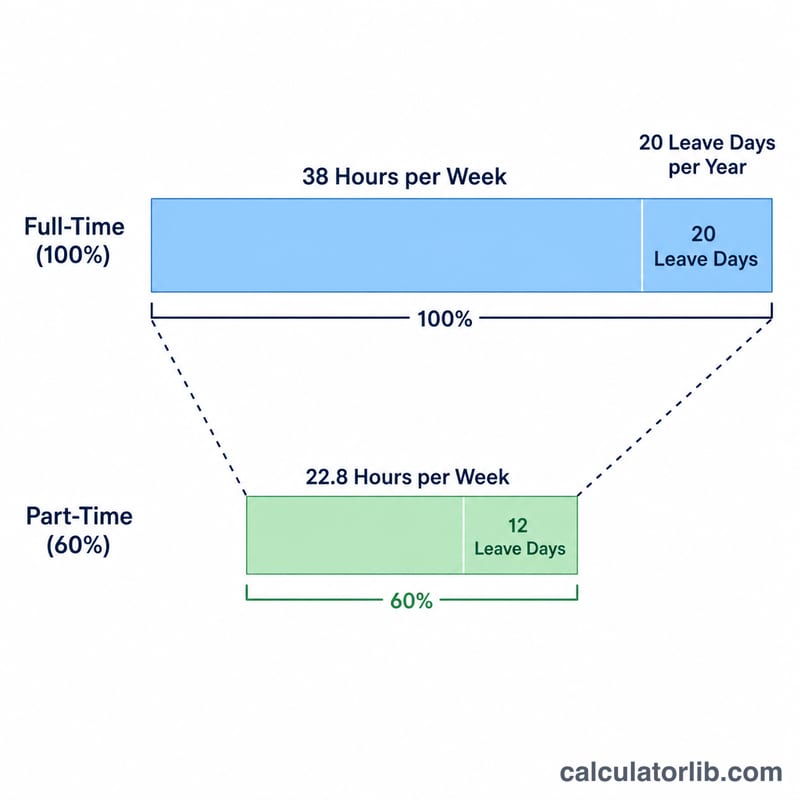
Worked example
Suppose full-time staff get 28 days of leave per year, the full-time week is 40 hours, and you work 20 hours per week. Your pro-rata factor is \(20 \div 40 = 0.5\) (50%). Your entitlement is \(28 \times 0.5 = \) 14 days per year.

Pro-Rata Leave Across Common Work Patterns
The table below shows how pro-rata annual leave is calculated for part-time staff measured against a full-time week of 40 hours with a standard 28-day entitlement. The pro-rata factor is simply the fraction of full-time hours worked, and the leave days are that factor applied to the 28-day entitlement:
$$\text{Leave Days} = 28 \times \frac{\text{Hours Worked}}{40}$$| Hours Worked / Week | Full-Time Hours | Pro-Rata Factor | Leave Days |
|---|---|---|---|
| 16 | 40 | 40% | 11.2 |
| 20 | 40 | 50% | 14 |
| 24 | 40 | 60% | 16.8 |
| 30 | 40 | 75% | 21 |
| 40 | 40 | 100% | 28 |
For example, an employee working 16 hours against a 40-hour full-time week earns 40% of the full entitlement: \(28 \times \tfrac{16}{40} = 11.2\) days. The same proportional logic applies to any full-time figure your employer uses — replace 40 with your own full-time weekly hours and 28 with your contractual entitlement.
Understanding Your Pro-Rata Result
The number this calculator returns is the proportional amount of paid annual leave you accrue based on the share of full-time hours you work. If you work half of full-time hours, you receive half of the full-time leave allowance — the entitlement scales directly with your contracted hours rather than being a fixed figure for everyone.
In the UK, the statutory minimum holiday is 5.6 weeks per year. For someone working a standard 5-day week this equals 28 days, and employers are allowed to include the 8 bank holidays within that 28-day figure. Part-time workers are entitled to the same 5.6 weeks on a pro-rata basis — for example, a 3-day week gives \(5.6 \times 3 = 16.8\) days. The statutory entitlement is capped at 28 days, so working more than 5 days a week does not increase the legal minimum beyond that.
To convert your leave days into hours, multiply the number of days by the length of your typical working day. For instance, 11.2 days at 8 hours per day is \(11.2 \times 8 = 89.6\) hours of leave. Expressing leave in hours is often clearer for staff who work irregular or varying shift lengths.
Pro-rata calculations frequently produce fractional days, such as 11.2 or 16.8 days. Many employers round these figures up to the nearest half or whole day in the employee's favour, though rounding practice varies between organisations. Check your contract or staff handbook for the exact entitlement and any rounding rules that apply.
This is general information only and not legal or employment advice. For decisions about your own entitlement, refer to your contract or speak with your employer or a qualified adviser.
FAQ
Does this include bank holidays? It depends on how your employer defines the full-time entitlement. If their figure includes public holidays, your pro-rata result will too.
Should leave be shown in days or hours? Some employers express part-time leave in hours to avoid rounding issues. This tool shows days; multiply by your typical daily hours to convert.
What if I get a fractional day? Round according to your employer's policy — many round up part-days in the employee's favour.