
What is the Annual to Monthly Salary Calculator?
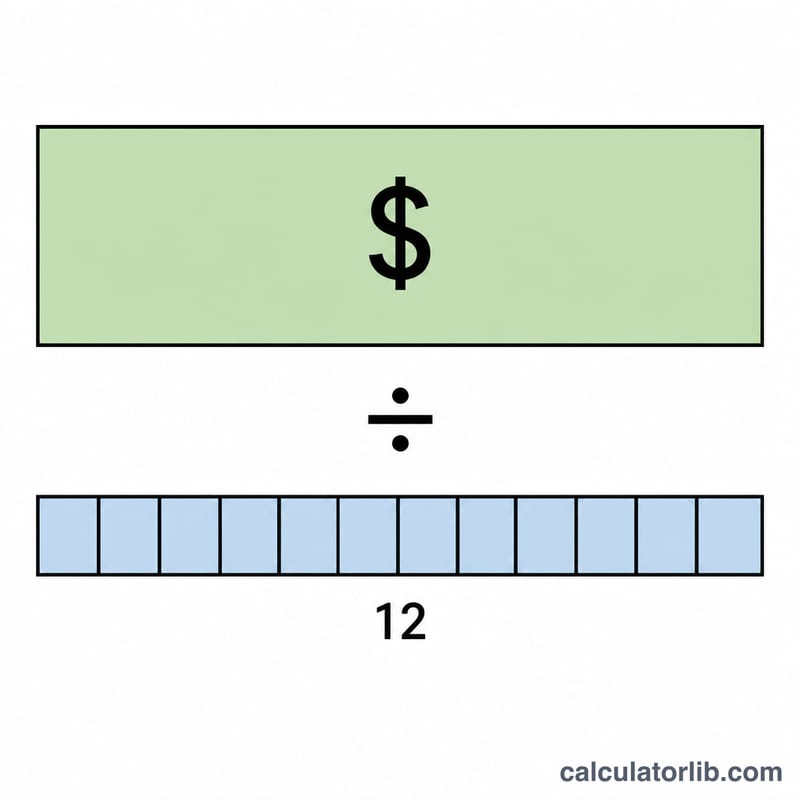
This tool converts a yearly (annual) salary into the equivalent monthly amount. Many job offers, contracts, and budgets are quoted as a single annual figure, but most people pay rent, bills, and subscriptions monthly. Dividing your annual salary by 12 gives a clear picture of what lands in your budget each month before tax and deductions.
How to use it
Enter your gross annual salary and the calculator instantly shows your monthly pay. It also breaks the same salary down into biweekly, weekly, and daily equivalents so you can compare offers paid on different schedules. All figures are gross (before tax, pension, and other deductions).
The formula explained
The core conversion is simple: $$\text{Monthly} = \frac{\text{Annual}}{12}$$ because there are 12 months in a year. For other periods we use the conventional counts: 52 weeks per year, 26 biweekly pay periods, and roughly 260 working days (\(52 \text{ weeks} \times 5 \text{ days}\)). These standard divisors give consistent, comparable estimates.
Worked example
Suppose your annual salary is $60,000. Monthly pay is $$60{,}000 \div 12 = \$5{,}000.$$ Weekly pay is \(60{,}000 \div 52 \approx \$1{,}153.85\), biweekly is \(60{,}000 \div 26 \approx \$2{,}307.69\), and daily is \(60{,}000 \div 260 \approx \$230.77\).
Annual Salary Breakdown at Common Salary Levels
The table below shows how common annual (gross) salaries divide into smaller pay periods. Each column uses a fixed divisor: monthly divides the year into 12 calendar months, biweekly into 26 pay periods (every two weeks), weekly into 52 weeks, and daily into 260 working days (52 weeks × 5 days, before holidays).
| Annual | Monthly (÷12) | Biweekly (÷26) | Weekly (÷52) | Daily (÷260) |
|---|---|---|---|---|
| $30,000 | $2,500.00 | $1,153.85 | $576.92 | $115.38 |
| $40,000 | $3,333.33 | $1,538.46 | $769.23 | $153.85 |
| $50,000 | $4,166.67 | $1,923.08 | $961.54 | $192.31 |
| $60,000 | $5,000.00 | $2,307.69 | $1,153.85 | $230.77 |
| $75,000 | $6,250.00 | $2,884.62 | $1,442.31 | $288.46 |
| $100,000 | $8,333.33 | $3,846.15 | $1,923.08 | $384.62 |
These are gross figures, before tax and other deductions. For example, a $60,000 salary at a 22% effective tax rate leaves a monthly take-home of about $3,900.00.
Key Terms Explained
- Gross salary
- Your total agreed annual pay before any taxes, benefits, or other deductions are withheld. This is the figure most calculators start from.
- Net pay
- The amount you actually receive after taxes and deductions are subtracted from gross pay — also called take-home pay.
- Monthly pay
- One twelfth of your annual salary (\(\text{Monthly} = \text{Annual} \div 12\)). Each month receives an equal share regardless of how many days it contains.
- Biweekly pay period
- A pay schedule that pays every two weeks, producing 26 paychecks per year (\(\text{Biweekly} = \text{Annual} \div 26\)). Two months each year contain a third biweekly paycheck.
- Weekly pay
- Pay issued once per week, giving 52 paychecks a year (\(\text{Weekly} = \text{Annual} \div 52\)).
- Working day (260-day basis)
- A standard full-time work year of 52 weeks × 5 days = 260 working days, used to estimate daily gross pay (\(\text{Daily} = \text{Annual} \div 260\)). This count is before subtracting public holidays or paid leave.
- Deductions
- Amounts removed from gross pay, such as income tax, Social Security, retirement contributions, and health insurance premiums. Deductions are the difference between gross and net pay.
FAQ
Is this before or after tax? These are gross amounts before income tax, social contributions, and other deductions. Your net (take-home) pay will be lower.
Why divide by 12 and not by the number of weeks? Months don't all have the same number of weeks, so the standard way to get a monthly salary is simply to split the annual figure into 12 equal parts.
Does the daily figure assume 260 days? Yes — it assumes a typical 5-day work week over 52 weeks. If your work calendar differs, treat the daily figure as an estimate.