
What This Calculator Does
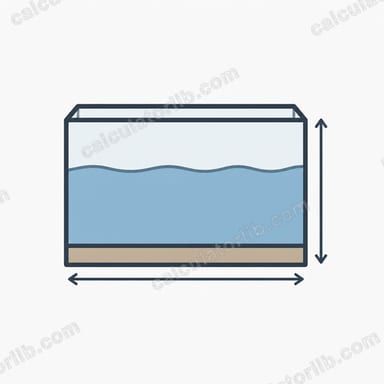
The Aquarium Heater Wattage Calculator helps you choose a properly sized heater for your fish tank. An undersized heater runs constantly and may never reach the target temperature, while an oversized one can overshoot. This tool estimates the wattage you need based on your tank's volume, how many degrees you must raise the water above room temperature, and a watts-per-gallon factor.
How to Use It
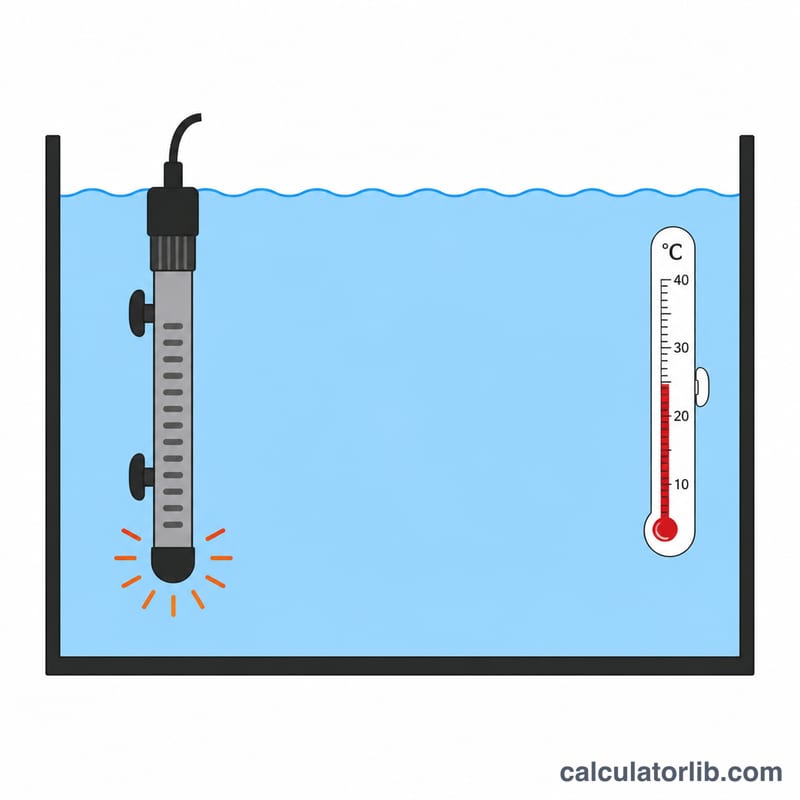
Enter your tank volume in gallons, the temperature rise you need in degrees Fahrenheit (target water temperature minus the coldest room temperature), and a base watts-per-gallon value. As a rule of thumb, use about 3 W/gal for a warm room, 4 W/gal for average conditions, and 5 W/gal for a cold room or large temperature gap. Press calculate to see the recommended wattage.
The Formula Explained
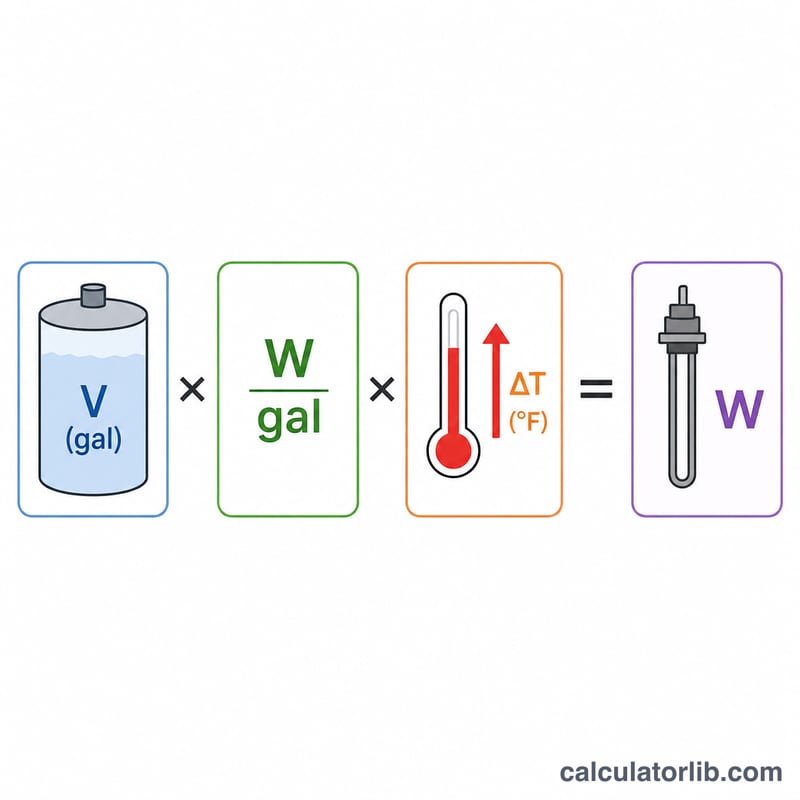
The calculation is $$\text{Watts} = \text{Gallons} \times \text{Watts/Gal} \times \frac{\text{Temp Rise (}^{\circ}\text{F)}}{10}$$. The temperature rise factor is normalized to a 10°F reference: a 10°F rise gives a factor of 1.0, a 20°F rise doubles the requirement, and a 5°F rise halves it. This keeps the familiar watts-per-gallon guideline while adapting to how cold your environment actually is.
Worked Example
Suppose you have a 40-gallon tank, need a 15°F rise, and use 4 W/gal. The temperature factor is \(15 \div 10 = 1.5\). So $$\text{Watts} = 40 \times 4 \times 1.5 = 240 \text{ watts}$$ You would round up to the nearest standard heater (e.g., 250 W) for headroom.
Heater Wattage by Tank Size and Temperature Rise
The table below shows the calculated heater wattage for common aquarium sizes against typical temperature rises (the difference between desired tank temperature and the coldest room temperature). All figures use a base of 4 watts per gallon, then are rounded up to the nearest standard heater size sold in stores.
The underlying formula is:
$$\text{Watts} = \text{Gallons} \times \text{Watts/Gal} \times \frac{\text{Temp Rise (}^{\circ}\text{F)}}{10}$$For example, a 40-gallon tank needing a 15°F rise at 4 W/gal calculates to \(40 \times 4 \times \frac{15}{10} = \) 240 watts, which rounds up to a 250 W heater.
| Tank Size | 10°F Rise | 15°F Rise | 20°F Rise |
|---|---|---|---|
| 10 gal | 40 W → 50 W | 60 W → 75 W | 80 W → 100 W |
| 20 gal | 80 W → 100 W | 120 W → 150 W | 160 W → 200 W |
| 40 gal | 160 W → 200 W | 240 W → 250 W | 320 W → 2×200 W |
| 55 gal | 220 W → 250 W | 330 W → 2×200 W | 440 W → 2×250 W |
| 75 gal | 300 W → 300 W | 450 W → 2×250 W | 600 W → 2×300 W |
Values shown as "2×" indicate the load is best split between two heaters, which is recommended for larger tanks (see sizing tips below).
Standard Heater Sizes and Suitable Tanks
Aquarium heaters are sold in fixed wattage increments. The table lists commonly available sizes and the approximate tank volume each comfortably maintains under average household conditions (a moderate 10–15°F rise above room temperature). Cooler rooms or larger temperature rises shift each heater toward the lower end of its range.
| Heater Wattage | Suitable Tank Range |
|---|---|
| 25 W | Up to 5 gal |
| 50 W | 5–15 gal |
| 75 W | 10–20 gal |
| 100 W | 15–30 gal |
| 150 W | 25–40 gal |
| 200 W | 35–55 gal |
| 250 W | 50–70 gal |
| 300 W | 65–90 gal |
These ranges assume a single heater. Tanks above roughly 50 gallons often pair two smaller heaters whose combined wattage covers the requirement.
Practical Heater Sizing Tips
- Round up to the next standard size. If your calculation lands between two available wattages, choose the larger one. A slightly oversized heater cycles on and off and reaches temperature easily, whereas an undersized heater may run continuously and still fall short on cold nights.
- Split large tanks into two heaters. For tanks over about 50 gallons, use two heaters of roughly half the total wattage placed at opposite ends. This gives more even heating and provides a safety margin—if one heater fails on (overheating) or fails off (no heat), the other partially compensates while you respond.
- Place the heater near water flow. Position it close to a filter outlet, powerhead, or pump intake so warmed water circulates throughout the tank instead of forming hot spots around the heater.
- Always add a separate thermometer. Built-in heater dials can drift. An independent thermometer (or a digital one) lets you verify the actual temperature and catch a malfunctioning heater early.
- Consider an external temperature controller. A controller plugs between the heater and the outlet and shuts power off at your set point, protecting fish from a stuck-on heater regardless of the heater's own thermostat.
- Account for your room. Base your temperature rise on the coldest the room gets, not the daytime average, so the heater is sized for worst-case conditions.
This is general aquarium-care information, not a substitute for the manufacturer's instructions for your specific heater and livestock. Always follow the safety guidance supplied with your equipment.
FAQ
What temperature rise should I use? Subtract your room's coldest temperature from your target water temperature. Most tropical fish want 76–80°F.
Should I round up? Yes. Pick the next standard heater size above the result, or split the load across two heaters in larger tanks for safety and even heating.
Can I use this for saltwater tanks? Yes — the wattage math is the same; saltwater holds heat similarly to freshwater at typical aquarium volumes.