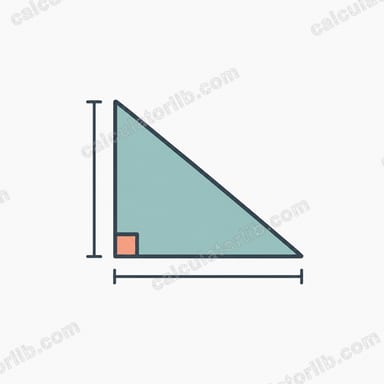

What This Calculator Does
This tool computes the area of any triangle when you know its base and the perpendicular height (the straight-line distance from the base to the opposite vertex). It works for any units — centimeters, meters, inches, feet — and the result is simply in the corresponding square units.
The Formula
The area of a triangle is given by \(A = \tfrac{1}{2} \cdot b \cdot h\). The key requirement is that the height must be measured perpendicular to the chosen base, not along a slanted side. This formula works for every triangle type — right, acute, obtuse, scalene, isosceles, or equilateral.
$$A = \tfrac{1}{2} \cdot b \cdot h$$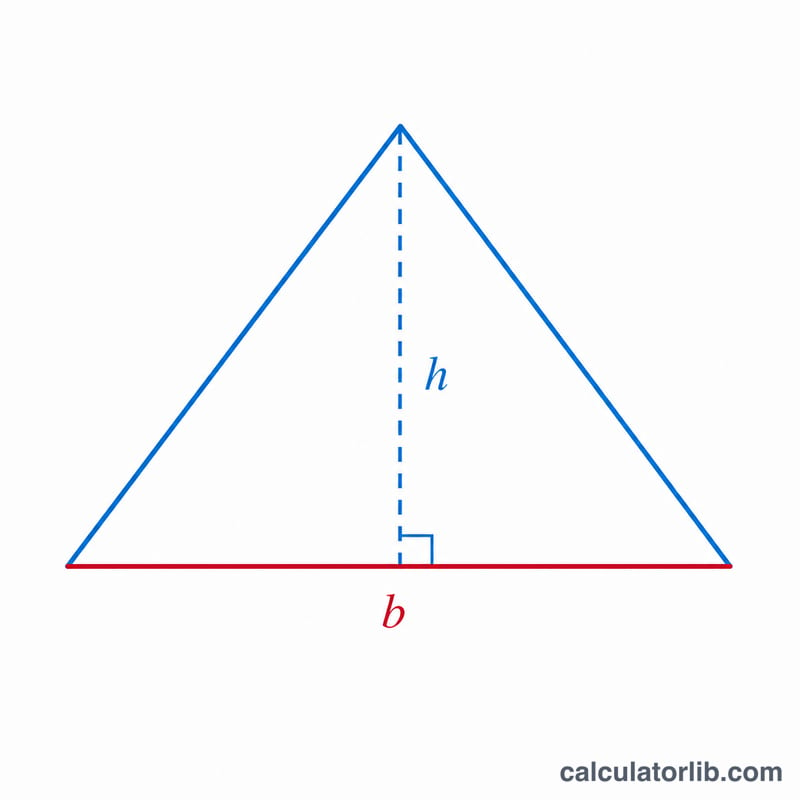
How To Use It
Enter the length of the base and the perpendicular height in the same unit, then read off the area. For example, if a triangle has a base of 10 and a height of 6, the area is \(\tfrac{1}{2} \times 10 \times 6 = 30\) square units.
Worked Example
Suppose a triangular garden bed has a base of 12 m and a height of 5 m. Plugging in:
$$A = \tfrac{1}{2} \times 12 \times 5 = \tfrac{1}{2} \times 60 = 30 \text{ square meters}$$You would need enough soil or turf to cover 30 m² of ground.
Area Across Common Base and Height Values
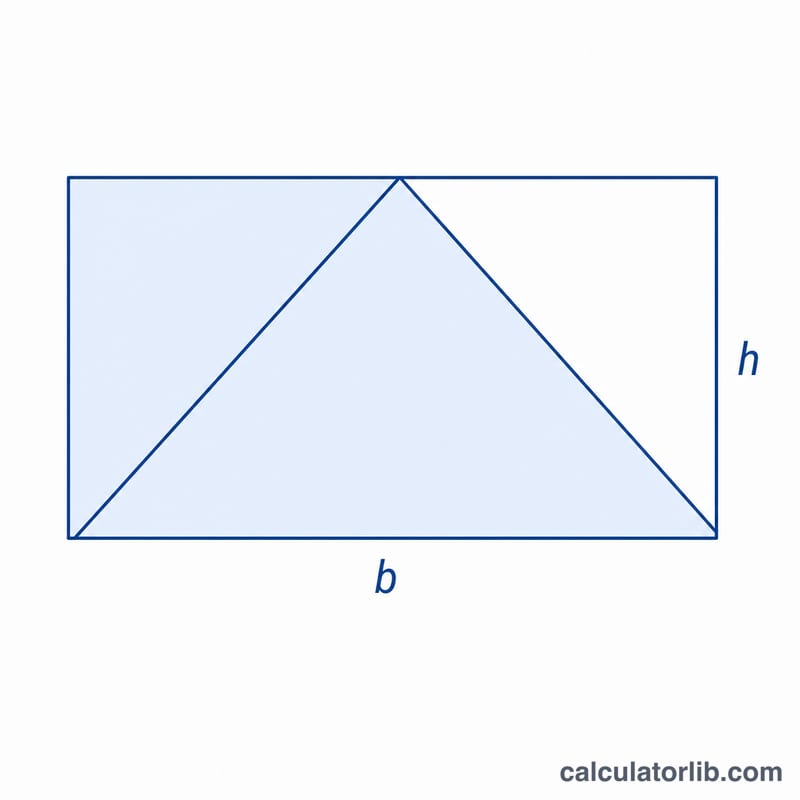
The area of any triangle is half the product of its base and the perpendicular height to the opposite vertex: \(A = \tfrac{1}{2} \times b \times h\). Because base and height appear as a simple product, the relationship is linear in each: doubling the base doubles the area, doubling the height doubles the area, and doubling both quadruples it.
| Base | Height | Calculation | Area (square units) |
|---|---|---|---|
| 4 | 3 | ½ × 4 × 3 | 6 |
| 8 | 3 | ½ × 8 × 3 | 12 |
| 10 | 6 | ½ × 10 × 6 | 30 |
| 12 | 5 | ½ × 12 × 5 | 30 |
| 20 | 8 | ½ × 20 × 8 | 80 |
Compare rows 1 and 2: keeping the height at 3 but doubling the base from 4 to 8 doubles the area from 6 to 12. The same proportional effect happens if you instead double the height — area scales directly with whichever dimension you change.
How to Calculate Triangle Area by Hand
- Identify the base. Pick any one side of the triangle to serve as the base, \(b\). Any side works as long as you use the matching height.
- Measure the perpendicular height. The height \(h\) is the straight-line distance from the base (or its extension) to the opposite vertex, measured at a right angle (90°) to the base — not along a slanted side.
- Multiply base by height. Compute \(b \times h\).
- Take half. Multiply that product by \(\tfrac{1}{2}\) (equivalently, divide by 2) to get the area.
- Attach square units. Area is always in square units — if the base and height were in centimeters, the area is in cm².
Quick demonstration. Suppose \(b = 14\,\text{cm}\) and \(h = 9\,\text{cm}\):
$$A = \tfrac{1}{2} \times 14 \times 9 = \tfrac{1}{2} \times 126 = 63\,\text{cm}^2$$
The area is 63 cm².
More Worked Examples
Example 1 — Right triangle
In a right triangle the two legs are perpendicular, so they serve directly as base and height. With legs of 6 and 8:
$$A = \tfrac{1}{2} \times 6 \times 8 = \tfrac{1}{2} \times 48 = 24\,\text{units}^2$$
The area is 24 square units. If you only knew the legs and wanted the hypotenuse, the Pythagorean theorem gives \(\sqrt{6^2 + 8^2} = 10\).
Example 2 — Obtuse triangle (height falls outside)
In an obtuse triangle, the foot of the perpendicular from a vertex can land outside the chosen base, so you measure the height to the base's extension. The formula is unchanged. Suppose the base is 12 and the perpendicular height to that base is 5:
$$A = \tfrac{1}{2} \times 12 \times 5 = 30\,\text{units}^2$$
The area is 30 square units. If you instead know all three side lengths of an obtuse triangle rather than a height, use Heron's formula.
Example 3 — Keeping units consistent
Base and height must be in the same unit before you multiply. Suppose the base is measured as 250 cm and the height as 1.2 m. Convert the base to meters first: \(250\,\text{cm} = 2.5\,\text{m}\). Then:
$$A = \tfrac{1}{2} \times 2.5 \times 1.2 = \tfrac{1}{2} \times 3.0 = 1.5\,\text{m}^2$$
The area is 1.5 m². Had you carelessly multiplied 250 by 1.2 without converting, you would have mixed centimeters and meters and gotten a meaningless result.
FAQ
Does height mean the length of a side? No. Height is the perpendicular distance from the base to the opposite corner, which may fall outside the triangle for obtuse triangles.
What units does the answer use? The area is in the square of whatever unit you enter. If base and height are in inches, the area is in square inches.
Can I use this for any triangle? Yes, as long as you provide a base and its matching perpendicular height the formula applies to all triangles.