
What is the Area of a Triangle Calculator?
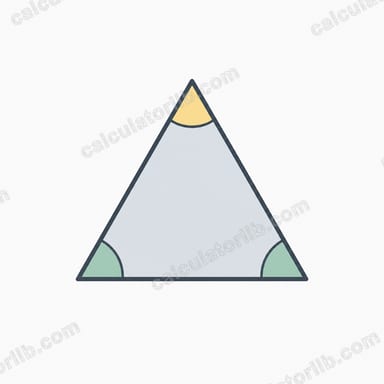
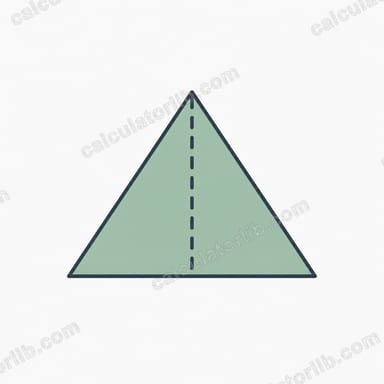
This calculator finds the area of any triangle when you know the lengths of all three sides. It uses Heron's formula, which works for every triangle—scalene, isosceles, or equilateral—without needing to know the height or any angles.
How to use it
Enter the three side lengths (a, b and c) in the same unit (cm, m, in, etc.). The calculator returns the area in square units, plus the semi-perimeter and perimeter. It also checks the triangle inequality: each side must be positive and shorter than the sum of the other two, otherwise no valid triangle exists.
The formula explained
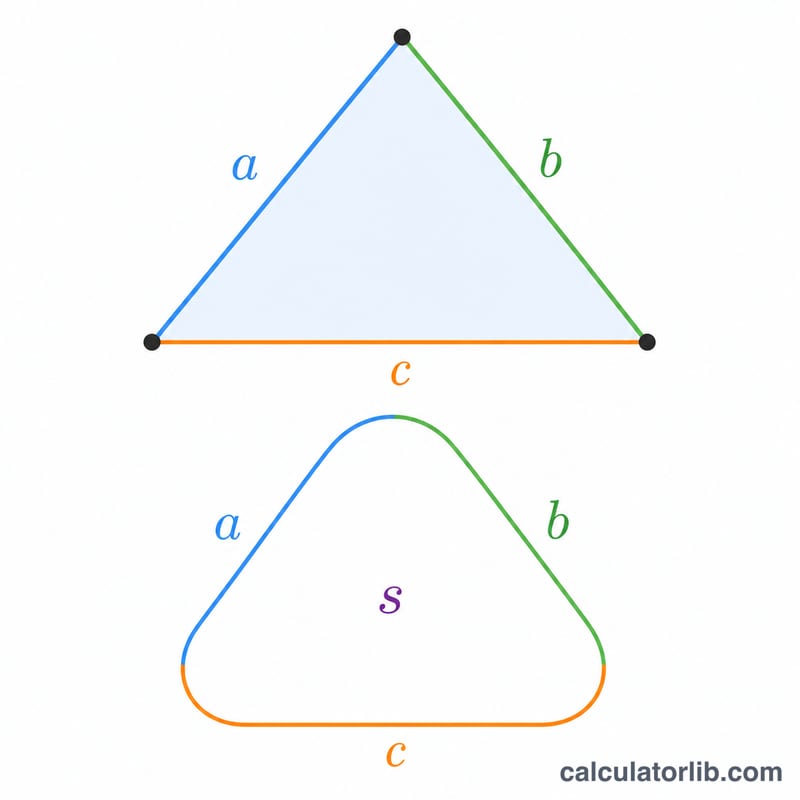
First compute the semi-perimeter \(s = (a + b + c) / 2\). Then the area is \(\sqrt{s(s - a)(s - b)(s - c)}\). The term under the square root is positive only when the three sides can actually form a triangle.
$$\text{Area} = \sqrt{s(s-a)(s-b)(s-c)}, \quad s = \frac{a+b+c}{2}$$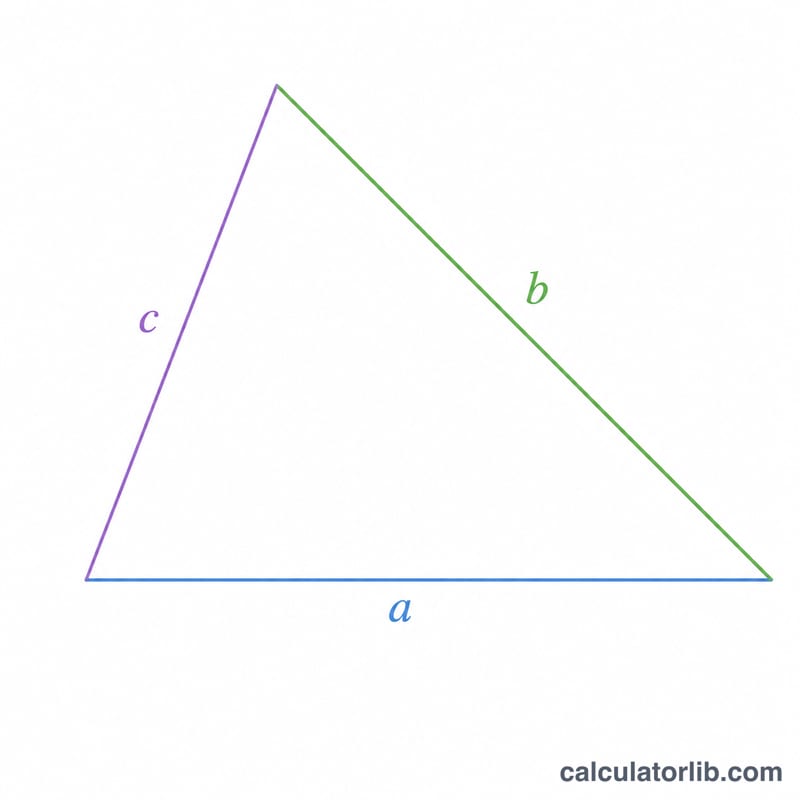
Worked example
For a 3-4-5 right triangle:
$$s = \frac{3 + 4 + 5}{2} = 6$$$$\text{Area} = \sqrt{6 \times (6-3) \times (6-4) \times (6-5)} = \sqrt{6 \times 3 \times 2 \times 1} = \sqrt{36} = 6 \text{ square units}$$This matches the simpler \(\text{base} \times \text{height} \div 2 = 3 \times 4 \div 2 = 6\).
More Worked Examples
Each example uses Heron's formula, \(A = \sqrt{s(s-a)(s-b)(s-c)}\), where the semi-perimeter is \(s = \tfrac{a+b+c}{2}\). Work through the substitution step by step.
Example 1 — Equilateral triangle (6, 6, 6)
- Semi-perimeter: \(s = \dfrac{6 + 6 + 6}{2} = 9\).
- Substitute: \(A = \sqrt{9\,(9-6)(9-6)(9-6)} = \sqrt{9 \cdot 3 \cdot 3 \cdot 3}\).
- Evaluate: \(A = \sqrt{243} \approx \) 15.588 square units.
For a regular equilateral triangle you can confirm this with the dedicated equilateral triangle formula \(A = \tfrac{\sqrt{3}}{4}a^2\), giving the same 15.588.
Example 2 — Isosceles triangle (5, 5, 8)
- Semi-perimeter: \(s = \dfrac{5 + 5 + 8}{2} = 9\).
- Substitute: \(A = \sqrt{9\,(9-5)(9-5)(9-8)} = \sqrt{9 \cdot 4 \cdot 4 \cdot 1}\).
- Evaluate: \(A = \sqrt{144} = \) 12 square units.
This one comes out to a clean whole number — splitting the base of 8 gives two 3-4-5 right triangles, so the height is 3 and \(A = \tfrac{1}{2}\cdot 8 \cdot 3 = 12\).
Example 3 — Scalene triangle (7, 9, 12)
- Semi-perimeter: \(s = \dfrac{7 + 9 + 12}{2} = 14\).
- Substitute: \(A = \sqrt{14\,(14-7)(14-9)(14-12)} = \sqrt{14 \cdot 7 \cdot 5 \cdot 2}\).
- Evaluate: \(A = \sqrt{980} \approx \) 31.305 square units.
FAQ
Do the units matter? Use the same length unit for all three sides; the area comes out in that unit squared.
What if my sides don't form a triangle? If any side is equal to or longer than the sum of the other two, the calculator flags the input as invalid and area is 0.
Can I use it for a right triangle? Yes—Heron's formula works for any triangle, including right triangles.