
What this calculator does
Sleep is one of the biggest worries for new parents, and the right amount changes fast in the first few years. This Baby & Toddler Sleep Needs Calculator estimates the recommended total daily sleep for a child based on age, then subtracts your estimated daytime nap hours to suggest a night-sleep target. These figures are general guidance commonly cited by pediatric sleep resources and are not a substitute for advice from your pediatrician.
How to use it
Enter your child's age and choose whether it is in months or years. Add the total hours your child usually naps during the day. The calculator shows the recommended total sleep per 24 hours for that age band, your nap total, and the leftover hours suggested for overnight sleep.
The formula explained
Recommended sleep is a piecewise function of age. Newborns (0–3 months) need around 16 hours, infants (4–11 months) about 13 hours, toddlers (1–2 years) roughly 12 hours, and preschoolers (3–5 years) close to 11 hours, tapering toward 10 hours for school-age children. Night sleep is simply the recommended total minus naps: Night = Recommended − Naps.
$$\text{Night Sleep} = R - \min\!\left(\text{Nap Total (h)},\; R\right)$$where
$$R = \begin{cases} 16 & \text{Age (mo)} < 4 \\ 13 & 4 \le \text{Age (mo)} < 12 \\ 12 & 12 \le \text{Age (mo)} < 36 \\ 11 & 36 \le \text{Age (mo)} < 72 \\ 10 & \text{Age (mo)} \ge 72 \end{cases}$$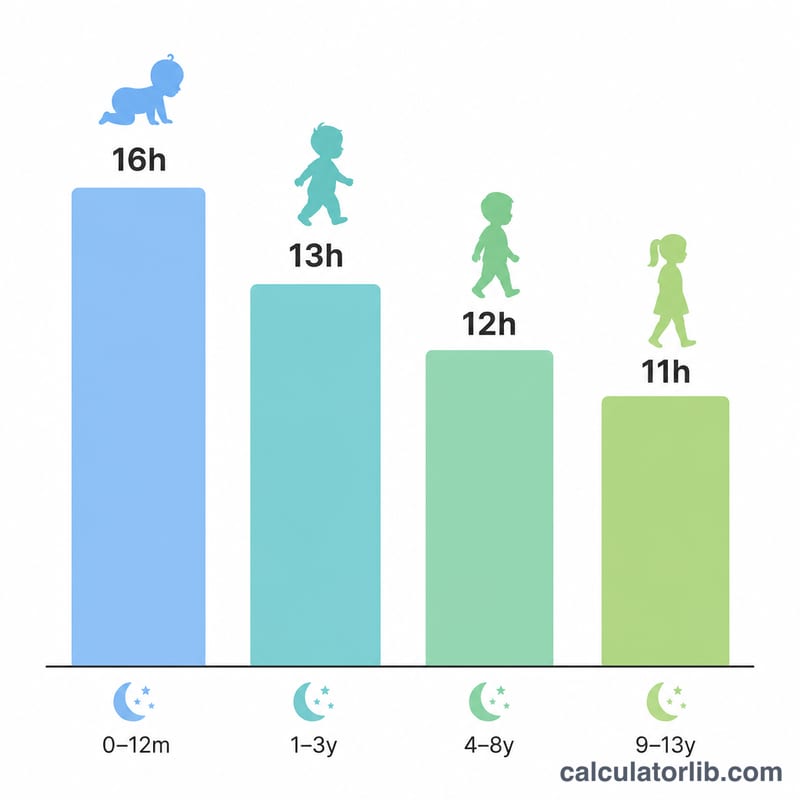
Worked example
A 6-month-old falls in the infant band, so the recommended total is 13 hours. If daytime naps add up to 3 hours, the suggested night sleep is \(13 - 3 = 10\) hours.
Recommended Sleep by Age (Reference Table)
The values below combine the American Academy of Pediatrics (AAP)–endorsed recommendations from the American Academy of Sleep Medicine (AASM) for total 24-hour sleep with the National Sleep Foundation (NSF) ranges, plus typical real-world nap and night patterns. Treat the totals as ranges covering all sleep in a 24-hour period — both night sleep and daytime naps — not exact quotas.
| Age band | Recommended total (24 h) | Typical naps/day | Typical night sleep |
|---|---|---|---|
| 0–3 months (newborn) | 14–17 h | Multiple (3–5+, irregular) | 8–9 h (broken) |
| 4–11 months (infant) | 12–16 h | 2–3 | 9–12 h |
| 1–2 years (toddler) | 11–14 h | 1–2 | 10–12 h |
| 3–5 years (preschool) | 10–13 h | 0–1 | 10–12 h |
| 6–12 years (school age) | 9–12 h | 0 | 9–12 h |
How the calculator uses these: it selects the recommended total \(R\) for your child's age band, then subtracts your reported nap hours to suggest a night-sleep target, \(\text{Night} = R - \text{Nap Hours}\). For example, a 9-month-old (band 4–11 months, midpoint \(\approx 14\) h) who naps about 3 hours a day has a suggested night target of roughly 11 hours. As naps shrink with age, that same total simply shifts toward more consolidated night sleep.
Interpreting Your Result
The number this calculator returns is a guide drawn from a recommended range, not a precise target your child must hit every day. The published bands (for example, 11–14 hours for toddlers) are wide on purpose: healthy children of the same age legitimately differ in how much sleep they need.
- ±1–2 hours is typically normal. A toddler sleeping 11 hours and one sleeping 13 hours can both be perfectly well-rested. Day-to-day variation — a short nap, an early wake-up, a growth spurt — is expected and usually evens out over a week.
- Totals are for the full 24 hours. Night sleep and naps are interchangeable parts of one budget. If naps run long, night sleep often shortens, and vice versa. The calculator reflects this by subtracting nap hours from the age-based total to estimate a night-sleep target.
- The nap-to-night balance shifts with age. Newborns sleep in short stretches around the clock; by 4–11 months sleep consolidates into a long night plus 2–3 naps; most children drop to one nap in the second year and give up napping entirely between ages 3 and 5. A falling nap total with steady or rising night sleep is normal maturation, not a problem.
- Watch the child, not just the clock. The best signs of adequate sleep are daytime mood, alertness, and easy (not overtired) settling — not whether the daily total exactly matches a number.
Consider talking with your pediatrician when deviations are persistent rather than occasional: total sleep consistently far below the range for the age, loud snoring or pauses in breathing, very difficult or prolonged night wakings beyond what's typical for the age, excessive daytime sleepiness in an older child, or sleep changes paired with poor growth, irritability, or developmental concerns.
This is general information, not medical advice. Every child is different; for concerns about your child's sleep, growth, or development, consult your pediatrician.
FAQ
Does this include naps? Yes — the recommended total covers all sleep in a 24-hour period, including naps and nighttime sleep.
My baby sleeps a little more or less. Is that a problem? Ranges vary by child. A difference of an hour or two from the guideline is usually normal. Talk to your pediatrician about persistent concerns.
What if I leave naps blank? If naps are 0, the full recommended total is suggested as night sleep, which is rarely realistic for younger babies — enter a nap estimate for a more useful target.