
What is batting average?
Batting average (AVG) is one of the oldest and most widely used hitting statistics in baseball. It measures how often a batter gets a base hit per official at-bat. The same statistic is used around the world, including Major League Baseball (MLB) and Nippon Professional Baseball (NPB, where it is called "daritsu"). It is conventionally expressed as a three-decimal figure such as .300, read aloud as "three hundred."
How to use this calculator
Enter the number of hits (singles, doubles, triples and home runs) and the number of official at-bats. The calculator divides hits by at-bats and rounds the result to three decimal places. Note that at-bats are not the same as plate appearances: at-bats normally equal plate appearances minus walks, hit-by-pitches, sacrifice hits/bunts, sacrifice flies, and interference. This tool takes the final at-bats figure directly, so you do not need to enter plate appearances.
The formula explained
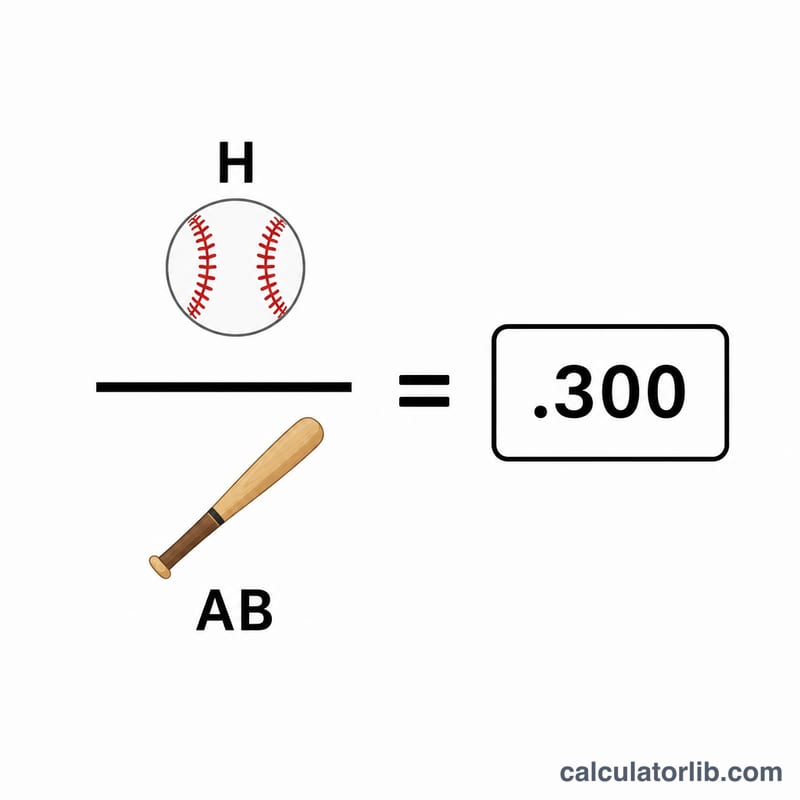
The formula is simply:
$$\text{Batting Average} = \frac{\text{Hits}}{\text{At-Bats}}$$
The raw quotient is then rounded to three decimals by examining the fourth decimal place and rounding half up. So a value of \(0.299413\) becomes .299, while \(0.4375\) becomes .438. A leading zero is usually dropped for display (.300), but writing 0.300 is also acceptable.
Worked example
Suppose a player has 150 hits in 500 at-bats. The batting average is $$150 / 500 = 0.300,$$ displayed as .300 — a strong full-season mark. For a player with 153 hits in 511 at-bats: $$153 / 511 = 0.299413\ldots,$$ which rounds to .299.
Interpreting Your Batting Average
Batting average (AVG) is the share of at-bats that result in a hit, expressed as a three-decimal number and read aloud without the leading zero — \(.300\) is "three hundred." The formula is simply hits divided by at-bats, so a player with 150 hits in 500 at-bats has an average of .300. Knowing the number is only half the picture; the context below explains what it actually signals about a hitter.
Common Benchmarks
| Batting Average | What it generally means |
|---|---|
| .330 and above | Elite — batting-title territory; only a handful of qualified players reach this in a season. |
| .300–.329 | Excellent; a long-standing mark of a high-quality hitter. |
| ~.240–.260 | Roughly league average in modern MLB. |
| .200 ("the Mendoza Line") | The informal threshold of offensive struggle; named after infielder Mario Mendoza. |
| Below .200 | Poor; difficult for a position player to retain regular playing time on average alone. |
Sample Size Matters
These benchmarks are meant for a full season of plate appearances. To win a batting title and be officially "qualified," MLB requires a hitter to average at least 3.1 plate appearances per team game — about 502 over a 162-game season. Over that many at-bats, a .300 average is a stable, meaningful reflection of skill.
Over small samples, the same number means far less. A player who goes \(6\) for \(15\) is hitting .400, but across a week or two of games that figure can swing wildly on a single bloop hit or hard-hit out. Early in a season, after an injury layoff, or for a part-time player, treat the average as a rough indicator and expect heavy regression toward a hitter's true talent level as at-bats accumulate.
Finally, remember what AVG leaves out: it ignores walks, hit-by-pitches, and the difference between a single and a home run. Two hitters with identical averages can have very different value, which is why on-base percentage and slugging are usually read alongside batting average rather than in place of it.
FAQ
What counts as a good batting average? A mark of .300 or higher is generally considered excellent for a full season; league averages typically sit around .240–.260.
Can a batting average be greater than 1.000? Not in real baseball, because hits can never exceed at-bats. If you enter more hits than at-bats this tool will warn you.
Why divide by at-bats and not plate appearances? At-bats exclude walks, hit-by-pitches, and sacrifices so the statistic reflects only true hitting opportunities. On-base percentage uses plate appearances instead.