
What Is the Amp Hours Calculator?
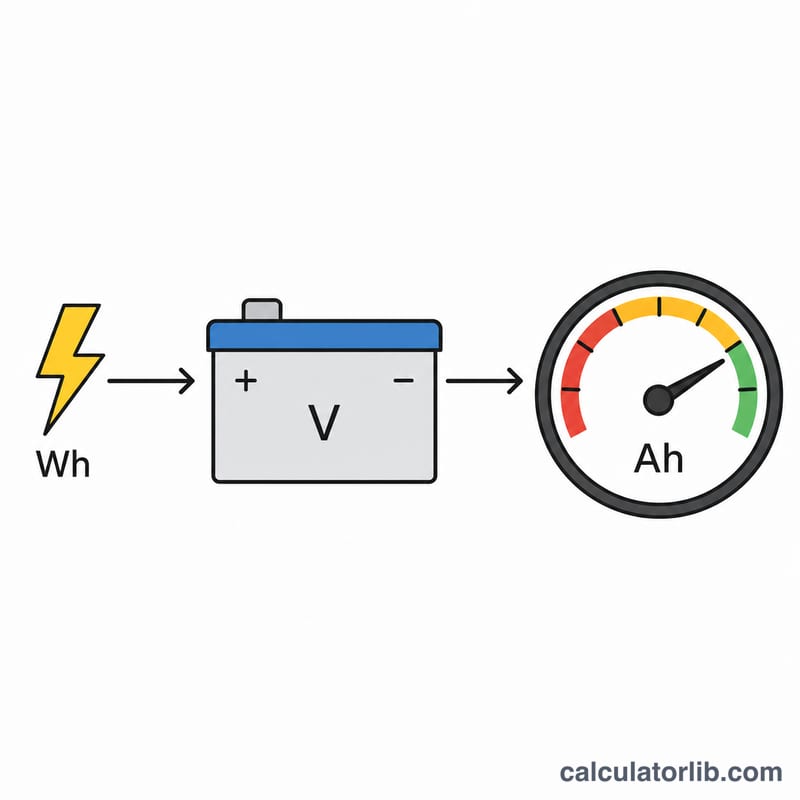
This tool converts a battery's energy rating in watt-hours (Wh) into its capacity in amp-hours (Ah). Amp-hours describe how much charge a battery can deliver over time, while watt-hours describe total stored energy. Because energy depends on both charge and voltage, you need the battery voltage to translate between the two. This calculator is universal and works for any battery chemistry — lithium-ion, lead-acid, LiFePO4, NiMH and more.
How to Use It
Enter the battery energy in watt-hours (often printed on the label, e.g. 500 Wh). Then enter the nominal voltage of the battery or pack (commonly 3.7 V for a single Li-ion cell, 12 V for a lead-acid battery, or 48 V for an e-bike pack). The calculator returns capacity in amp-hours and also in milliamp-hours for smaller cells.
The Formula Explained
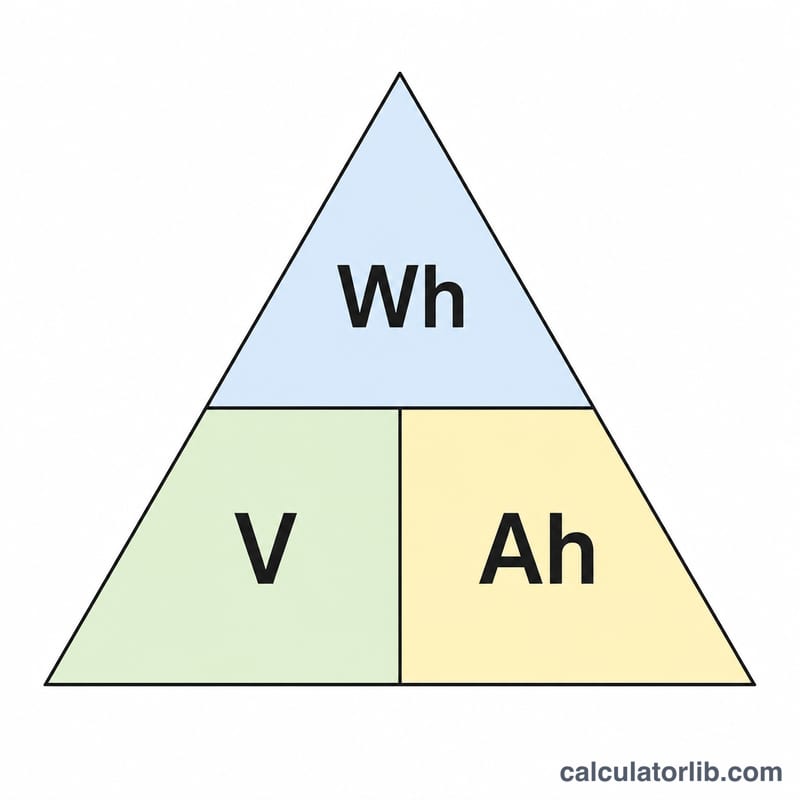
The core relationship is $$\text{Ah} = \frac{\text{Wh}}{\text{V}}$$ Energy (Wh) equals charge (Ah) multiplied by voltage (V), so rearranging gives charge as energy divided by voltage. To express the result in milliamp-hours simply multiply the amp-hours by 1000.
Worked Example
Suppose a power station is rated at 500 Wh and operates at 12 V. Capacity $$= 500 \div 12 = \mathbf{41.67 \text{ Ah}},$$ or 41,666.67 mAh. A 18.5 Wh phone battery at 3.7 V would be 5 Ah (5000 mAh).
Common Battery Voltages by Type
The voltage you divide by in \(\text{Ah} = \frac{\text{Wh}}{\text{V}}\) should be the battery's nominal voltage — the average voltage it holds during a typical discharge, not the fully-charged peak. The table below lists nominal voltages for the most common cells and packs.
| Battery type | Nominal voltage | Notes |
|---|---|---|
| NiMH / NiCd cell | 1.2 V | Rechargeable AA/AAA; alkaline single-use is ~1.5 V |
| LiFePO4 (LFP) cell | 3.2 V | Long-cycle lithium chemistry; 4 cells ≈ 12.8 V pack |
| Li-ion / Li-po cell (e.g. 18650) | 3.7 V | Range ~3.0 V (empty) to 4.2 V (full) |
| 9 V battery | 9 V | Common smoke-detector / multimeter battery |
| Lead-acid (car / SLA) | 12 V | 6 cells × 2 V; ~12.6–12.8 V when full |
| LiFePO4 "12 V" pack | 12.8 V | 4 LFP cells in series |
| E-bike / scooter pack | 24 V | Often labelled as 36 V or 48 V variants below |
| E-bike pack | 36 V | 10 Li-ion cells in series |
| E-bike / light EV pack | 48 V | 13 Li-ion cells in series |
Key Terms Explained
- Watt-hour (Wh)
- A unit of energy equal to one watt of power sustained for one hour. It captures both how much charge a battery holds and at what voltage: \(\text{Wh} = \text{V} \times \text{Ah}\).
- Amp-hour (Ah)
- A unit of electric charge capacity — the current in amps a battery can deliver for one hour. One amp-hour equals 3600 coulombs. It depends on voltage, so it is not directly comparable between batteries of different voltages.
- Milliamp-hour (mAh)
- One thousandth of an amp-hour (\(1\ \text{Ah} = 1000\ \text{mAh}\)). Used for small cells like phones and power banks. A 4000 mAh phone battery is 4 Ah.
- Nominal voltage (V)
- The average rated voltage of a battery during discharge, used in capacity and energy calculations. Actual voltage swings above this when full and below it when nearly empty.
- Charge
- The quantity of electricity a battery stores, measured in amp-hours or coulombs (1 Ah = 3600 C). It is what Ah and mAh ratings describe.
- Energy
- The capacity to do work, measured in watt-hours. Energy combines charge and voltage (\(\text{Wh} = \text{Ah} \times \text{V}\)), making Wh the fairest way to compare batteries of different voltages.
FAQ
What voltage should I use? Use the nominal (average) voltage of the battery, not the fully-charged peak voltage, for the most realistic capacity figure.
Why does the same Wh give different Ah? Higher voltage means fewer amp-hours for the same energy. A 48 V pack stores far more energy per amp-hour than a 12 V pack.
Is this affected by battery chemistry? No — the math is purely Wh \(\div\) V. Chemistry only matters because it sets the nominal voltage you enter.