
What is a Board and Batten Calculator?
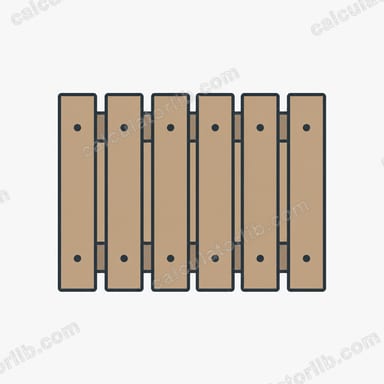
Board and batten is a popular wall treatment where wide vertical boards (battens) are mounted at even intervals over a flat surface to create a classic, dimensional look. This calculator tells you how many battens you need to span a wall and what the real-world spacing between them will be, so your layout looks balanced and professional.
How to use it
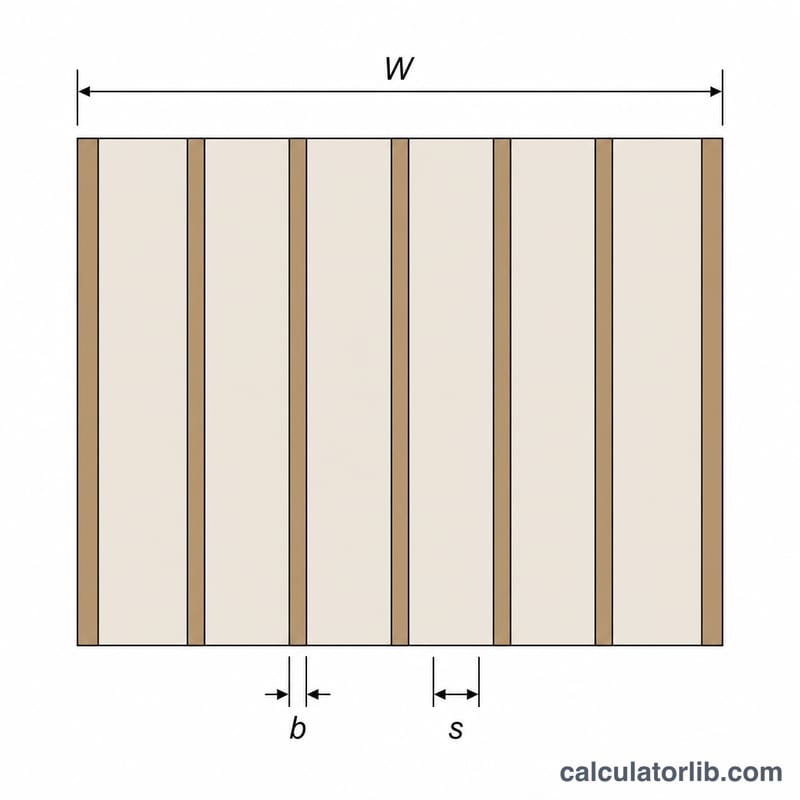
Enter the total wall width in inches, the width of each batten board (commonly 1×3 trim is about 2.5"), and your desired spacing between battens (often 8"–16"). The calculator returns the number of battens, then recalculates the actual spacing so the gaps come out perfectly even across the wall.
The formula explained
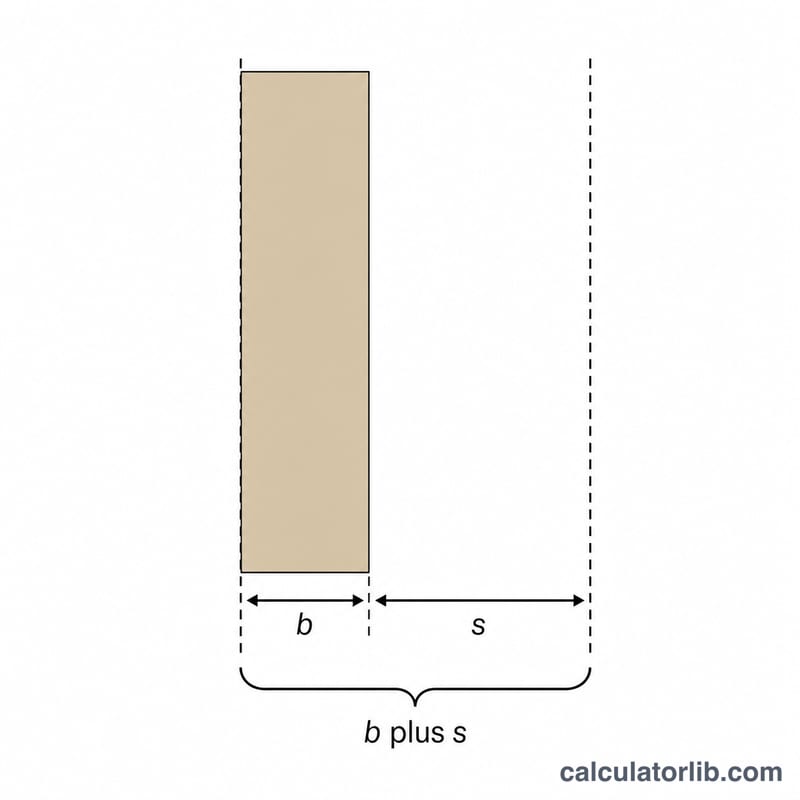
The repeat unit of the pattern is one board plus one gap, or \(b + s\). Dividing the wall width by this repeat unit and rounding up gives the number of gaps; adding one accounts for the batten that closes the run, giving $$\text{Battens} = \left\lceil \frac{W}{b + s} \right\rceil + 1$$ Because rounding up usually leaves a little slack, the actual spacing is found by subtracting the total board coverage from the wall width and dividing by the number of gaps: $$\frac{W - N \cdot b}{N - 1}$$
Worked example
For a 120" wall with 2.5" boards and 12" target spacing: repeat unit = \(2.5 + 12 = 14.5\)". Then \(120 / 14.5 = 8.27\), rounded up to 9, plus 1 = 10 battens. Actual spacing $$= \frac{120 - 10 \times 2.5}{9} = \frac{120 - 25}{9} \approx 10.56\text{\"}$$ between each batten.
Common Wall Sizes and Batten Spacing
The number of battens depends on the wall width, the width of each batten board, and your target gap between battens. The calculator first finds the repeating pitch \(P = \text{board width} + \text{spacing}\), divides the wall by the pitch and rounds up, then adds one batten so both ends are capped. Because the count is a whole number, the actual spacing usually differs slightly from your target — the table below shows that adjustment for a 2.5" (1×3) batten.
| Wall width | Target spacing | Batten width | Battens (N) | Actual spacing (S) |
|---|---|---|---|---|
| 96" | 8" | 2.5" | 10 | 7.89" |
| 96" | 12" | 2.5" | 8 | 11.21" |
| 96" | 16" | 2.5" | 6 | 15.00" |
| 120" | 8" | 2.5" | 13 | 7.71" |
| 120" | 12" | 2.5" | 10 | 11.39" |
| 120" | 16" | 2.5" | 8 | 15.36" |
| 144" | 12" | 2.5" | 11 | 11.65" |
| 144" | 16" | 2.5" | 9 | 15.19" |
| 180" | 12" | 2.5" | 14 | 11.65" |
| 180" | 16" | 2.5" | 11 | 15.50" |
Notice that wider walls and tighter spacing both push the batten count up, and the actual spacing settles to whatever value distributes the battens evenly across the full wall.
Typical Batten Widths and Spacing
Battens are usually cut from standard nominal lumber or trim stock. Remember that nominal sizes are larger than actual sizes, so plug the actual face width into the calculator.
| Nominal size | Actual face width | Typical use |
|---|---|---|
| 1×2 | ~1.5" | Delicate, fine-grid look |
| 1×3 | ~2.5" | Most common all-purpose batten |
| 1×4 | ~3.5" | Bolder, farmhouse-style batten |
Common spacing between battens (measured as the gap, not center-to-center) generally falls in the following range:
- 8"–10": Tight, traditional grid — busier, more detailed.
- 12": The most popular choice — balanced and widely flattering.
- 14"–16": Wider, more modern and economical (fewer battens).
These are design conventions, not strict building standards. The "right" spacing depends on the room scale, ceiling height and the look you want — pick a target, then let the calculator fine-tune it so the battens land evenly.
Practical Tips for Your Layout
- Buy about 10% extra trim. Cuts, knots, splits and the occasional mistake add up. If your battens total roughly 120 linear feet, order around 132 feet so you are not short mid-project.
- Check that actual spacing looks balanced. The calculator distributes battens evenly, but compare the actual spacing to your target — if it drifts far from what you pictured, nudge the target spacing up or down by an inch and recalculate until the count and gap both feel right.
- Dry-fit before nailing. Lay out or lightly tack all the battens first, step back, and confirm the rhythm looks even across the whole wall before committing with nails or adhesive.
- Account for windows, doors and outlets. The basic formula assumes a clear, flat wall. Where a batten would land on an opening, plan to shift it, frame around the opening, or treat each wall segment separately and run the calculation per section.
- Add corner battens deliberately. Inside and outside corners usually get their own batten so the grid reads cleanly. Confirm your end battens sit flush at corners — that is why the formula adds one extra batten to cap both ends.
This is general guidance for planning a board and batten layout, not professional construction advice. Always verify measurements on your actual wall and follow local building practices.
FAQ
Should I include the boards at the wall ends? Yes — the +1 in the formula adds the closing batten so both ends of the wall are framed.
Why is the actual spacing smaller than my target? Rounding up the count adds an extra batten, which tightens the gaps slightly to keep them all equal.
What units does it use? All measurements are in inches. Convert feet to inches by multiplying by 12 before entering.