
What Is the Bradford Factor?
The Bradford Factor is a formula widely used by HR teams to measure the disruption caused by employee absence. It weights frequent short absences more heavily than occasional long ones, because repeated short spells tend to be more disruptive to a team's workflow than a single extended absence. The score is calculated over a rolling period — commonly 52 weeks.
How to Use This Calculator
Enter the number of separate absence spells (each distinct occasion an employee was off, regardless of how long), and the total number of days absent across all those spells. The calculator multiplies the square of the spells by the total days to produce the Bradford Factor score, along with an indicative rating.
The Formula Explained
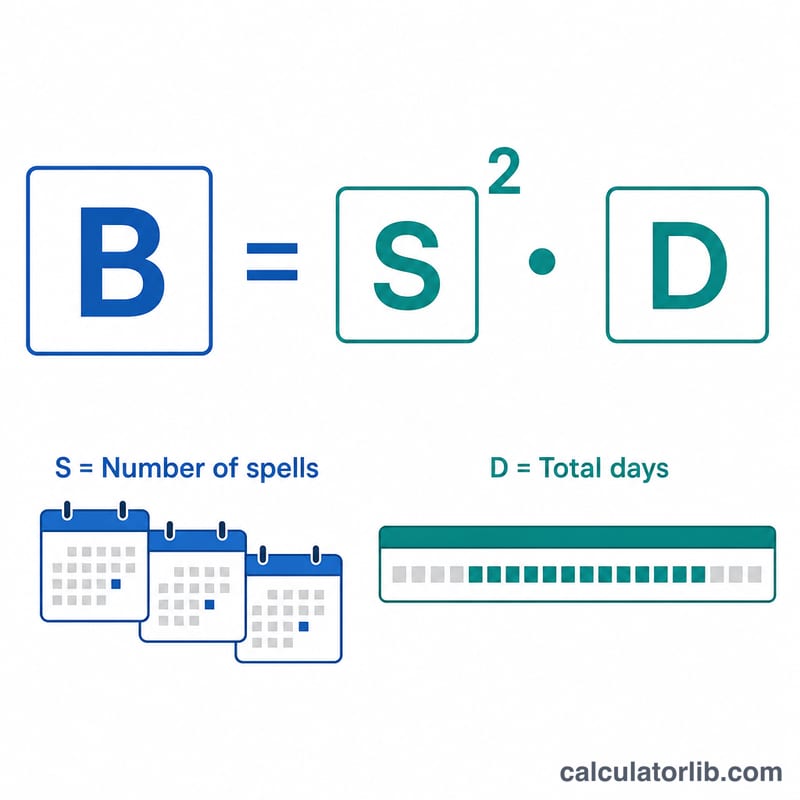
The Bradford Factor is: $$B = S^{2} \times D$$ where S is the number of absence spells and D is the total days absent. Squaring the number of spells is what penalises frequent absences. For example, 1 absence of 10 days scores \(1^{2} \times 10 = 10\), while 10 absences of 1 day each scores \(10^{2} \times 10 = 1{,}000\).
Worked Example
An employee had 4 separate absence spells totalling 10 days. The score is $$4^{2} \times 10 = 16 \times 10 = 160 \text{ points}$$ which falls into the "moderate concern" band under many company policies.
How Spell Frequency Affects the Score
The Bradford Factor is built on the principle that frequent, short absences are more disruptive to a workplace than a single longer absence. This is reflected in the formula, which squares the number of separate absence spells (S) before multiplying by the total days lost (D):
$$B = S^{2} \times D$$
Because the spell count is squared, breaking the same total number of days into more separate occasions raises the score dramatically. The table below holds the total days absent constant at 10 and varies only the number of spells, so you can see the effect of frequency in isolation.
| Spells (S) | Total Days (D) | Calculation | Bradford Factor (B) |
|---|---|---|---|
| 1 | 10 | 1² × 10 | 10 |
| 2 | 10 | 2² × 10 | 40 |
| 4 | 10 | 4² × 10 | 160 |
| 8 | 10 | 8² × 10 | 640 |
| 10 | 10 | 10² × 10 | 1,000 |
Every row above represents the same 10 days off work, yet the score climbs from 10 to 1,000 as those days are split into more separate spells. A single 10-day absence scores just 10, while ten separate one-day absences score 1,000 — a hundredfold difference driven entirely by the squared spell count. This is why many absence policies set escalating trigger points (for example, review at 100, 200 and 500) rather than simply counting total days lost.
FAQ
What counts as a spell? Any continuous period of absence is one spell, whether it lasts one day or several weeks.
Is there a standard trigger score? No — each organisation sets its own thresholds. Common informal trigger points are around 50, 100 or 200 points, but always check your employer's policy.
Does the period matter? Yes. The score is normally calculated over a defined rolling window such as the previous 12 months, so both inputs should reflect the same period.